Napoli
218 places
 Sacred art
Cappella Sansevero (Cristo Velato)
Napoli (NA)
Beneath a veil of marble that still seems to breathe, Sanmartino's Cristo Velato rests in the chapel's half-light, and the whiteness of the stone deceives every eye.
 Sacred art
Duomo di Napoli
Napoli
Three times a year the city holds its breath as the blood of San Gennaro waits to liquefy, among Gothic naves and the gold of the chapel devoted to him.
 Sacred art
Cappella del Tesoro di San Gennaro
Napoli
Behind a bronze gate lie silverware, gems and the jewel-studded mitre of the saint: a treasure heaped up over centuries by the devotion of Naples.
 Sacred art
Chiesa del Gesù Nuovo
Napoli
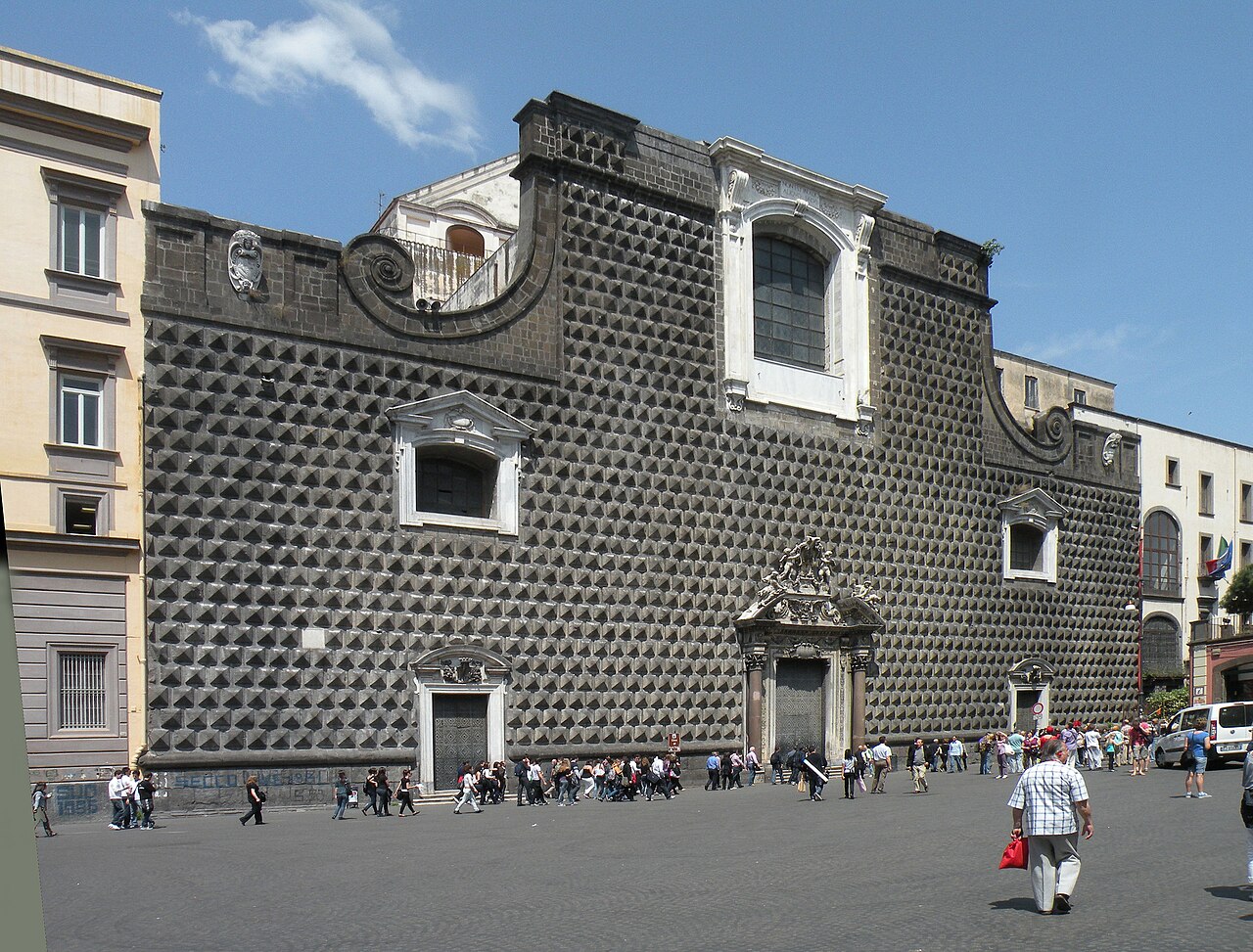
The facade of pyramid-cut piperno stone hides symbols carved into the blocks, while inside the Baroque bursts out in marble and in the memory of the physician Giuseppe Moscati.
 Sacred art
Chiostro di Santa Chiara
Napoli
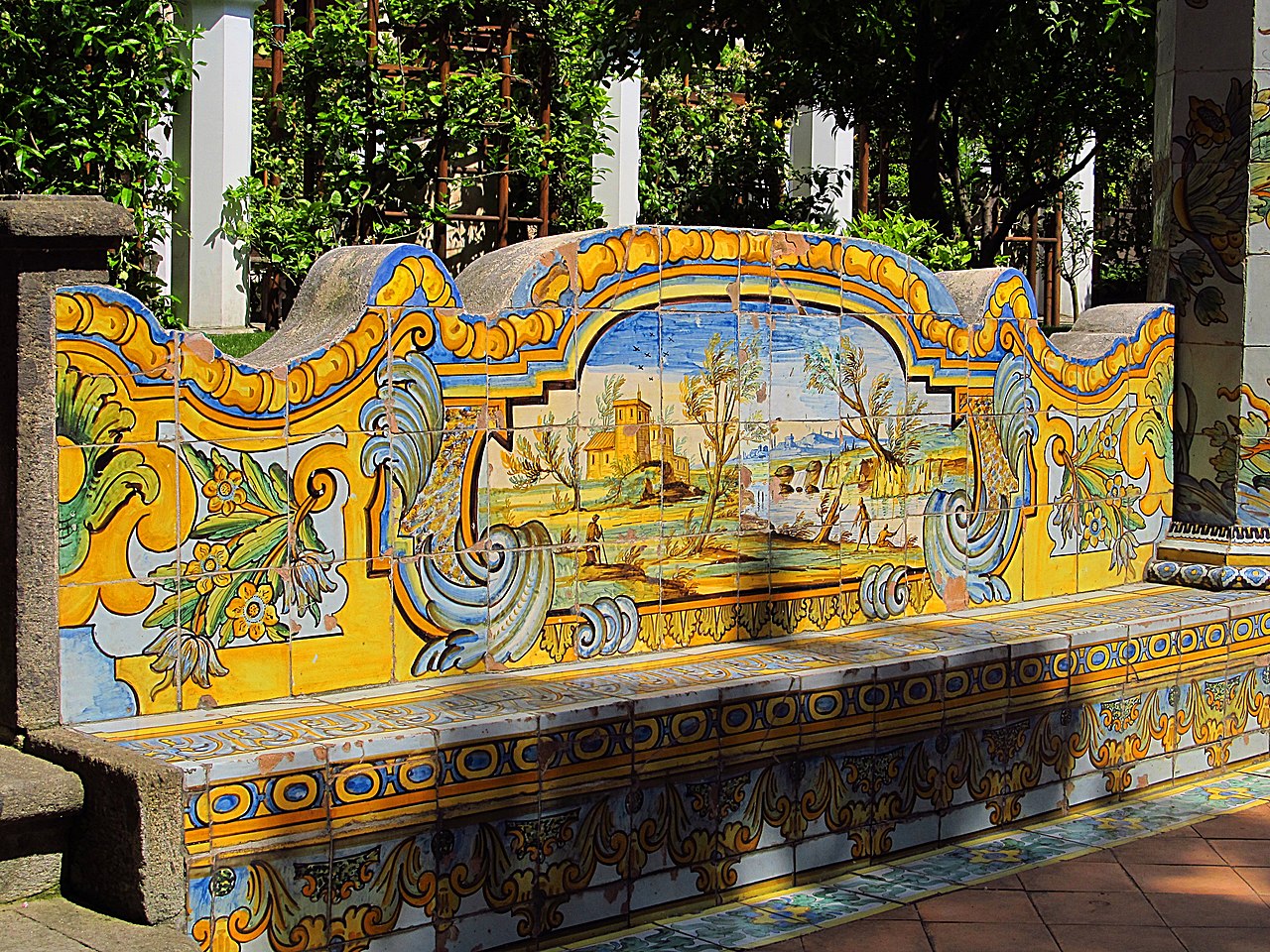
A garden of pillars clad in yellow and blue majolica, where lemon pergolas and eighteenth-century scenes painted on the tiles keep the noise of the city at bay.
 History & archaeology
Statua del Nilo ("Corpo di Napoli")
Largo Corpo di Napoli
A river god reclining for centuries in a quiet square, whom Neapolitans call the Corpo di Napoli: he leans his bearded head among putti and a sphinx.
 Sacred art
Santa Maria delle Anime del Purgatorio ad Arco
Via Tribunali 39
Bronze skulls stand guard at the entrance, and down in the hypogeum the cult of the anime pezzentelle (adopted souls of the dead) still leaves flowers and prayers beside abandoned crania.
 ◆ Sacred art
Chiesa di Santa Luciella ai Librai (teschio con le orecchie)
Napoli
In the crypt of a small church rediscovered in the maze of the Librai rests the skull with ears, which the faithful believed could listen to their prayers.
 Sacred art
Pio Monte della Misericordia
Via Tribunali
Above the altar of an octagonal church still hangs, exactly where Caravaggio painted it, his Sette opere di Misericordia: a single canvas holding all the charity in the world.
 Sacred art
San Gregorio Armeno
Napoli
The street of the presepe (nativity scene) masters, where terracotta shepherds are shaped all year round and the alley smells of glue and wood beneath Baroque bell towers.
 ◆ Sacred art
San Giovanni a Carbonara
Napoli
A double forceps-shaped flight of stairs leads up to the church, inside which the monumental tomb of King Ladislao rises like a tower of marble.
 ◆ History & archaeology
Cappella Pontano
Decumani
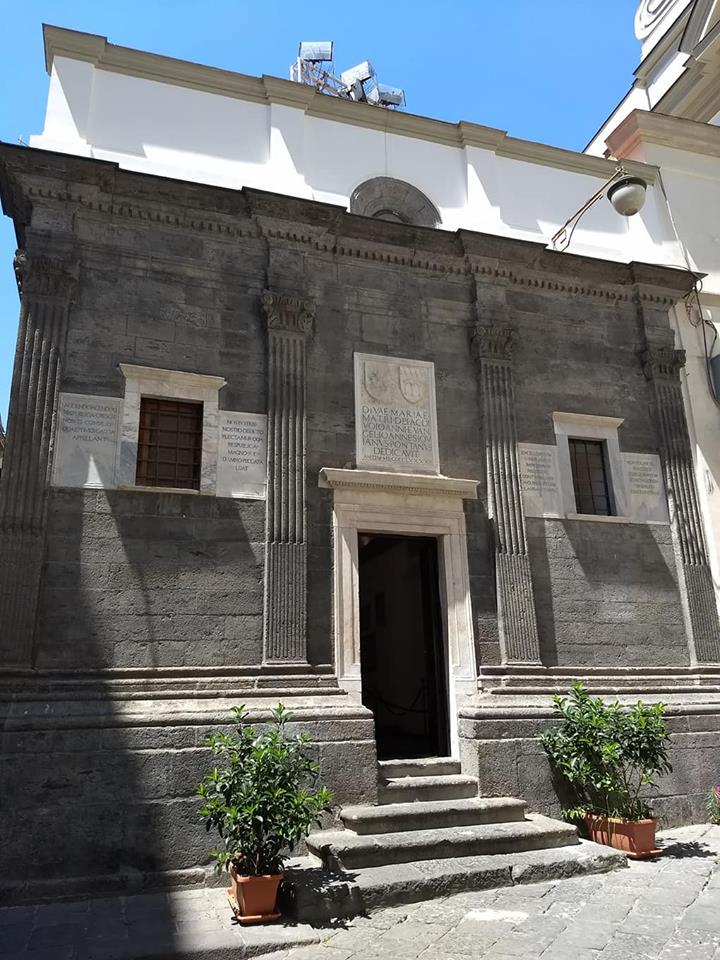
A small Renaissance temple on the decumanus, which the humanist Pontano had raised for his lost wife, still lined inside with Latin inscriptions dictated by his grief.
 ◆ History & archaeology
Sedile di Nilo
Decumani
On the corner of a small Spaccanapoli square survives the seat of the old Nilo quarter, where the nobles once gathered before the sedili of Naples vanished.
 Sacred art
Guglie di San Gennaro
Decumani
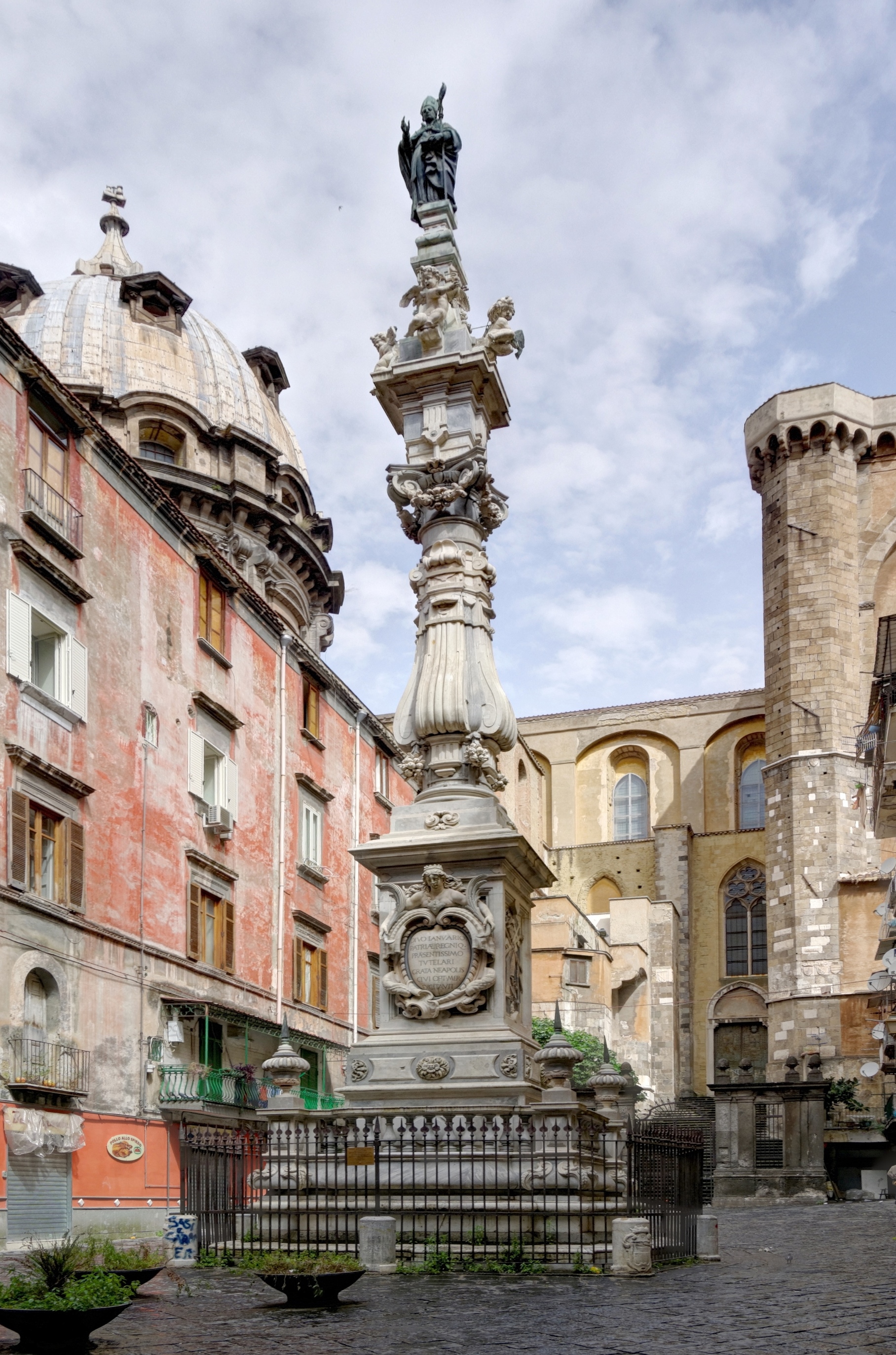
The oldest of the Neapolitan spires, raised in thanksgiving to the patron saint who is said to have halted the lava of Vesuvius, his bronze statue keeping watch beside the Duomo.
 ◆ History & archaeology
Port'Alba
Napoli
A seventeenth-century arch cut into the walls leads to the booksellers' street, where stalls of second-hand volumes pile up among yellowed pages and the shade of the old city.
 ◆ History & archaeology
Porta Capuana
zona Garibaldi
Between two cylindrical towers an arch of white marble opens like a Renaissance triumph, the old city gate facing the road to Capua.
 ◆ Castles
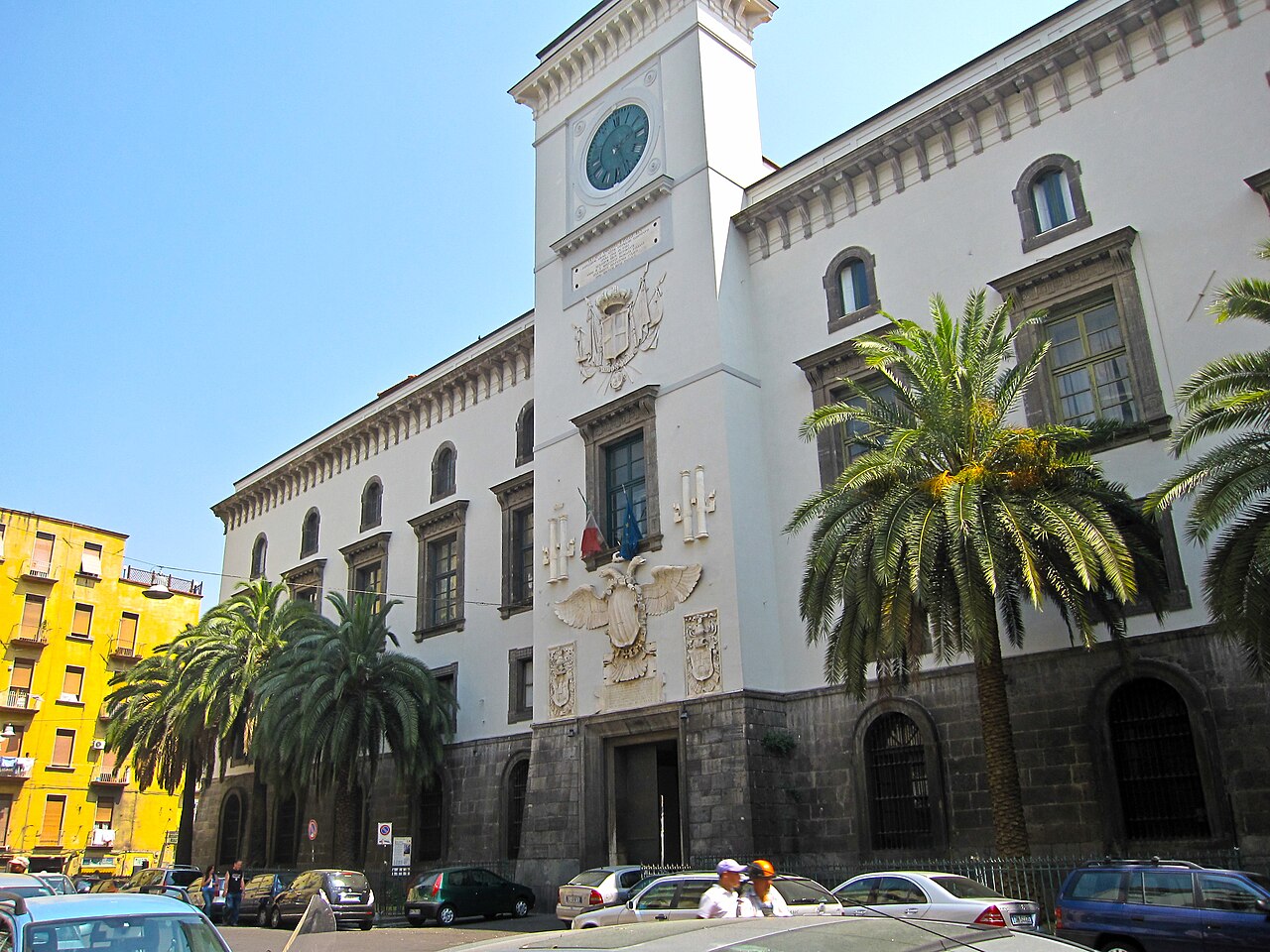
Castel Capuano
zona Garibaldi
An old Norman castle that for four centuries served as the courthouse of Naples: here justice held session in frescoed halls, in the shadow of nearby Porta Capuana.
 Villages
La Pignasecca
Montesanto
The oldest market in Naples unspools through the alleys of Montesanto: fish stalls, fry shops and old-time botteghe (traditional shops) in a hubbub that never stops.
 Museums
MANN — Museo Archeologico Nazionale
P.za Museo
One of the world's great archaeological museums: here the Toro Farnese, the mosaics of Pompeii and the Gabinetto Segreto tell the whole ancient Mediterranean in a single visit.
 ◆ Nature
Orto Botanico
via Foria
Founded in the Napoleonic age, the botanical garden on via Foria lines up glasshouses, palms and rare species across twelve hectares: a green breath a step away from the traffic.
 ◆ History & archaeology
Real Albergo dei Poveri
P.za Carlo III
An eighteenth-century colossus willed by Charles of Bourbon to shelter the poor of the Kingdom: a façade running more than three hundred metres, among the largest historic buildings in Europe.
 Sacred art
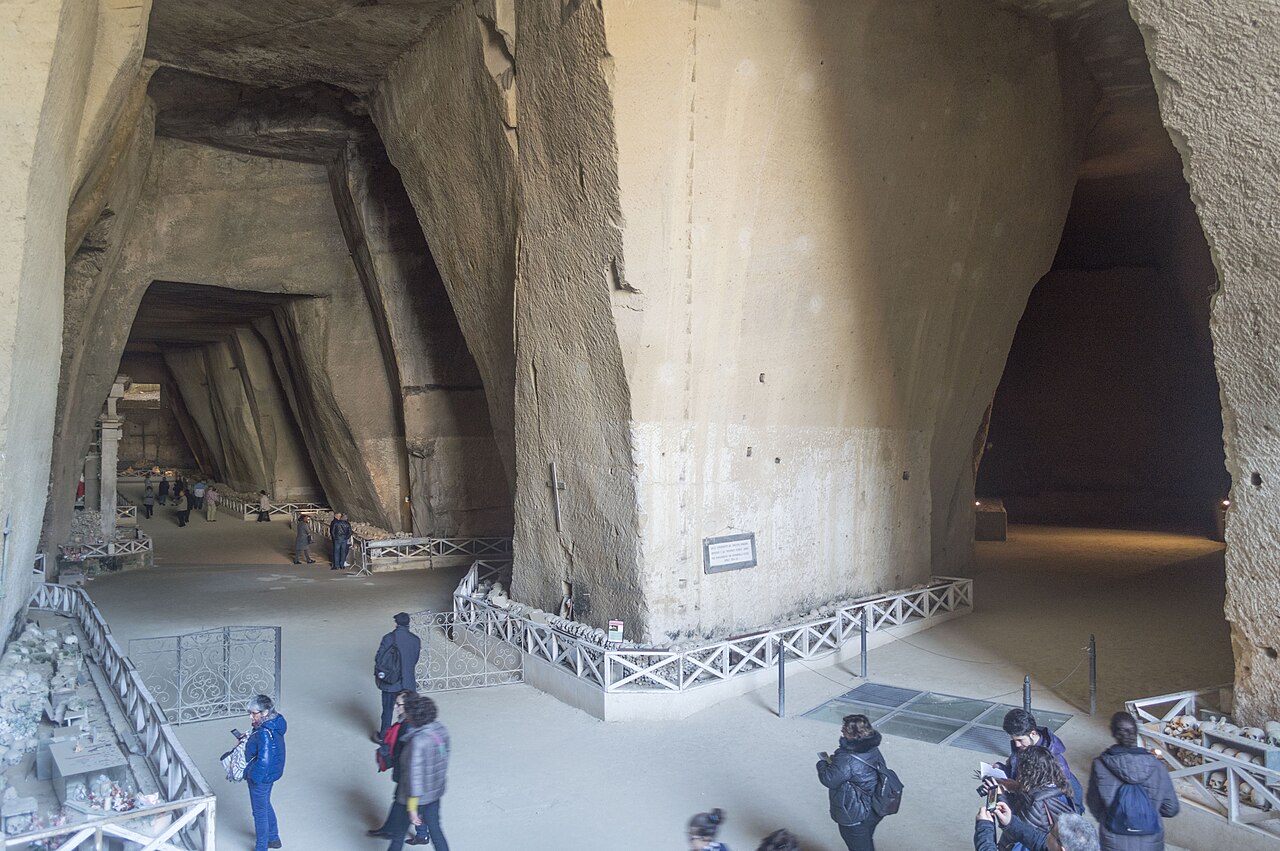
Cimitero delle Fontanelle / Museo delle Capuzzelle
Rione Sanità
Thousands of nameless skulls line the old tufo (volcanic tuff) quarry: the capuzzelle (little skulls) that Neapolitans adopted and cared for, in the tender, desperate cult of the souls of purgatory.
 ◆ Sacred art
Catacombe di San Gaudioso
Basilica della Sanità
Beneath the basilica of the Sanità, early Christian catacombs where noble dead were portrayed with their real skull set above the painted body: death put on stage.
 History & archaeology
Ipogei dei Cristallini
Sanità
Twelve metres below the Rione Sanità, Greek tombs of the 4th century BC with frescoes intact — Egyptian blues and trompe-l'oeil: Hellenistic Neapolis found again in a baron's garden.
 History & archaeology
Palazzo Sanfelice
Sanità
In the heart of the Sanità, Ferdinando Sanfelice signed his hawk-wing staircase: a baroque set piece of open flights, chosen again and again by the cinema for its theatrical sweep.
 ◆ Sacred art
Chiesa di Santa Maria della Sanità
Sanità
Fra Nuvolo's basilica keeps watch over the quarter it gives its name to: dedicated to San Vincenzo, 'o Munacone to Neapolitans, it holds the Catacombe di San Gaudioso beneath it.
 ◆ Sacred art
Basilica di San Gennaro extra Moenia
Sanità
Outside the ancient walls, beside the catacombs that once held the body of San Gennaro: one of the oldest churches in Naples, in the shade of the Capodimonte hill.
 Views & panoramas
Belvedere di San Martino
Vomero
From the forecourt of the Certosa the gaze drops sheer onto Naples: the rooftops of the old centre, the bay, Vesuvius and the islands far off — all in a single frame.
 ◆ Nature
Pedamentina di San Martino
Vomero→centro
A fourteenth-century stairway dropping from the hill of San Martino down to the city: hundreds of steps through vegetable plots, gardens and glimpses of the bay — one of the finest urban paths in Naples.
 History & archaeology
Quartieri Spagnoli
QS
A grid of alleys born in the sixteenth century for the Spanish troops: laundry strung overhead, votive shrines and, at the end of a small square, the great Maradona mural everyone comes looking for.
 Villages
Borgo Marinari
S. Lucia
At the foot of Castel dell'Ovo, the little fishermen's borgo (old village) is now a marina of boats and restaurants: stone, salt air and the legend of Virgil's egg hidden in the foundations.
 Views & panoramas
Fontana del Gigante
via Partenope
A seventeenth-century fountain by Pietro Bernini and Naccherino, moved again and again before settling on the seafront: marble and tritons facing the water, in the shadow of Castel dell'Ovo.
 History & archaeology
Piazza del Plebiscito
centro
The great square opens between the colonnade of the basilica of San Francesco di Paola and the Palazzo Reale: a hemicycle, equestrian statues and an emptiness that in Naples is close to a miracle.
 History & archaeology
Palazzo Reale
P.za Plebiscito
On the facade the kings of Naples keep watch from their niches over the empty sweep of Piazza del Plebiscito; inside, marble staircases and rooms that still smell of the court.
 History & archaeology
Teatro San Carlo
centro
The red and gold of the oldest working opera house in Europe, where since the eighteenth century the voice has risen towards the frescoed ceiling and the royal box.
 History & archaeology
Galleria Umberto I
centro
Beneath the dome of glass and iron the light falls on the marble floor; footsteps and echoes get lost in the octagon, among the shopfronts of the late nineteenth century.
 Views & panoramas
Gran Caffè Gambrinus
P.za Trieste e Trento
Mirrors, stucco and Belle Époque velvet: at the counter you order an espresso and, by old Neapolitan custom, you leave a second one paid for whoever comes next.
 ◆ Views & panoramas
Palazzo Mannajuolo (scala ellittica)
via Filangieri
The elliptical staircase climbs in a perfect spiral of steps and Liberty-style railings: lean over from the top and the eye falls into a vortex of stone.
 Nature
Villa Comunale
Riviera di Chiaia
The garden stretched out along the sea at Chiaia: avenues of holm oaks, benches and old statues, with the gulf breathing beyond the iron railing.
 Nature
Acquario Anton Dohrn
Riviera di Chiaia
The oldest aquarium in Europe, opened in 1874 inside the Villa Comunale: historic tanks inhabited only by the fauna of the Gulf of Naples, behind the glass.
 ◆ History & archaeology
Monte Echia / Pizzofalcone (ascensore)
S. Lucia
The tufo (volcanic tuff) hill where Partenope was born, the city's first nucleus: a lift rises up the cliff and at the top the gulf opens out from Santa Lucia to Vesuvius.
- ◆ Views & panoramas
Rampe di Pizzofalcone
Monte di Dio
The ramps drop in hairpins from Monte di Dio, between old walls and sudden glimpses of the sea: a slow shortcut worth taking for the view alone.
 ◆ Sacred art
Parco Vergiliano a Piedigrotta (tombe di Virgilio e Leopardi)
Mergellina
A park climbing at Piedigrotta holds the columbarium known as the tomb of Virgil and, just below, that of Leopardi: two poets in the greenery, above the traffic.
 Views & panoramas
Parco Virgiliano
Posillipo
At the far end of Posillipo the terraces look out over the islet of Nisida and the open sea: from here the eye takes in the whole gulf and the Campi Flegrei.
 ◆ History & archaeology
Parco Archeologico del Pausilypon
Posillipo
The imperial villa of Vedius Pollio looking over the Gaiola: theatre and odeion among the pines, there where the Romans called this place the pause from pain.
 Views & panoramas
Marechiaro e la Fenestella
Posillipo
The fishing borgo (old village) where Salvatore Di Giacomo imagined the fenestella with its carnation: below, the shallow water and Vesuvius closing the horizon.
 ◆ Castles
Palazzo Donn'Anna
Posillipo
The unfinished seventeenth-century palace juts sheer over the water, dark and labyrinthine: through its empty rooms legend has the shadow of Donn'Anna still wandering.
 History & archaeology
Anfiteatro Flavio
Pozzuoli
The third largest Roman amphitheatre, at Pozzuoli: above ground the tiers, but it is underground that it strikes you, in the intact passages from which the beasts rose.
 History & archaeology
Tempio di Serapide (Macellum)
Pozzuoli
Not a temple but the ancient Roman market: on the marble columns the holes bored by marine molluscs tell how much the Flegrean ground has risen and sunk over the centuries.
 Nature
Solfatara
Pozzuoli
The ground breathes: hissing fumaroles, mud that boils up and a smell of sulphur reminding you how alive the earth is beneath the Campi Flegrei.
 History & archaeology
Antro della Sibilla
Bacoli
A long trapezoidal corridor carved into the tufo (volcanic tuff), cut by blades of light, where Virgil imagined the Sibyl prophesying among the shadows of the rock.
 History & archaeology
Parco di Cuma
Bacoli
The oldest Greek colony in Italy, with the temples of Apollo and Jupiter stretched across the acropolis between pines and sea, where history begins in silence.
 ◆ History & archaeology
Cento Camerelle
Bacoli
A labyrinth of cisterns on two levels dug into the tufo (volcanic tuff), also called Carceri di Nerone, where Roman water ran beneath a villa facing the gulf.
 In the water & diving
Parco Sommerso di Baia
Bacoli
A Roman city swallowed by the sea through bradyseism: mosaics, columns and statues visited from a glass-bottomed boat or with a mask.
 History & archaeology
Terme di Baia e Castello Aragonese (Museo Campi Flegrei)
Bacoli
Terraces of imperial baths descending towards the sea, and above them the Castello Aragonese guards the statues brought back up from the sunken Baia.
 Castles
Casina Vanvitelliana
Lago Fusaro, Bacoli
An octagonal pavilion that seems to float on Lago Fusaro, a Bourbon hunting lodge reached by a little bridge, among reflections and morning mists.
 History & archaeology
Scavi di Ercolano
Ercolano
A Roman town petrified by volcanic mud, with wooden beams, beds and doors still in place: here time stopped more intact than anywhere.
 ◆ Museums
Antiquarium
Boscoreale
The museum that tells of daily life at the foot of Vesuvius before the eruption, among carbonised loaves, farm tools and finds handed back by the ash.
 Volcanoes
Vesuvio — Gran Cono
Ercolano
The last stretch climbs on foot over the scree to the rim of the crater, where the warm breath of the earth mixes with the view of the whole Gulf of Naples.
 ◆ Nature
Monte Somma
Ottaviano
The ancient volcanic ring that embraces Vesuvius, with its jagged crests and woods of holm oak and chestnut where the noise of the city gets lost.
 ◆ Museums
Museo dell'Osservatorio Vesuviano
Ercolano
The oldest volcanological observatory in the world, willed by the Bourbons in 1841, with historic instruments and mineral collections, looking out over the slopes of Vesuvius.
 Free beaches
Baia di Ieranto
Nerano
The bay protected by the FAI that looks across at the Faraglioni of Capri, reachable only on foot among olive trees and scrub, with the clear water of an old quarry.
 Nature
Punta Campanella
Massa Lubrense
The furthest tip of the Sorrento peninsula, a wind-beaten marine reserve between the two gulfs, with its watchtower and Capri an arm of sea away.
 ◆ Free beaches
Fiordo
Massa Lubrense
A cleft in the rock where the sea slips in, narrow and green, almost always shaded beneath high walls: you don't come here for the sun, but for the silence.
 Nature
Vallone dei Mulini
Sorrento
A canyon in the heart of the town where an old grain mill crumbles under the vegetation, wrapped in ferns and damp air, in a microclimate that time has forgotten.
 ◆ Museums
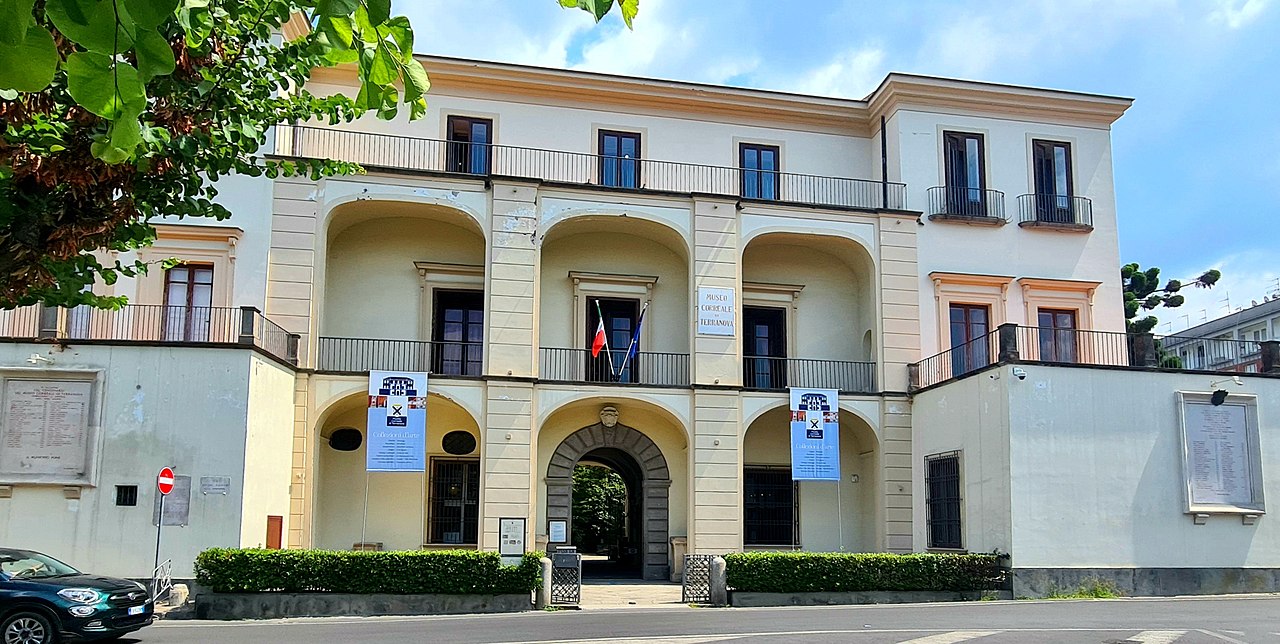
Museo Correale
Sorrento
In the family villa of the Correale counts: porcelain, inlaid wood and eighteenth-century views of Naples, and a garden that runs down to a belvedere over the sea.
 ◆ History & archaeology
Sedile Dominova
Sorrento
The only surviving noble sedile in Campania, an open sixteenth-century loggia with a frescoed dome and majolica tiles, today a club for the town's elders on the corner of two alleys.
 ◆ History & archaeology
Villa Fondi
Piano di Sorrento
The villa of the de Sangro family overlooking the gulf, with a garden sheer above the sea and the Georges Vallet archaeological museum gathering the finds of the peninsula.
 ◆ Free beaches
Marina di Seiano
Vico Equense
The little harbour of Vico Equense beneath the tufo (volcanic tuff) walls, with the fishermen's boats, the bathing clubs on the rocks and a reef that shelters the water from the wind.
 History & archaeology
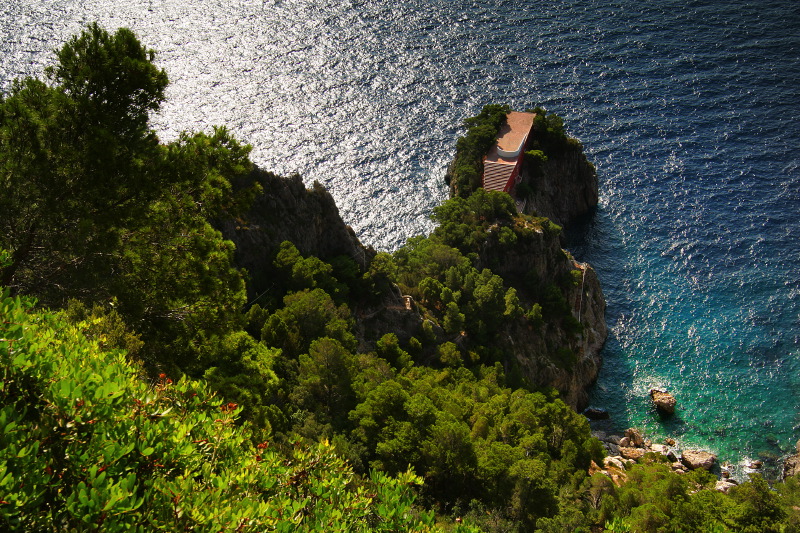
Villa Malaparte
Punta Massullo
Curzio Malaparte's red house glued to the rock of Punta Massullo, with the trapezoidal stairway climbing to the roof: a scene out of Godard's Le Mépris, suspended over the sea.
 Hiking
Scala Fenicia
Marina Grande→Anacapri
The ancient stone stairway that for centuries was the only link between Marina Grande and Anacapri, step after step up the face of the mountain.
 ◆ Castles
Palazzo d'Avalos (ex carcere)
Terra Murata
First the palace of the d'Avalos family, then a prison until the late twentieth century: the empty cells command Terra Murata, suspended between the memory of the inmates and the silence that lives there now.
 Castles
Castello Aragonese
Ischia Ponte
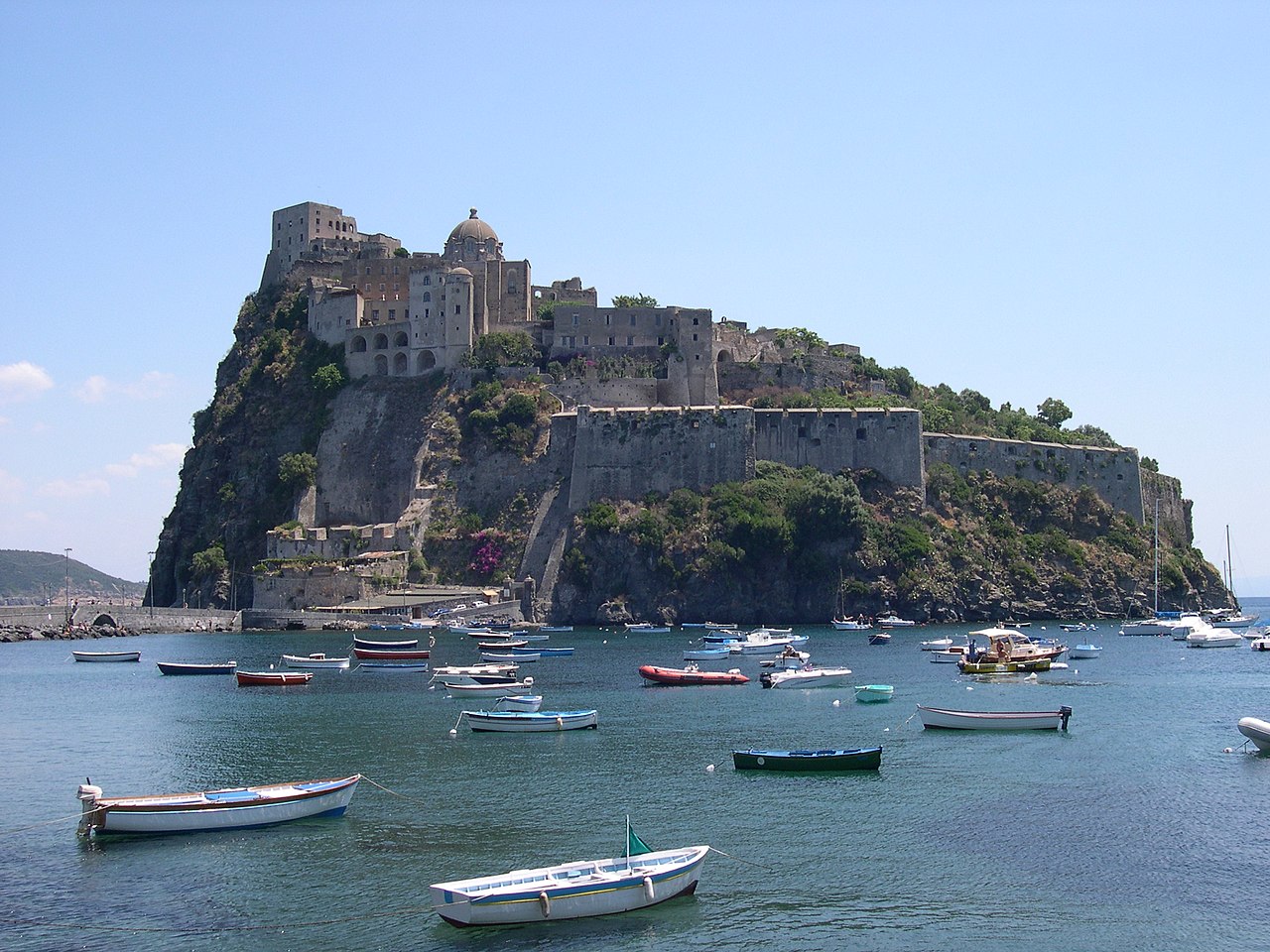
A fortress on a rocky islet tied to Ischia by a stone causeway, layered with millennia of history, the gaze ranging over the bay between walls, courtyards and gardens.
 History & archaeology
Real Sito di Carditello
San Tammaro
A Bourbon lodge standing alone in the Caserta countryside, the heart of a royal estate given over to hunting and horse breeding, survivor of abandonment and reborn today.
 ◆ Sacred art
Basiliche paleocristiane di Cimitile
Cimitile (NA)
Around the tomb of Saint Felix, a rare complex of early Christian basilicas layered over the centuries preserves mosaics and frescoes, the memory of Paulinus' Christian Nola.
 Sacred art
Santuario Madonna dell'Arco
Sant'Anastasia (NA)
At the foot of Vesuvius, the Marian sanctuary draws every Easter Monday the fujenti dressed in white, among walls covered with ex voto and promises of grace.
 Nature
Valle dei Mulini di Gragnano
Gragnano (NA)
Where water once turned the mills, the valley of Gragnano guards ivy-clad ruins and waterfalls; not far off, the breeze of the gorge dried the pasta of the town.
 Museums
Museo del Corallo
Torre del Greco (NA)
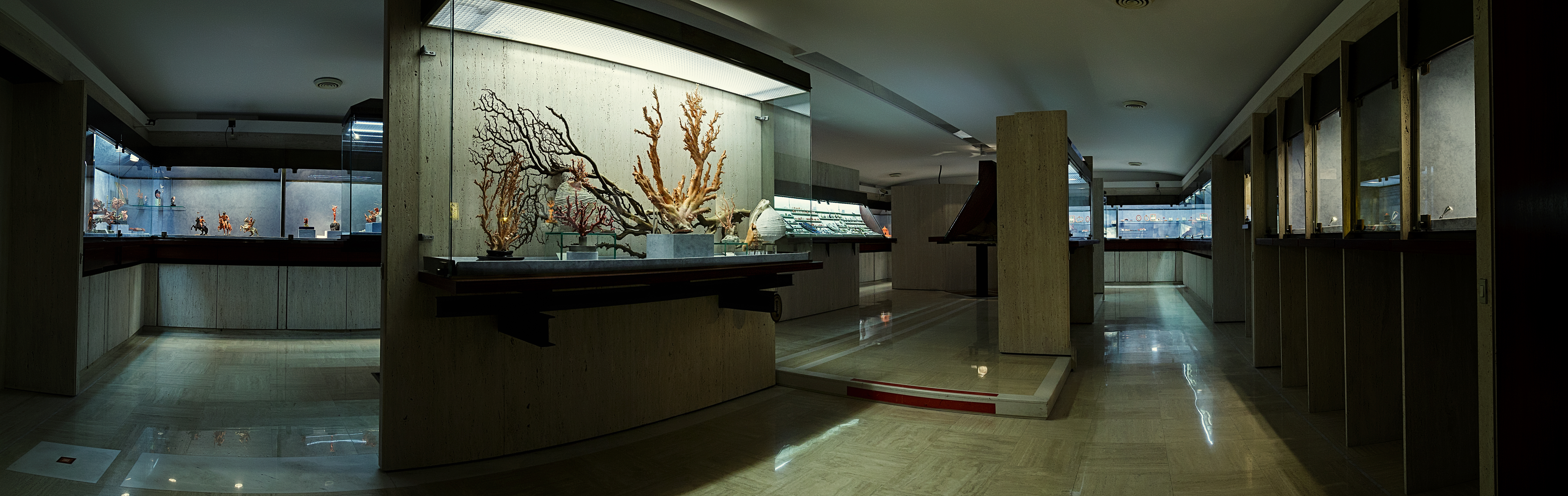
In Torre del Greco, capital of coral, the museum gathers hand-carved cameos and red branches: the memory of a town that has been carving the treasure of the sea for centuries.
 ◆ Castles
Castello di Lettere
Lettere (NA)
Perched on the Monti Lattari, the castle of Lettere watched over the Amalfi frontier: from its ruins the gaze runs from the Gulf of Napoli to the Sarno valley, beneath Vesuvius.
 Street art
Murales di Maradona
Napoli (NA)
In the Quartieri Spagnoli a giant mural of Maradona has turned a courtyard into a secular shrine, among scarves, votive candles and fans on pilgrimage.
 History & archaeology
Napoli Sotterranea
Napoli (NA)
Forty metres beneath the alleys, Greek quarries and Roman cisterns turned into shelters during the war: another Naples carved into the tufo (volcanic tuff), dark and cool.
 History & archaeology
Stadio Diego Armando Maradona
Napoli (NA)
At Fuorigrotta the old San Paolo now bears the name of Maradona: on match nights the whole city seems to hold its breath.
 Sacred art
Catacombe di San Gennaro
Napoli (NA)
In the Sanità district open two levels of frescoed galleries where San Gennaro was buried, the largest catacomba in the South carved into the yellow tufo (volcanic tuff).
 Views & panoramas
Palazzo dello Spagnolo
Napoli (NA)
In the Sanità district the Palazzo dello Spagnolo opens its courtyard onto a double-ramp staircase, wings of stucco like a falcon's: baroque turned into stagecraft.
 Street art
Stazione Toledo (Stazioni dell'Arte)
Napoli (NA)
Toledo station descends into the deep blue of the sea through Tusquets' 'Crater de luz', where the shimmering mosaics turn the metro into a plunge into water and light.
 Street art
Stazione Università (Karim Rashid)
Napoli (NA)
Karim Rashid has turned Università station into a flash of magenta and fluid surfaces, futuristic geometries conceived as a hymn to knowledge and connection.
 Street art
Stazione Materdei
Napoli (NA)
Materdei station weaves together natural light and coloured mosaics, bringing back to the surface the breath of a hillside neighbourhood often left off the usual itineraries.
 Street art
Stazione Dante
Napoli (NA)
At Dante station contemporary art inhabits the daily passage, from Joseph Kosuth's neon to the works that accompany commuters between the piazza and the bowels of the city.
 Museums
Museo di Capodimonte
Napoli (NA)
In the Bourbon palace set within a monumental wood, Capodimonte holds Titian, Caravaggio and the Farnese collection, with the gulf appearing beyond the tree-lined avenues.
 Museums
MADRE — Museo d'Arte Contemporanea Donnaregina
Napoli (NA)
In the Donnaregina palace the MADRE gathers contemporary art in Napoli, from the site-specific installations conceived for its rooms to the great names of the later twentieth century.
 History & archaeology
PAN — Palazzo delle Arti Napoli
Napoli (NA)
At Palazzo Roccella, among the elegant streets of Chiaia, the PAN hosts exhibitions of art, photography and comics, a civic space where contemporary research meets the city.
 Museums
Gallerie d'Italia — Palazzo del Banco di Napoli
Napoli (NA)
On via Toledo the Gallerie d'Italia hold Caravaggio's last canvas, the 'Martirio di sant'Orsola', painted in Napoli in the final months of his life.
 Views & panoramas
Le Vele di Scampia
Napoli (NA)
Le Vele di Scampia, enormous sail-shaped structures designed in the 1970s, remain a controversial icon of the Neapolitan periphery, between demolitions and the memory of redemption.
 Views & panoramas
Mostra d'Oltremare
Napoli (NA)
Among the rationalist avenues of Fuorigrotta, geometric fountains and the Torre delle Nazioni sketch a suspended 1940s landscape, where architecture becomes the perfect stage set for the camera.
 Villages
Rione Terra
Pozzuoli (NA)
On the acropolis of Pozzuoli, evacuated in 1970 because of bradyseism, the Rione Terra guards beneath its houses an intact Roman town of streets, workshops and paved hinges.
 Hiking
Alta Via dei Monti Lattari
Castellammare di Stabia (NA)
The ridge of the Monti Lattari, traced by a long crest path, runs among beech woods and rocky balconies suspended between the gulf of Naples and that of Salerno.
 Hiking
Monte Faito
Vico Equense (NA)
Above the gulf of Naples the Faito covers itself in cool beech woods, a destination of panoramic ridges where in summer you breathe mountain air a stone's throw from the sea.
 Castles
Maschio Angioino (Castel Nuovo)
Napoli (NA)
Its cylindrical towers watch over the port, while the triumphal arch of white marble is set into the dark stone like a doorway to the Renaissance.
 Castles
Castel dell'Ovo
Napoli (NA)
On the little islet of Megaride, the oldest fortress in Naples reaches out over the sea, wrapped in the legend of the egg hidden by Virgil in its foundations.
 Castles
Castel Sant'Elmo
Napoli (NA)
A star-shaped fortress on the Vomero hill, from its ramparts it offers the widest view over the city, the gulf and Vesuvius on the horizon.
 Sacred art
Certosa e Museo Nazionale di San Martino
Napoli (NA)
Beside Sant'Elmo, the Carthusian monastery weaves together marble cloisters and a sumptuous church, keeper of the most famous collection of Neapolitan presepi (nativity scenes).
 History & archaeology
Palazzo Reale di Portici
Portici (NA)
Commissioned by the Bourbons at the foot of Vesuvius, the palace looks out on the sea on one side and the volcano on the other, set in a park that runs down to the coast.
- Castles
Castello di Baia
Bacoli (NA)
On the high promontory sheer above the gulf, the Aragonese castle guards the statues resurfaced from the submerged Roman city of the Campi Flegrei.
 In the water & diving
Parco della Gaiola
Napoli (NA)
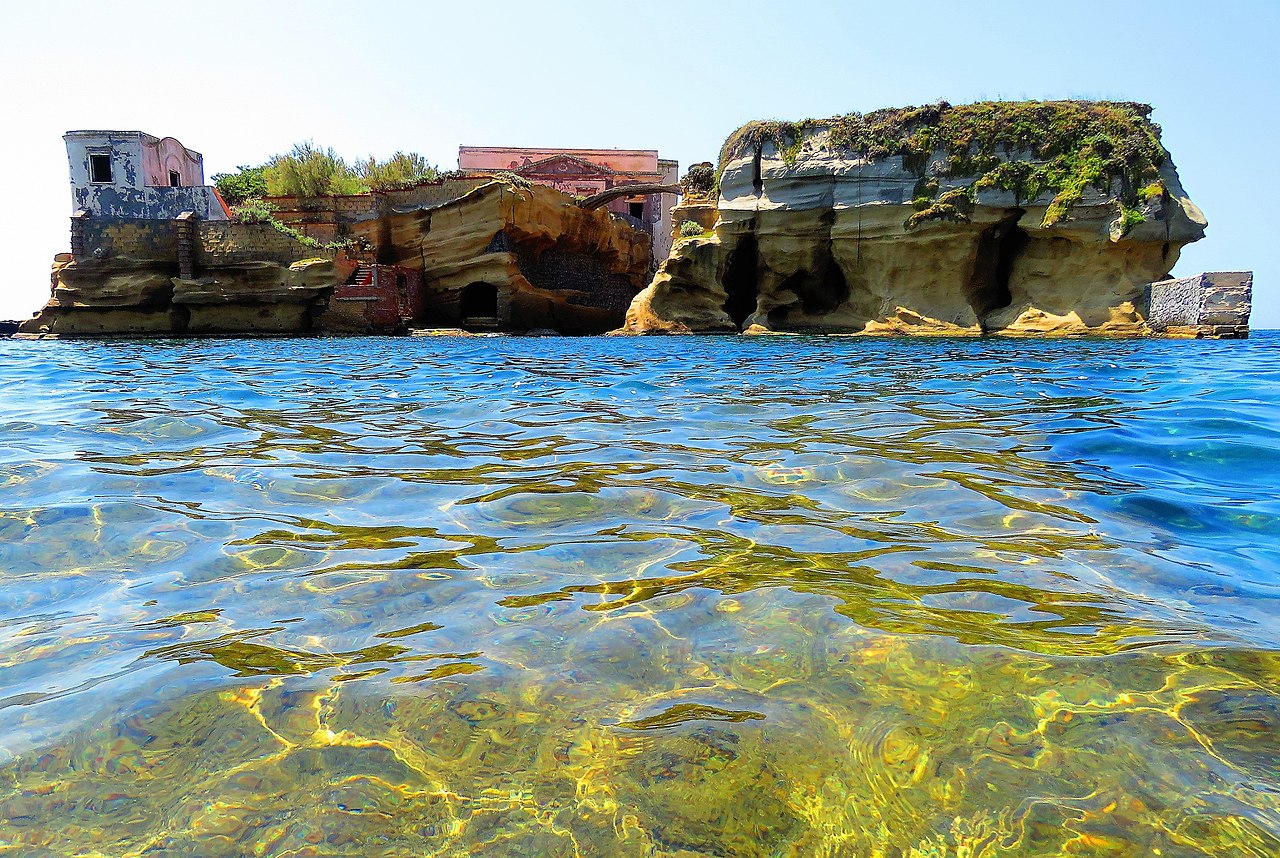
Below Posillipo, two islets linked by a fragile bridge: the Gaiola marine protected area, with submerged Roman ruins, transparent waters and the whispered fame of a cursed island.
 ◆ History & archaeology
Piscina Mirabilis
Bacoli (NA)
At Bacoli, forty-eight pillars hold up the vault of a Roman cistern dug into the tufo (volcanic tuff): the largest ever built, an underground cathedral that once quenched the Misenum fleet.
 Nature
Lago d'Averno
Pozzuoli (NA)
In the extinct crater of a volcano, the still waters of Averno: for the ancients the threshold of the underworld, the one Aeneas crossed to descend into the kingdom of shadows.
 ◆ Views & panoramas
Faro di Capo Miseno
Bacoli (NA)
At the mouth of the Campi Flegrei, the headland that was the base of the Roman fleet closes the gulf with a lighthouse overlooking Procida, Ischia and the sea of Miseno.
 ◆ History & archaeology
Anfiteatro di Liternum
Giugliano in Campania (NA)
On the shores of Lake Patria, where Scipio Africanus chose voluntary exile and death, the amphitheatre and forum of Liternum remain, a Roman colony facing the coast.
 Volcanoes
Cratere degli Astroni
Napoli (NA)
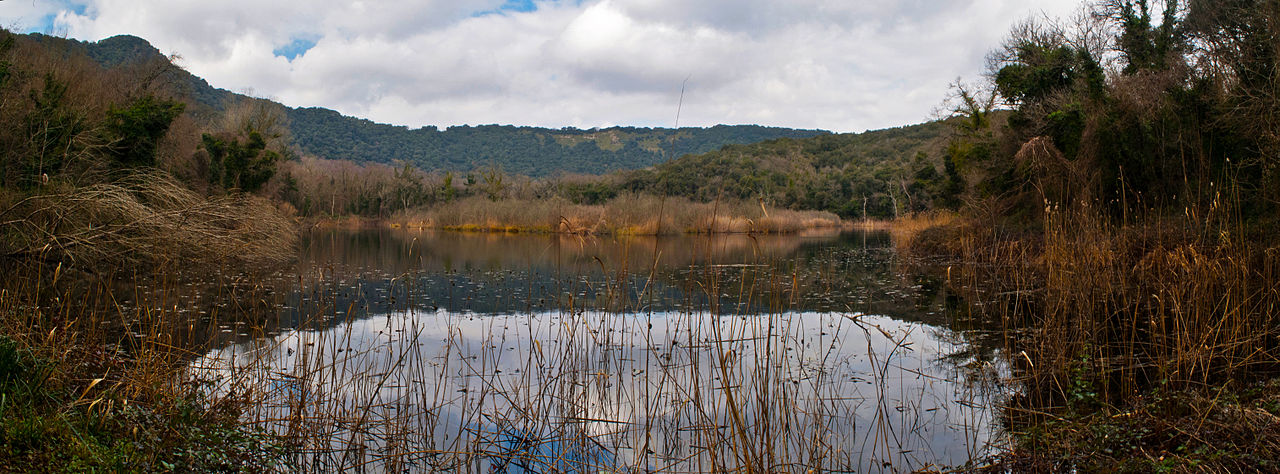
An extinct crater enclosed by wooded walls, with small lakes and silent trails: once a Bourbon hunting reserve, today an oasis where the woodpecker marks the time.
 ◆ Volcanoes
Monte Nuovo
Pozzuoli (NA)
Born in a single night from a sixteenth-century eruption, the youngest mountain of the Campi Flegrei holds within its crater a green silence looking out over the gulf of Pozzuoli.
 ◆ Villages
Marina della Lobra
Massa Lubrense (NA)
Colourful boats hauled ashore, nets spread out and the church facing the sea: below Massa Lubrense a small fishing harbour survives, far from the clamour of the coast.
 ◆ Sacred art
Cattedrale dell'Annunziata di Vico
Vico Equense (NA)
Clinging to a spur of tufo (volcanic tuff) sheer above the sea, the Annunziata is the peninsula's only Gothic cathedral: inside, the half-light; outside, the Bay of Naples flung wide open.
 ◆ Museums
Museo Mineralogico Campano
Vico Equense (NA)
In a seventeenth-century former convent of Vico Equense, thousands of minerals from all over the world gathered by a single enthusiast, down to a fragment of graphene donated by a Nobel laureate.
 Views & panoramas
Belvedere di Sant'Agata sui Due Golfi
Massa Lubrense (NA)
From here, in a single glance, the two gulfs: Naples with Vesuvius on one side, Salerno and the mountains on the other, with the watershed of the Sorrento peninsula underfoot.
 ◆ Museums
Museo Ferroviario di Pietrarsa
Portici (NA)
In the old Bourbon workshop where Italy's first railway was born, historic locomotives rest by the sea, with the Vesuvius closing the horizon.
- ◆ History & archaeology
Parco Archeologico di Liternum
Giugliano in Campania (NA)
By Lago Patria surface the forum, basilica and theatre of the Roman colony where Scipio Africanus chose voluntary exile and wished to be buried.
 History & archaeology
Neapolis Sotterrata (San Lorenzo Maggiore)
Napoli (NA)
Beneath the cloister you walk along a real Greco-Roman street: the macellum, the bakers' shops, the laundry. The Neapolis of the 1st century, frozen beneath your feet.
 ◆ Sacred art
Santa Maria la Nova e la "tomba di Dracula"
Napoli (NA)
In the cloister stands a tomb with a dragon carved between two sphinxes. Since 2014 some swear that Vlad the Impaler lies inside, buried here by his daughter. Historians shake their heads. The dragon, though, is right there.
 ◆ Sacred art
Chiesa di Santa Maria del Pianto
Napoli (NA)
Built in 1657 over the mass graves of the plague that in a single year carried off half of Naples. Below lies the Grotta degli Sportiglioni: the tufo quarries where the plague victims were thrown by the thousand.
 ◆ Castles
Palazzo Serra di Cassano — il portone chiuso dal 1799
Napoli (NA)
On 20 August 1799 Gennaro Serra di Cassano was executed in Piazza Mercato for the Repubblica Napoletana. His father had the palace's monumental door barred. It has never been reopened since.
 ◆ Castles
Palazzo Penne — il patto col diavolo
Napoli (NA)
Antonio Penne wanted his palace built in a single night, and asked the devil for it in exchange for his soul. Then he cheated him with an impossible clause. The quills carved on the façade since 1406 are still there as a reminder.
 ◆ Castles
Villa Ebe e le Rampe Lamont Young
Napoli (NA)
Lamont Young dreamed of a Naples crossed by canals and underground railways. Nobody listened. In 1929 he shot himself inside this neo-Gothic castle built for his wife Ebe. In 2000 an arson fire devoured its interiors.
 ◆ Castles
Castello Aselmeyer
Napoli (NA)
A Tudor manor with turrets and mullioned windows, planted in the middle of Corso Vittorio Emanuele: Lamont Young's other English dream, built for British tourists who never came.
 ◆ Castles
Torre Palasciano
Napoli (NA)
A Florentine tower rising on the Capodimonte hill: it was wanted by Ferdinando Palasciano, the surgeon who cried "the wounded are sacred" and anticipated the Red Cross. They say his ghost still leans out to admire the bay.
 ◆ Nature
Palazzo Venezia e il suo giardino segreto
Napoli (NA)
From 1412 to 1797 this was the embassy of the Republic of Venice in Naples. You step through the door on Spaccanapoli, climb a ramp and find yourself in a hanging garden carved into the tufo (volcanic tuff), with a little Pompeian pavilion and not a tourist in sight.
 ◆ Street art
Fontana della Sirena (Piazza Sannazaro)
Napoli (NA)
Rejected by Ulysses, the siren Partenope let herself die and the sea laid her on this shore: from her the city took its name. Here she is in marble, lyre in hand, on a rock of horses, lions and dolphins.
 ◆ Street art
Murales di Jorit a Piscinola-Scampia (Pasolini, Angela Davis, De Andre')
Napoli (NA)
You come out of the metro and Pasolini is waiting for you, as tall as a building, next to Angela Davis and De André. Scampia told by those who live there, not by those who use it as a set.
 ◆ Museums
Museo Civico Gaetano Filangieri
Napoli (NA)
Armour, porcelain, paintings and the library of a collector prince, in a Renaissance palace that in the nineteenth century was taken apart stone by stone and rebuilt thirty metres further along.
 Museums
Museo Duca di Martina — Villa Floridiana
Napoli (NA)
Six thousand pieces of decorative art — Meissen porcelain, ivories, corals — in a white villa built by a king for his morganatic wife, at the top of a park looking over the bay.
 Museums
Villa Pignatelli
Napoli (NA)
A neoclassical villa left exactly as it was: the halls, the library, the little red drawing room. And, in the annexe, the carriage museum — with the park all around, in the middle of Chiaia's traffic.
 ◆ Museums
MuSA — Museo dell'Osservatorio Astronomico di Capodimonte
Napoli (NA)
The first observatory of the Kingdom of the Two Sicilies, with its nineteenth-century brass telescopes, on a terrace overlooking the whole of Naples. On some evenings you really do watch the stars.
 ◆ Sacred art
Chiostro di San Marcellino e Festo
Napoli (NA)
A monastic cloister open on one side — an extremely rare thing — that suddenly gives onto the roofs of Naples, the sea and Vesuvius. At its centre, a baroque fountain with dolphins. And it is free.
 ◆ Hiking
Salita del Petraio
Napoli (NA)
Five hundred steps dropping from the Vomero down to Chiaia along an ancient watercourse, among bassi (ground-floor homes), washing lines, cats and little gardens. At every turn the bay reappears, and there is not a single tourist.
 ◆ Views & panoramas
Parco Urbano ed Eremo dei Camaldoli
Napoli (NA)
The roof of Naples, 458 metres. From here, in a single glance: Vesuvius, the Campi Flegrei, Capri, Ischia, Procida and the Monti Lattari. Behind you, a hermitage of 1585 where nuns still live.
 Views & panoramas
Pontile Nord di Bagnoli
Napoli (NA)
Nine hundred metres of concrete running out into the sea: it was the Italsider pier, where the steel was loaded. Today you walk out over the bay, with Nisida ahead and the chimneys behind. At sunset it feels unreal.
 History & archaeology
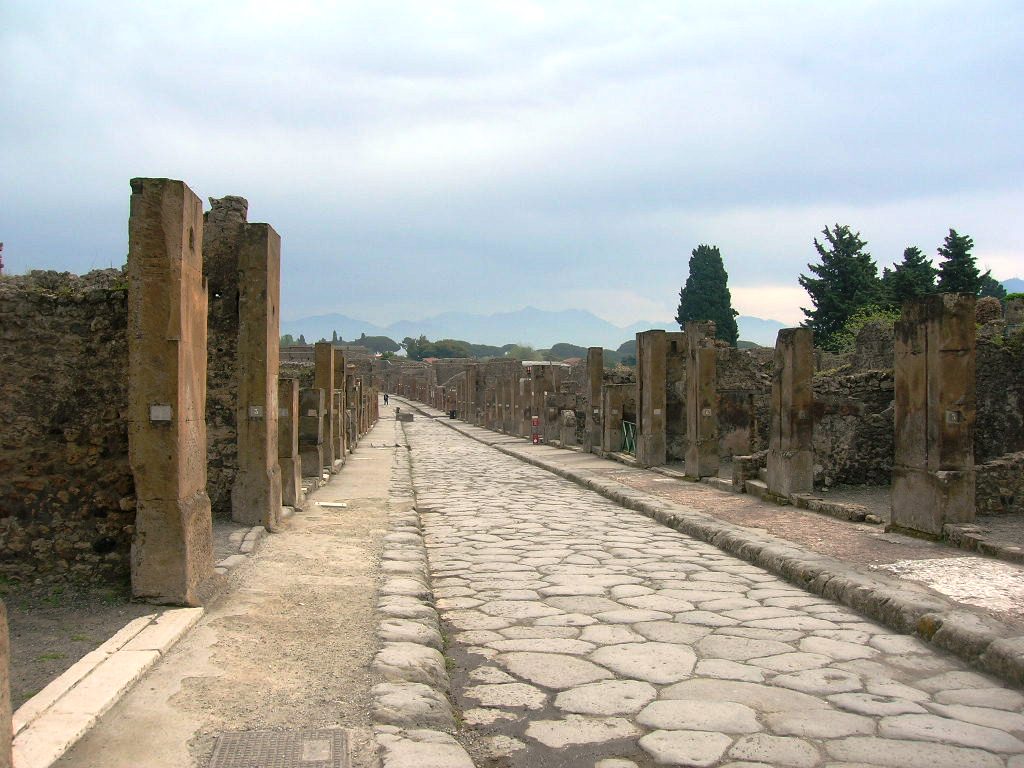
Scavi di Pompei
Pompei (NA)
The Roman city stopped in AD 79 by the eruption of Vesuvius: paved streets, frescoed houses and the casts of the bodies, beneath the volcano that buried it. It is the most visited archaeological site in Italy after the Colosseum.
- ◆ Museums
Ospedale delle Bambole
Napoli
Behind a shop window in Palazzo Marigliano a craftsman mends glass eyes, porcelain arms and dolls' curls, in a workshop born more than a century ago.
- ◆ Sacred art
Complesso dei Girolamini
Napoli
Beyond the white facade open one of the oldest libraries in Naples and a silent picture gallery, among wooden shelves and canvases hung by the Oratorian fathers.
- Sacred art
Immacolata
Decumani
In the heart of piazza del Gesù the Baroque spire soars straight up, an explosion of marble and statues crowned by the Immacolata turned toward the sky.
- Sacred art
San Domenico
Decumani
The square where the heart of Spaccanapoli beats, with the Baroque spire at its centre and the apse of the Angevin basilica that once held the rooms of San Tommaso.
- ◆ Castles
Palazzo Sansevero
P.za San Domenico Maggiore
On the corner of piazza San Domenico the palace of the princes of Sangro still carries the echo of the night when Gesualdo surprised and killed Maria d'Avalos and her lover.
- ◆ Sacred art
Basilica dell'Annunziata e Ruota degli Esposti
zona Forcella
The revolving wooden drum where for centuries newborns were laid in secret, and from which so many Neapolitans inherited the surname Esposito.
- Street art
Murale di San Gennaro (Jorit)
Forcella
Fifteen metres high on a facade in Forcella, Jorit's San Gennaro has the face of a young worker marked by the two red stripes of the human tribe.
- ◆ Villages
Mercato di Porta Nolana
zona Garibaldi
Beneath the Aragonese arch of Porta Nolana the fish market erupts with voices, crates of seawater and shellfish still alive: Naples at its most unvarnished.
- ◆ Sacred art
Cimitero delle 366 Fosse
Poggioreale
Ferdinando Fuga drew here one pit for every day of the year: 366 anonymous graves for the city's poor, an Enlightenment geometry of dying beneath the hill of Poggioreale.
- ◆ Sacred art
Presepe Favoloso
Sanità
In the sacristy of the basilica of the Sanità the Scuotto brothers have lit up more than a hundred figures: a presepe (nativity scene) where eighteenth-century tradition and fairy tale interlace, suspended between the sacred and sheer wonder.
- ◆ Nature
Vigna di San Martino
collina S. Martino
One of the largest urban vineyards in Europe, worked by the Carthusians since the fourteenth century: seven hectares of vines, citrus and olive trees hanging over the bay, a step from the city's chaos.
- Views & panoramas
Lungomare
via Partenope
A seafront walk from via Partenope: Vesuvius straight ahead, Castel dell'Ovo out on the water, and all of Naples strolling slowly through the evening between a gelato and the horizon.
- Views & panoramas
Terrazza di Sant'Antonio (tredici scese)
Posillipo
Thirteen flights of steps climb to the terrace of Sant'Antonio, where the gulf lines up like a postcard: Vesuvius, sea and city in a single glance.
- Views & panoramas
Via Petrarca / Via Orazio
Posillipo
The two roads run halfway up the hill of Posillipo, natural terraces suspended over the gulf: little villas, bougainvillea and the sea appearing between one bend and the next.
- ◆ History & archaeology
Grotta di Seiano
Posillipo
A Roman tunnel nearly eight hundred metres long bores through the hill in the dark, then opens onto the light of the Gaiola valley and the villa of Pausilypon.
- ◆ Free beaches
Lido delle Monache / spiaggia libera di Posillipo e Riva Fiorita
Posillipo
Tiny coves among the rocks, once the bathing place of the nuns of a convent above the sea: almost secret free beaches, reachable mostly from the water.
- ◆ Free beaches
Baia di Trentaremi
Posillipo
A bay closed in by high cliffs of yellow tufo (volcanic tuff), with caves cut by the Romans: no road reaches it, only the sea and the kayaks slip in among the rocks.
- ◆ Views & panoramas
Belvedere Stupor Mundi
Monte di Procida
A terrace suspended on the tufo (volcanic tuff) sheer above the sea, from which the eye runs to Procida, Ischia and Capri, all the way to Capo Miseno.
- ◆ History & archaeology
Tomba di Agrippina
Bacoli
Not a tomb at all but the remains of a small Roman theatre by the sea, tied by legend to Agrippina, mother of Nero, killed at Bauli.
- ◆ History & archaeology
Grotta della Dragonara
Capo Miseno
An Augustan cistern carved into the tufo (volcanic tuff) of Capo Miseno, five naves and twelve pillars under a barrel vault, perhaps the reservoir of the imperial fleet.
- ◆ Free beaches
Capo Miseno e porticciolo di Acquamorta
Bacoli/Monte di Procida
The headland that closes the gulf and, at its foot, the little harbour of Acquamorta with the boats hauled ashore and the water shallow and clear.
- History & archaeology
Villa di Oplontis (Poppea)
Torre Annunziata
The villa d'otium attributed to Poppaea, Nero's wife, with frescoes of illusory gardens and a great pool facing rooms whose colours are still vivid.
- ◆ Nature
Valle dell'Inferno
Ottaviano
The wild hollow between Monte Somma and the Gran Cono, among ropy lava flows and broom that in spring sets the landscape ablaze with yellow.
- ◆ Villages
Borgo di Casamale
Somma Vesuviana
The medieval heart enclosed by Aragonese walls and towers, a tangle of alleys where every four years the Festa delle Lucerne lights thousands of little lamps.
- ◆ History & archaeology
Miglio d'Oro e Ville Vesuviane (Villa Campolieto)
Ercolano
The eighteenth-century residences of the Neapolitan nobility along the Miglio d'Oro, with Villa Campolieto and its elliptical portico facing the sea among stuccoes and gardens.
- Sacred art
Belvedere del Deserto — Sant'Agata sui Due Golfi
Massa Lubrense
From the old Carmelite convent the gaze takes in both gulfs at a single turn, Naples and Salerno, high above Sant'Agata.
- ◆ Free beaches
Cala di Mitigliano e grotta
Massa Lubrense
A path through olive trees drops down to the rocks, Capri looks an arm's length away, and the cave opens in the water like a hall of shadow and salt.
- ◆ Free beaches
Marina di Crapolla
Massa Lubrense
Seven hundred steps down from Torca lead to a tiny landing place, where the chapel of San Pietro rests on Benedictine ruins and fishermen carve boat shelters out of Roman columns.
- Free beaches
Bagni della Regina Giovanna
Capo di Sorrento
The ruins of Pollio Felice's Roman villa look down on a natural pool, joined to the sea by a rock arch where the water changes colour with every hour.
- Free beaches
Marina del Cantone
Nerano
The widest pebble beach on the peninsula, where at sunset the restaurants serve the spaghetti alla Nerano born right here, between fried courgettes and provolone del monaco cheese.
- Free beaches
Recommone
Nerano
A few steps from Marina del Cantone, a small cove tucked among the rocks, with a watchtower on the headland and water that stays clear until late.
- ◆ Free beaches
Spiaggia di Tordigliano
Vico Equense/Positano
A long wild beach with no roads and no beach clubs, reachable only on foot from the main road: dark sand, Mediterranean scrub and the silhouette of Li Galli on the horizon.
- Villages
Marina Grande di Sorrento
Sorrento
Below the town's cliffs, the old fishermen's borgo (old village) with houses faded by the salt, boats hauled ashore and trattorias fragrant with frying.
- Sacred art
Villa Comunale di Sorrento e Chiesa/Chiostro di San Francesco
Sorrento
A terrace suspended over the gulf beside the fourteenth-century cloister of San Francesco, where interlacing arches and bougainvillea frame Vesuvius and the notes of the summer concerts.
- Nature
Monte Faito e il Molare
Vico Equense
Beech woods a step from the sea, where the Molare marks the highest summit of the Lattari and on clear days the eye travels from Ischia to the Cilento.
- ◆ Views & panoramas
Punta Scutolo e belvedere di Arola/Monte Comune
Vico Equense
The headland that divides two gulfs and, higher up, the plateau of Monte Comune above Arola, from where the eye takes in Naples and Salerno in a single sweep of the horizon.
- ◆ Nature
⚠️ Il Passetiello
Capri⇄Anacapri
The old, dizzying pass that linked Capri and Anacapri before the roads existed: a steep, rough climb for those with a sure foot.
- ◆ In the water & diving
Parco Sommerso di Aenaria
baia di Cartaromana
Beneath the bay of Cartaromana lie the remains of the ancient Roman port of Aenaria: you explore them from a glass-bottomed boat or with a mask, among amphorae and submerged structures.
- ◆ In the water & diving
Siti diving AMP Regno di Nettuno (Formiche di Vivara, Parete di Sant'Angelo, Scoglio della Nave, Secca del Bell'Ommo, Mezzatorre)
Ischia/Procida
The seabeds of the Regno di Nettuno marine protected area, among the shoals and walls off Vivara and Sant'Angelo, where gorgonians and shoals of fish move through the clear water.
- Hiking
Sentiero degli Dei
Agerola→Nocelle
The path that runs along the mountainside between Agerola and Nocelle, suspended above the coast: terraces, dry-stone walls and the sea opening all the way to the Faraglioni of Capri.
- ◆ Nature
Gole del Sammaro
Sacco
The Sammaro torrent has carved a canyon of vertical walls where cold water runs through narrow gorges, one of the wildest passages of the inland Cilento.
- Museums
Museo Vivo del Mare e della Dieta Mediterranea
Pioppi (Pollica)
Inside the seventeenth-century Palazzo Vinciprova, where Ancel Keys studied the Mediterranean diet, the aquariums tell the story of the Cilento seabed, and upstairs the scientist's library rests in silence.
- Nature
Noce delle Streghe / Ripa delle Janare
fiume Sabato
On the banks of the Sabato, legend places the walnut tree where the janare (Benevento witches) gathered by night: a site of Lombard pagan rites that still feeds the myth of the witches.
- History & archaeology
Festa dei Gigli + Nola
Nola (NA)
Every June, wooden spires tens of metres high are carried shoulder-high through the streets in honour of San Paolino, in a festival recognised by Unesco.
- History & archaeology
Scavi di Stabia (Villa San Marco e Villa Arianna)
Castellammare di Stabia (NA)
Poised on the edge of the Varano hill, the patrician villas of Stabia preserve frescoes and gardens with the breath of the sea: Roman luxury buried by Vesuvius and left almost intact.
- ◆ History & archaeology
Palazzo Mediceo
Ottaviano (NA)
At the foot of Vesuvius, the ancient fortress that the Medici turned into a residence dominates Ottaviano; today it houses the park authority, suspended between medieval stone and gardens in the shadow of the volcano.
- ◆ Nature
Parco archeo-fluviale di Longola
Poggiomarino (NA)
On the banks of the Sarno, among channels and islets, a Bronze Age village resurfaces: stilt houses and boats of a river port buried in the mud for millennia.
- ◆ Castles
Castello di Acerra
Acerra (NA)
Built over a Roman theatre, the castle of the Counts dominates the square of Acerra: a mass of tufo (volcanic tuff) among towers and courtyards, where the medieval fortress became a lordly residence.
- Street art
Madonna con la pistola (Banksy)
Napoli (NA)
In piazza dei Girolamini, Banksy's Madonna wears a pistol in place of a halo, the street artist's only Neapolitan work, now protected behind glass.
- Museums
Museo Jago (Sant'Aspreno ai Crociferi)
Napoli (NA)
In a church of the old town Jago shows his marble sculptures, among them the Figlio Velato: the contemporary in dialogue with Neapolitan baroque.
- Street art
Murale Maradona-Pino Daniele-Troisi (Torre Enel)
Napoli (NA)
On the former Torre Enel of the Centro Direzionale, Jorit has raised vertically the faces of Maradona, Pino Daniele and Troisi: the Neapolitan trinity watching over the city from on high.
- Street art
Maradona 'Dios Umano' di Jorit
Napoli (NA)
In San Giovanni a Teduccio a colossal Maradona fills an entire suburban building, suspended between the divine and the human in the gaze Jorit painted for the neighbourhood.
- Street art
Parco dei Murales (Parco Merola)
Napoli (NA)
Among the tower blocks of Ponticelli, the courtyards of Parco Merola have become an open-air gallery, with tender figures and giant faces painted on the facades of the public housing.
- Street art
Murale di BLU all'ex OPG
Napoli (NA)
On the walls of the former judicial asylum of Materdei, today an occupied space, the huge figure signed BLU turns the memory of confinement into a gesture of collective redemption.
- Street art
Murale 'Totò e la Banda degli Onesti'
Napoli (NA)
Totò and Peppino De Filippo return to the walls of Napoli in the scene from 'La Banda degli Onesti', funny and tender, where a little cup of coffee becomes a lesson in life.
- Street art
Murales di Cyop&Kaf 'Quore Spinato'
Napoli (NA)
In the alleys of the Quartieri Spagnoli a great red heart girdled with barbed wire, signed Cyop&Kaf, tells without words the rough, stubborn love of this part of Napoli.
- Street art
Iside / Pudicizia di Bosoletti
Napoli (NA)
In the Quartieri Spagnoli Bosoletti rewrites in negative the veiled Pudicizia of the Sansevero: a woman's figure surfaces on the plaster, at once delicate and monumental.
- Street art
Murale di Massimo Troisi di Jorit
San Giorgio a Cremano (NA)
In San Giorgio a Cremano, his birthplace, the face of Massimo Troisi painted by Jorit watches over the neighbourhood with the same gentle irony as his films.
- Views & panoramas
Casa del Portuale
Napoli (NA)
On the port of Napoli, Aldo Loris Rossi's Casa del Portuale rises like a concrete spaceship, brutalist architecture whose cylindrical pillars are inspired by the quayside silos.
- Hiking
Anello di Punta Campanella
Massa Lubrense (NA)
At the tip of the Sorrento peninsula the trail reaches Punta Campanella, where a watchtower gazes at Capri opposite, across a narrow, blue arm of sea.
- Hiking
Salita al Gran Cono del Vesuvio (da Quota 1000)
Ercolano (NA)
From Quota 1000 the trail climbs the ash up to the rim of the Gran Cono, where the smoking crater opens up and below stretches the whole gulf of Naples.
- ◆ History & archaeology
Lanificio Borbonico
Napoli (NA)
Behind Porta Capuana, inside a former Renaissance convent, the old Bourbon factory that wove the uniforms of the Kingdom is reborn today as a space for art and craft.
- ◆ Nature
Giardini di Cataldo
Sorrento (NA)
You stroll beneath pergolas of lemon and orange trees in the heart of Sorrento, amid the scent of citrus and a taste of limoncello made at home by the family that tends the garden.
- ◆ History & archaeology
LAPIS Museum — Acquedotto Augusteo del Serino
Napoli (NA)
Beneath the oldest basilica in Naples you descend into the aqueduct that Augustus had brought all the way here from the springs of Serino, and into the shelters where the city hid from the bombs.
- ◆ Museums
Museo del Sottosuolo
Napoli (NA)
Cisterns, tunnels and wells under Piazza Cavour, where the munaciello (little monk of Neapolitan lore) is not a fairy tale but the trade of those who worked down here: small, hooded, always in the shadows.
- ◆ Museums
MUSA — Museo di Anatomia Umana
Napoli (NA)
Skeletons, foetuses in formalin, bodies petrified with Giuseppe Aloe's nineteenth-century method. One of the most striking anatomical collections in Europe, inside a former monastery, and almost nobody knows it.
- ◆ Museums
Museo delle Arti Sanitarie e Farmacia degli Incurabili
Napoli (NA)
Surgical instruments that look like torture tools, the lazaretto ward, and the most beautiful eighteenth-century pharmacy in Europe: carved wood, majolica jars, and a poison jar with an inscription that chills you.
- ◆ Sacred art
Basilica di San Severo fuori le mura e il Figlio Velato di Jago
Napoli (NA)
In the chapel of the Bianchi, a marble child sleeps beneath a veil of stone: Jago's contemporary answer to the Cristo Velato, a stone's throw from the oldest catacombe (catacombs) in the city.
- ◆ Nature
Cimitero degli Inglesi (Santa Maria della Fede)
Napoli (NA)
The old non-Catholic cemetery of Naples, where the English, the Protestants and the foreigners without a church ended up. Closed in 1893, today it is a public garden where the gravestones surface among the trees.
- ◆ Street art
Murale di Maradona di Jorit (Taverna del Ferro)
Napoli (NA)
On the blind wall of a social-housing block, Maradona watches over the neighbourhood from above: a giant secular icon painted where the city ends and nobody expects beauty.
- ◆ Street art
Murale del Che Guevara di Jorit (San Giovanni a Teduccio)
Napoli (NA)
Che Guevara looks at Maradona from one end of the neighbourhood to the other, as tall as a building. Two secular saints on the social housing of San Giovanni.
- ◆ Museums
Museo Hermann Nitsch
Napoli (NA)
In a former power station: the blood-soaked canvases, the vestments and the instruments of Hermann Nitsch's Theatre of Orgies and Mysteries. This is not art for everyone: it is a rite.
- ◆ Museums
Il Cartastorie — Museo dell'Archivio del Banco di Napoli
Napoli (NA)
Eighty kilometres of shelving holding the records of the oldest banking archive in the world: inside are the payments to Caravaggio, the debts of noblemen, five centuries of Neapolitan lives. The pages light up and tell their stories.
- ◆ Museums
Musei universitari delle Scienze Naturali
Napoli (NA)
In the baroque halls of the Collegio dei Gesuiti: giant crystals donated by the Bourbons, whale skeletons hanging from the ceiling, skulls, mummies and foetuses in display cases. It costs about the price of one and a half coffees.
- ◆ Museums
Museo della Fondazione Nunziatella
Napoli (NA)
Inside the oldest military school in Italy, the eighteenth-century church is a jewel of marble and stucco that almost nobody sees — and from here came both the royalists and the revolutionaries of 1799.
- Museums
Museo Archeologico di Stabia Libero D'Orsi
Castellammare di Stabia (NA)
The treasures of the Roman villas of Stabiae, brought to light by Libero D'Orsi on the Varano hill.
- Museums
Museo Archeologico Nazionale di Nola
Nola (NA)
From the Bronze Age village of Croce del Papa to Neapolitan riggiole (majolica floor tiles): the long history of the Nola area.
- Museums
MAV — Museo Archeologico Virtuale di Ercolano
Ercolano (NA)
With digital and multimedia reconstructions it brings back to life Herculaneum, Pompeii and the Vesuvian cities as they were before the eruption of AD 79.
- History & archaeology
Galleria Borbonica
Napoli (NA)
A tunnel commissioned by Ferdinand II as an escape route from the royal palace to the sea, then a wartime shelter and car depot: Bourbon Naples carved into the tuff.
- Nature
Orto Botanico di Portici
Portici (NA)
In the park of the Royal Palace of Portici, the botanical garden of the Federico II University holds over a thousand species, with an extraordinary collection of cacti and succulents.
- Street art
Stazione Municipio (Stazioni dell'Arte)
Napoli (NA)
The station-museum in Piazza Municipio, designed by Siza and Souto de Moura, incorporates the remains of the ancient harbour of Naples and five Roman ships found during the excavations.
- ◆ Nature
Real Bosco di Capodimonte
Napoli (NA)
The great historic park surrounding the palace-museum of Capodimonte: 130 hectares of avenues, clearings and woods where Neapolitans walk, run and get some air above the city. Free entry.