Villa Malaparte
Punta Massullo
KnownHistory & archaeology
The story
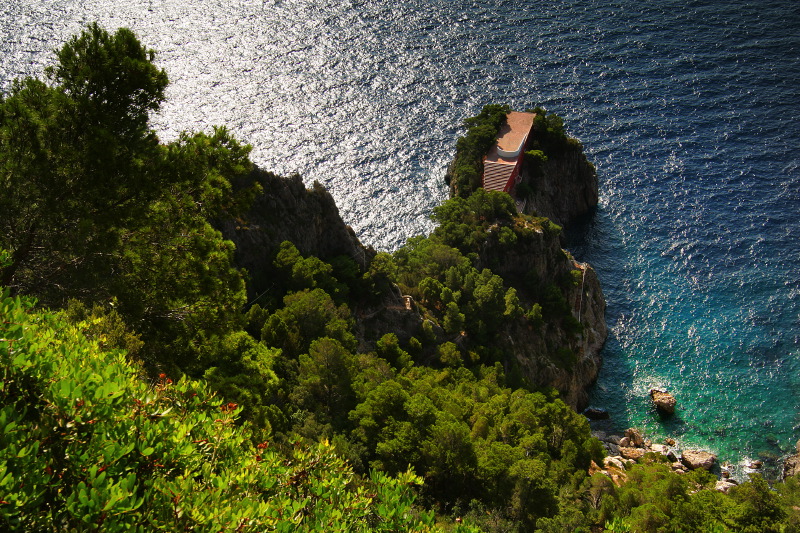
Curzio Malaparte's red house glued to the rock of Punta Massullo, with the trapezoidal stairway climbing to the roof: a scene out of Godard's Le Mépris, suspended over the sea.
Access
PRIVATE, photograph it from the Pizzolungo
The story
Villa Malaparte, or Casa Malaparte, stands alone on the promontory of Punta Massullo, sheer above the sea on the eastern side of Capri. The writer Curzio Malaparte had it built in the late 1930s: a long red parallelepiped, a famous example of Rationalist architecture, with a trapezoidal staircase that rises like an inverted pyramid to the roof-terrace. The design is linked to the architect Adalberto Libera, but the house bears above all the mark of Malaparte himself.
What to see
The unmistakable profile of the building set into the rock, with the great flight of steps and the rooftop solarium looking out over the open sea — an image made iconic by cinema, from Jean-Luc Godard's «Contempt» to «The Skin». The villa is a private residence and is not open to the public: it is admired from outside, from the Pizzolungo path or from the sea.
Tips
The house is private property and cannot be visited inside: reckon with that and enjoy it as part of the landscape. You can see it from above along the scenic Pizzolungo path, which connects the Arco Naturale to the area of the Faraglioni, or from the sea during the boat tour of the island.
Frequently asked questions
Can you visit Villa Malaparte?
No: it is a private residence and is not open to the public. It can be admired only from outside, from the Pizzolungo path or from the sea.
Who built Villa Malaparte?
The writer Curzio Malaparte wanted it, in the late 1930s; the design is linked to the architect Adalberto Libera, but the house reflects above all the ideas of Malaparte himself.
Why is Villa Malaparte famous?
For its Rationalist architecture with the trapezoidal rooftop staircase, and for cinema: it appears in Godard's «Contempt» and in «The Skin».
More gems: History & archaeology
 History & archaeology
Statua del Nilo ("Corpo di Napoli")
Largo Corpo di Napoli
A river god reclining for centuries in a quiet square, whom Neapolitans call the Corpo di Napoli: he leans his bearded head among putti and a sphinx.
 ◆ History & archaeology
Cappella Pontano
Decumani
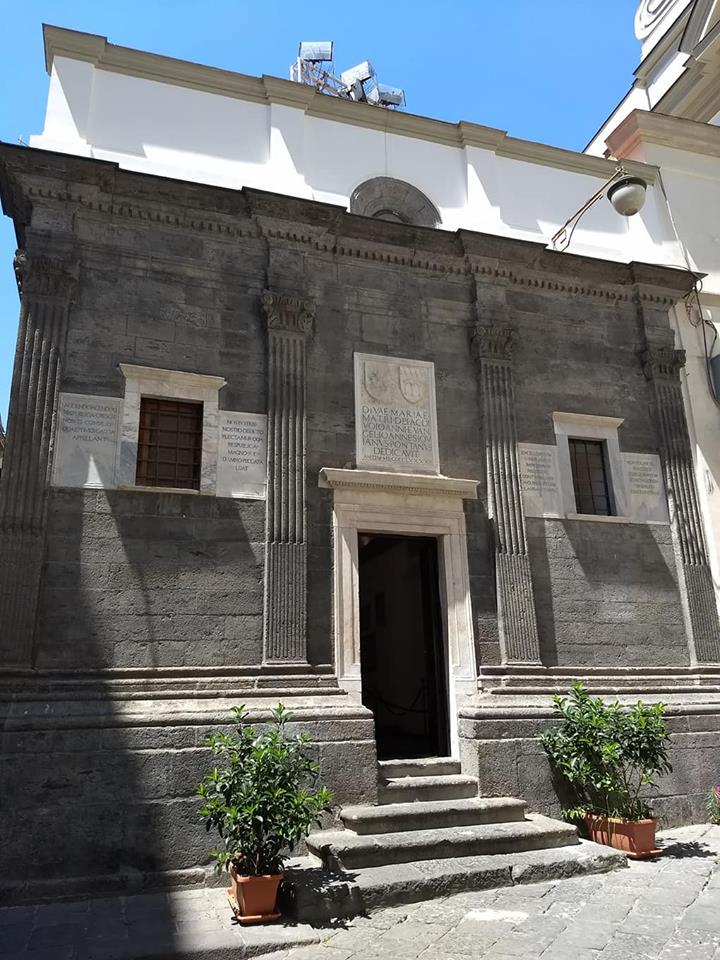
A small Renaissance temple on the decumanus, which the humanist Pontano had raised for his lost wife, still lined inside with Latin inscriptions dictated by his grief.
 ◆ History & archaeology
Sedile di Nilo
Decumani
On the corner of a small Spaccanapoli square survives the seat of the old Nilo quarter, where the nobles once gathered before the sedili of Naples vanished.
 ◆ History & archaeology
Port'Alba
Napoli
A seventeenth-century arch cut into the walls leads to the booksellers' street, where stalls of second-hand volumes pile up among yellowed pages and the shade of the old city.
 ◆ History & archaeology
Porta Capuana
zona Garibaldi
Between two cylindrical towers an arch of white marble opens like a Renaissance triumph, the old city gate facing the road to Capua.
 ◆ History & archaeology
Real Albergo dei Poveri
P.za Carlo III
An eighteenth-century colossus willed by Charles of Bourbon to shelter the poor of the Kingdom: a façade running more than three hundred metres, among the largest historic buildings in Europe.