Palazzo Mediceo
Ottaviano (NA)
Hidden gemHistory & archaeology
The story
At the foot of Vesuvius, the ancient fortress that the Medici turned into a residence dominates Ottaviano; today it houses the park authority, suspended between medieval stone and gardens in the shadow of the volcano.
Access
Check for visits
The story
The Medici Palace of Ottaviano, at the foot of Vesuvius, was born as a Lombard castle on a spur, in a strategic position over the Nola plain. In 1567 Don Bernardetto de' Medici, nephew of Cosimo the Elder, bought it and turned it from a fortress into a Renaissance princely residence: hence the branch of the Medici Princes of Ottajano.
What to see
The great palace with its historic gardens, a testimony of the Vesuvian nobility. Confiscated in 1991 and returned to the community, since 2008 it has housed on the ground floor the seat of the Vesuvius National Park Authority and an environmental education centre; the upper floor hosts cultural events.
Tips
The palace is the seat of the Vesuvius National Park and a cultural space: gardens and events have their own arrangements and hours, to be checked on the official channels of the Municipality of Ottaviano and the Park. You are at the foot of Vesuvius, a good starting point for the protected area.
Frequently asked questions
What is the Medici Palace of Ottaviano?
An ancient Lombard castle turned in the sixteenth century into a princely residence by the Medici Princes of Ottajano; today, returned to the community, it is the seat of the Vesuvius National Park Authority.
What does it house today?
On the ground floor the seat of the Vesuvius National Park and an environmental education centre; on the upper floor cultural events. The historic gardens are part of the complex.
Where is it?
At Ottaviano, at the foot of Vesuvius, in the Vesuvian hinterland east of Naples.
More gems in Ottaviano
 ◆ Nature
Monte Somma
Ottaviano
The ancient volcanic ring that embraces Vesuvius, with its jagged crests and woods of holm oak and chestnut where the noise of the city gets lost.
- ◆ Nature
Valle dell'Inferno
Ottaviano
The wild hollow between Monte Somma and the Gran Cono, among ropy lava flows and broom that in spring sets the landscape ablaze with yellow.
More gems: History & archaeology
 History & archaeology
Statua del Nilo ("Corpo di Napoli")
Largo Corpo di Napoli
A river god reclining for centuries in a quiet square, whom Neapolitans call the Corpo di Napoli: he leans his bearded head among putti and a sphinx.
 ◆ History & archaeology
Cappella Pontano
Decumani
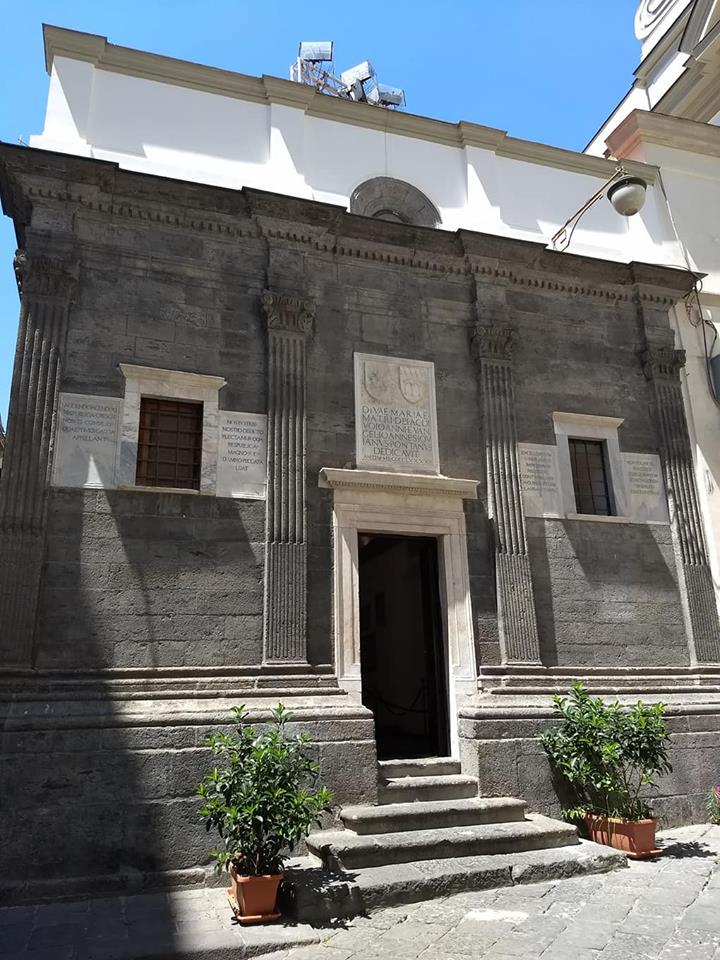
A small Renaissance temple on the decumanus, which the humanist Pontano had raised for his lost wife, still lined inside with Latin inscriptions dictated by his grief.
 ◆ History & archaeology
Sedile di Nilo
Decumani
On the corner of a small Spaccanapoli square survives the seat of the old Nilo quarter, where the nobles once gathered before the sedili of Naples vanished.
 ◆ History & archaeology
Port'Alba
Napoli
A seventeenth-century arch cut into the walls leads to the booksellers' street, where stalls of second-hand volumes pile up among yellowed pages and the shade of the old city.
 ◆ History & archaeology
Porta Capuana
zona Garibaldi
Between two cylindrical towers an arch of white marble opens like a Renaissance triumph, the old city gate facing the road to Capua.
 ◆ History & archaeology
Real Albergo dei Poveri
P.za Carlo III
An eighteenth-century colossus willed by Charles of Bourbon to shelter the poor of the Kingdom: a façade running more than three hundred metres, among the largest historic buildings in Europe.