Villa di Oplontis (Poppea)
Torre Annunziata
KnownHistory & archaeology
The story
The villa d'otium attributed to Poppaea, Nero's wife, with frescoes of illusory gardens and a great pool facing rooms whose colours are still vivid.
Access
€
The story
The Villa of Oplontis, at Torre Annunziata, is a sumptuous Roman villa of otium buried by the eruption of AD 79 together with Pompeii and Herculaneum. Tradition attributes it to Poppaea Sabina, wife of Nero, on the basis of an inscription on an amphora. It has been a UNESCO site since 1997.
What to see
Some of the most beautiful Roman frescoes of the Second Style, with illusionistic architectures in trompe l'oeil, peacocks, theatrical masks and still lifes, in spaces still legible in their grandeur. A masterpiece often less crowded than Pompeii, a stone's throw from the station.
How to get there
- Circumvesuviana
Tips
The site has its own entrance and hours, and is included in some combined tickets of the Vesuvian area: check on the official site of the Archaeological Park of Pompeii. It is a few minutes from the Circumvesuviana station of Torre Annunziata; handy to combine with Pompeii.
Frequently asked questions
What is the Villa of Oplontis?
A luxurious Roman villa at Torre Annunziata, buried by the eruption of AD 79 and attributed by tradition to Poppaea Sabina, wife of Nero; it is a UNESCO site.
What can you see at Oplontis?
Splendid Second Style frescoes with illusionistic architectures, peacocks and still lifes, in a villa less crowded than Pompeii.
How do you visit the Villa of Oplontis?
With its own entrance and hours, sometimes in combined tickets of the Vesuvian area: check on the site of the Archaeological Park of Pompeii. It is near the station of Torre Annunziata.
More gems: History & archaeology
 History & archaeology
Statua del Nilo ("Corpo di Napoli")
Largo Corpo di Napoli
A river god reclining for centuries in a quiet square, whom Neapolitans call the Corpo di Napoli: he leans his bearded head among putti and a sphinx.
 ◆ History & archaeology
Cappella Pontano
Decumani
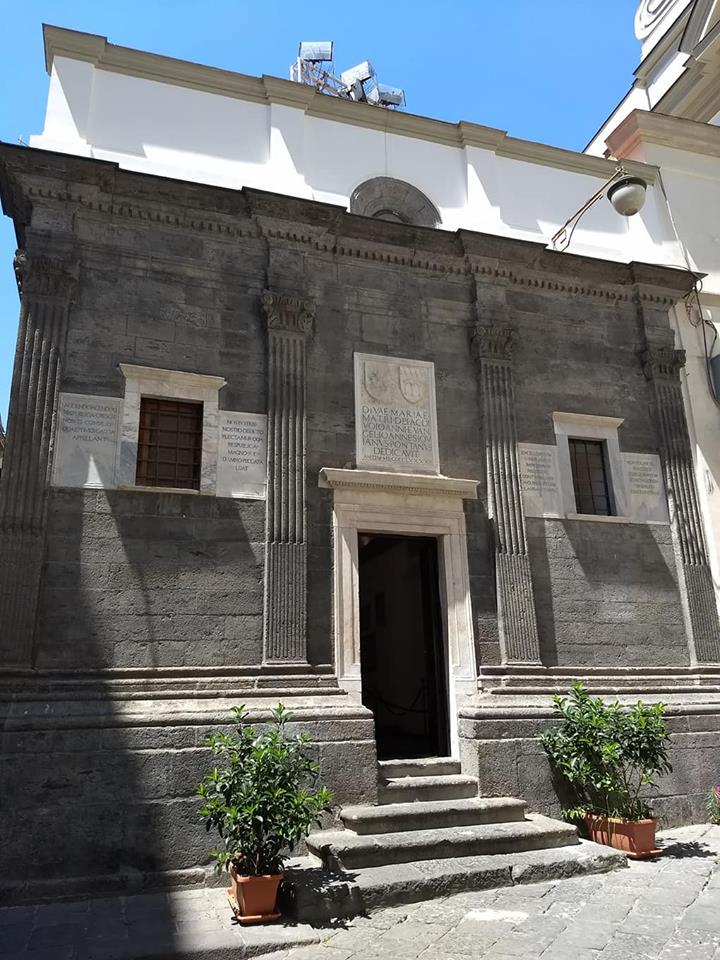
A small Renaissance temple on the decumanus, which the humanist Pontano had raised for his lost wife, still lined inside with Latin inscriptions dictated by his grief.
 ◆ History & archaeology
Sedile di Nilo
Decumani
On the corner of a small Spaccanapoli square survives the seat of the old Nilo quarter, where the nobles once gathered before the sedili of Naples vanished.
 ◆ History & archaeology
Port'Alba
Napoli
A seventeenth-century arch cut into the walls leads to the booksellers' street, where stalls of second-hand volumes pile up among yellowed pages and the shade of the old city.
 ◆ History & archaeology
Porta Capuana
zona Garibaldi
Between two cylindrical towers an arch of white marble opens like a Renaissance triumph, the old city gate facing the road to Capua.
 ◆ History & archaeology
Real Albergo dei Poveri
P.za Carlo III
An eighteenth-century colossus willed by Charles of Bourbon to shelter the poor of the Kingdom: a façade running more than three hundred metres, among the largest historic buildings in Europe.