Scavi di Ercolano
Ercolano
FamousHistory & archaeology

The story
A Roman town petrified by volcanic mud, with wooden beams, beds and doors still in place: here time stopped more intact than anywhere.
Access
€ 16, closed Wednesday, 1st Sunday free
The story
Herculaneum was buried by the eruption of Vesuvius in AD 79 together with Pompeii, but by a different blanket — mud and materials that carbonised and preserved even wood, food and fabrics. Rediscovered by chance in 1709 while digging a well, it was investigated from 1738 and then, systematically, by Amedeo Maiuri from 1927. Since 1997 it has been a UNESCO World Heritage Site.
What to see
Smaller and more compact than Pompeii, Herculaneum astonishes for its state of preservation: multi-storey houses with wooden floors, signs, furnishings, the dense web of alleys of a Roman city left as it was. Many of the most precious finds are today at the National Archaeological Museum of Naples.
How to get there
- Circumvesuviana
Tips
Reckon on a couple of hours and comfortable shoes. The site is less vast than Pompeii: ideal for those who want to understand a Roman city without the enormous distances of the Pompeian excavations. Check hours and tickets on the site of the Archaeological Park of Herculaneum. It is also easily reached by the Circumvesuviana.
Frequently asked questions
What is the difference between Herculaneum and Pompeii?
Herculaneum is smaller but preserved exceptionally well: the type of burial preserved even wood, food and organic objects, and multi-storey buildings survive.
Are the excavations of Herculaneum a UNESCO site?
Yes, since 1997, together with the ruins of Pompeii and Oplontis.
Where are the finds discovered at Herculaneum?
Many of the most important are kept at the National Archaeological Museum of Naples (MANN).
This page may contain affiliate links: if you book through them, the site earns a small commission at no extra cost to you. Trasparenza
More gems in Ercolano
 Volcanoes
Vesuvio — Gran Cono
Ercolano
The last stretch climbs on foot over the scree to the rim of the crater, where the warm breath of the earth mixes with the view of the whole Gulf of Naples.
 ◆ Museums
Museo dell'Osservatorio Vesuviano
Ercolano
The oldest volcanological observatory in the world, willed by the Bourbons in 1841, with historic instruments and mineral collections, looking out over the slopes of Vesuvius.
- ◆ History & archaeology
Miglio d'Oro e Ville Vesuviane (Villa Campolieto)
Ercolano
The eighteenth-century residences of the Neapolitan nobility along the Miglio d'Oro, with Villa Campolieto and its elliptical portico facing the sea among stuccoes and gardens.
- Hiking
Salita al Gran Cono del Vesuvio (da Quota 1000)
Ercolano (NA)
From Quota 1000 the trail climbs the ash up to the rim of the Gran Cono, where the smoking crater opens up and below stretches the whole gulf of Naples.
- Museums
MAV — Museo Archeologico Virtuale di Ercolano
Ercolano (NA)
With digital and multimedia reconstructions it brings back to life Herculaneum, Pompeii and the Vesuvian cities as they were before the eruption of AD 79.
More gems: History & archaeology
 History & archaeology
Statua del Nilo ("Corpo di Napoli")
Largo Corpo di Napoli
A river god reclining for centuries in a quiet square, whom Neapolitans call the Corpo di Napoli: he leans his bearded head among putti and a sphinx.
 ◆ History & archaeology
Cappella Pontano
Decumani
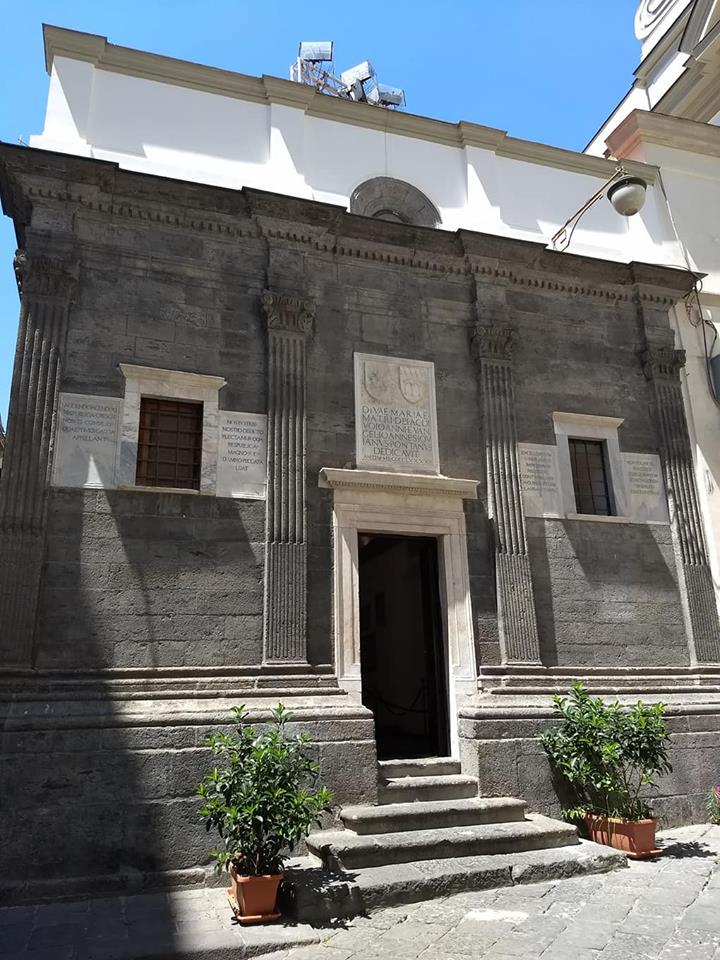
A small Renaissance temple on the decumanus, which the humanist Pontano had raised for his lost wife, still lined inside with Latin inscriptions dictated by his grief.
 ◆ History & archaeology
Sedile di Nilo
Decumani
On the corner of a small Spaccanapoli square survives the seat of the old Nilo quarter, where the nobles once gathered before the sedili of Naples vanished.
 ◆ History & archaeology
Port'Alba
Napoli
A seventeenth-century arch cut into the walls leads to the booksellers' street, where stalls of second-hand volumes pile up among yellowed pages and the shade of the old city.
 ◆ History & archaeology
Porta Capuana
zona Garibaldi
Between two cylindrical towers an arch of white marble opens like a Renaissance triumph, the old city gate facing the road to Capua.
 ◆ History & archaeology
Real Albergo dei Poveri
P.za Carlo III
An eighteenth-century colossus willed by Charles of Bourbon to shelter the poor of the Kingdom: a façade running more than three hundred metres, among the largest historic buildings in Europe.