Real Albergo dei Poveri
P.za Carlo III
Hidden gemHistory & archaeology

The story
An eighteenth-century colossus willed by Charles of Bourbon to shelter the poor of the Kingdom: a façade running more than three hundred metres, among the largest historic buildings in Europe.
Access
exterior
The story
The Real Albergo dei Poveri, also called Palazzo Fuga, is the largest monumental palace in Naples and one of the greatest eighteenth-century constructions in Europe. It was willed by Charles of Bourbon as a hospice to receive and educate the poor of the Kingdom: the works, to a design by Ferdinando Fuga, ran from 1751 to 1819. The façade is about four hundred metres long.
What to see
An immense mass — over one hundred thousand square metres — facing Piazza Carlo III, with its endless façade and the internal courtyards (three of the five planned were built). A monument to the great Bourbon season, damaged by the 1980 earthquake and for years at the centre of an imposing restoration.
Tips
The building is the subject of a great restoration and is destined for new cultural functions in the coming years: visitability is partial and tied to events and specific openings. Check on the official channels whether and what is accessible before going. You are in Piazza Carlo III, near the Botanical Garden.
Frequently asked questions
What is the Real Albergo dei Poveri?
The largest monumental palace in Naples, willed by Charles of Bourbon as a hospice for the poor, built from 1751 to a design by Ferdinando Fuga; the façade is about four hundred metres long.
Can you visit the Real Albergo dei Poveri?
It is the subject of a great restoration: visitability is partial and tied to events and specific openings. It is best to check on the official channels what is accessible.
Where is the Real Albergo dei Poveri?
In Piazza Carlo III, in Naples, near the Botanical Garden.
More gems: History & archaeology
 History & archaeology
Statua del Nilo ("Corpo di Napoli")
Largo Corpo di Napoli
A river god reclining for centuries in a quiet square, whom Neapolitans call the Corpo di Napoli: he leans his bearded head among putti and a sphinx.
 ◆ History & archaeology
Cappella Pontano
Decumani
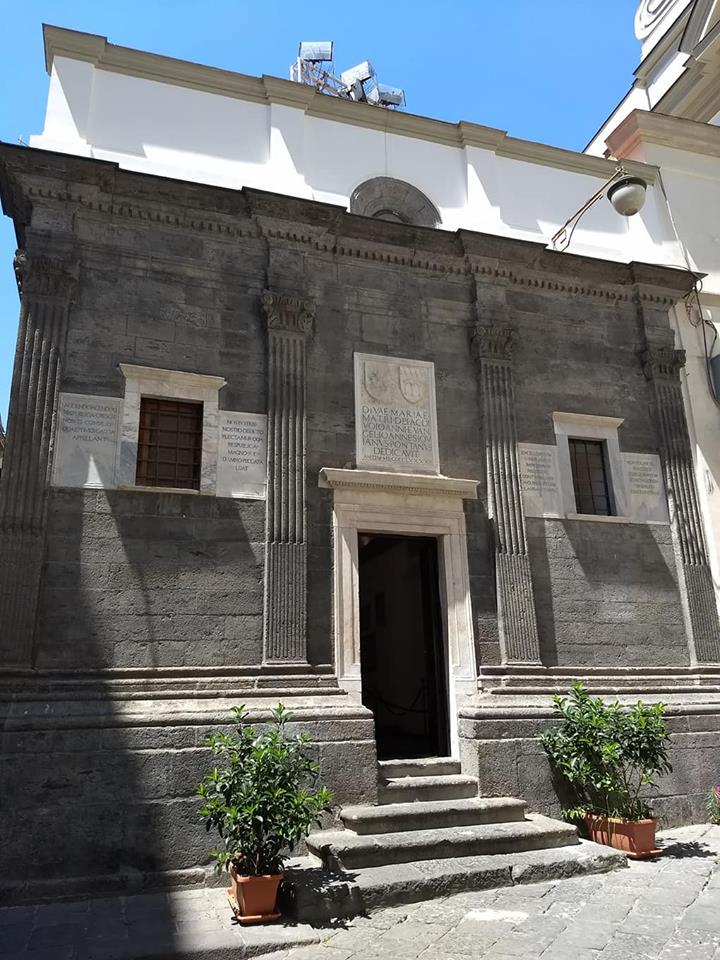
A small Renaissance temple on the decumanus, which the humanist Pontano had raised for his lost wife, still lined inside with Latin inscriptions dictated by his grief.
 ◆ History & archaeology
Sedile di Nilo
Decumani
On the corner of a small Spaccanapoli square survives the seat of the old Nilo quarter, where the nobles once gathered before the sedili of Naples vanished.
 ◆ History & archaeology
Port'Alba
Napoli
A seventeenth-century arch cut into the walls leads to the booksellers' street, where stalls of second-hand volumes pile up among yellowed pages and the shade of the old city.
 ◆ History & archaeology
Porta Capuana
zona Garibaldi
Between two cylindrical towers an arch of white marble opens like a Renaissance triumph, the old city gate facing the road to Capua.
 History & archaeology
Ipogei dei Cristallini
Sanità
Twelve metres below the Rione Sanità, Greek tombs of the 4th century BC with frescoes intact — Egyptian blues and trompe-l'oeil: Hellenistic Neapolis found again in a baron's garden.