Villa Jovis
Capri
KnownHistory & archaeology

The story
On the highest, loneliest point of the island, the ruins of the villa from which Tiberius ruled the empire for ten years, among cisterns, terraces and the emptiness of the sea all around.
Access
🎟️ combined ticket, 45 min on foot from the Piazzetta
The story
Villa Jovis, on the top of Monte Tiberio in Capri, was the largest of the villas of the emperor Tiberius, who from AD 27 withdrew there, governing the empire from the island. At three hundred and fifty-four metres above the sea, at the eastern tip of Capri, it dominated a panorama that goes from Ischia to the gulfs of Naples and Salerno.
What to see
The imposing remains of the imperial palace — residential spaces, the great water cisterns, the terracings — and the famous 'Tiberius's Leap' (Salto di Tiberio), the sheer precipice tied to the legends about the emperor. One of the most spectacular views on the island.
How to get there
- Hydrofoil
- Ferry
Tips
Villa Jovis is reached only on foot from the centre of Capri, with an uphill walk of about forty minutes along little streets and stairways: comfortable shoes and water. The site is run by the State, with its own entrance and hours: check on the official channels.
Frequently asked questions
What is Villa Jovis?
The largest villa of the emperor Tiberius in Capri, on Monte Tiberio, where he withdrew from AD 27, governing the empire from the island.
How do you reach Villa Jovis?
Only on foot from the centre of Capri, with a climb of about forty minutes among alleys and stairways; the site has its own entrance and hours.
What is Tiberius's Leap?
The sheer precipice near Villa Jovis, tied to the legends about the emperor Tiberius.
More gems in Capri
 Museums
Villa Lysis — Jago Museum Capri
Capri
A 1905 Art Nouveau villa by the poet Fersen, dedicated to love and sorrow; since June 2026 it houses the Jago Museum Capri, with Jago's sculptures in the historic rooms high above the sea.
 Nature
Arco Naturale
Capri
An arch of rock suspended among the holm oaks, sheer above the sea, all that remains of an ancient collapsed cave, at the end of a path above Matermania.
 ◆ Nature
Grotta di Matermania
Capri
A great cave that the Romans turned into a nymphaeum, with niches and traces of stucco facing the dawn, perhaps consecrated to the Magna Mater from which it takes its name.
- Views & panoramas
Salto di Tiberio
Capri
The sheer cliff beside Villa Jovis, from which legend says Tiberius had those who betrayed him thrown into the sea: three hundred metres of void beneath your feet.
- Nature
Pizzolungo
Capri
The path that runs along the hillside among the myrtle bushes, passing beneath Malaparte's house until it opens onto the Faraglioni seen from above.
- Views & panoramas
Belvedere di Tragara
Capri
At the end of the lane lined with villas and bougainvillea, the terrace where the Faraglioni line up perfectly, three rocks rising from the blue like the island's signature.
More gems: History & archaeology
 History & archaeology
Statua del Nilo ("Corpo di Napoli")
Largo Corpo di Napoli
A river god reclining for centuries in a quiet square, whom Neapolitans call the Corpo di Napoli: he leans his bearded head among putti and a sphinx.
 ◆ History & archaeology
Cappella Pontano
Decumani
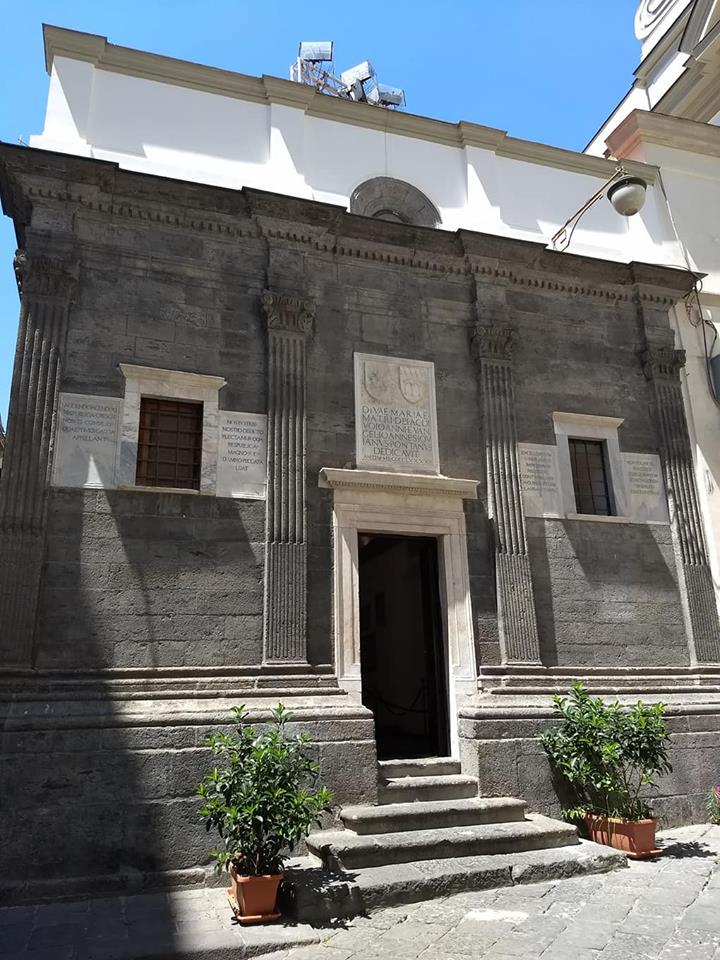
A small Renaissance temple on the decumanus, which the humanist Pontano had raised for his lost wife, still lined inside with Latin inscriptions dictated by his grief.
 ◆ History & archaeology
Sedile di Nilo
Decumani
On the corner of a small Spaccanapoli square survives the seat of the old Nilo quarter, where the nobles once gathered before the sedili of Naples vanished.
 ◆ History & archaeology
Port'Alba
Napoli
A seventeenth-century arch cut into the walls leads to the booksellers' street, where stalls of second-hand volumes pile up among yellowed pages and the shade of the old city.
 ◆ History & archaeology
Porta Capuana
zona Garibaldi
Between two cylindrical towers an arch of white marble opens like a Renaissance triumph, the old city gate facing the road to Capua.
 ◆ History & archaeology
Real Albergo dei Poveri
P.za Carlo III
An eighteenth-century colossus willed by Charles of Bourbon to shelter the poor of the Kingdom: a façade running more than three hundred metres, among the largest historic buildings in Europe.