Monte Echia / Pizzofalcone (ascensore)
S. Lucia
Hidden gemHistory & archaeology

The story
The tufo (volcanic tuff) hill where Partenope was born, the city's first nucleus: a lift rises up the cliff and at the top the gulf opens out from Santa Lucia to Vesuvius.
Access
FREE
The story
Monte Echia is the spur of yellow tuff of Pizzofalcone from which Naples was born: here, around the eighth century BC, the Greek settlers of Cumae founded the settlement of Parthenope, the first core of the city. It is the oldest balcony of Naples, suspended between Santa Lucia and Monte di Dio.
What to see
From the top, a panorama that takes in the whole gulf: Vesuvius, the Sorrento peninsula and Capri, Posillipo and, behind, the hill of Capodimonte. Beneath your feet, the tuff on which the city has grown for almost three millennia.
Tips
You climb up to Monte Echia from the Rampe di Pizzofalcone, a stairway that passes next to Villa Ebe, or by the Santa Lucia lift, inaugurated in 2024, which connects the district to the sea: handy to avoid the climb on foot. Come at sunset, when the whole gulf turns golden.
Frequently asked questions
What is Monte Echia?
The spur of tuff of Pizzofalcone where, around the eighth century BC, the Greeks founded Parthenope, the first core of Naples; today it is a belvedere over the gulf.
How do you get to Monte Echia?
On foot from the Rampe di Pizzofalcone, which pass next to Villa Ebe, or by the Santa Lucia lift inaugurated in 2024.
What can you see from Monte Echia?
The whole gulf: Vesuvius, the Sorrento peninsula, Capri, Posillipo and the hill of Capodimonte.
More gems in S. Lucia

More gems: History & archaeology
 History & archaeology
Statua del Nilo ("Corpo di Napoli")
Largo Corpo di Napoli
A river god reclining for centuries in a quiet square, whom Neapolitans call the Corpo di Napoli: he leans his bearded head among putti and a sphinx.
 ◆ History & archaeology
Cappella Pontano
Decumani
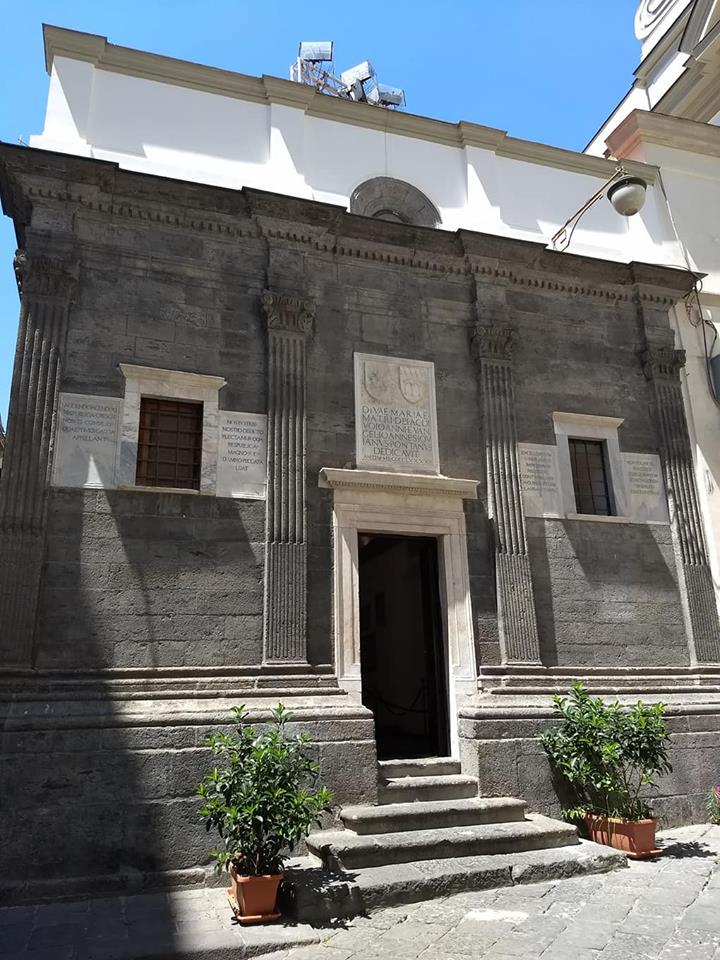
A small Renaissance temple on the decumanus, which the humanist Pontano had raised for his lost wife, still lined inside with Latin inscriptions dictated by his grief.
 ◆ History & archaeology
Sedile di Nilo
Decumani
On the corner of a small Spaccanapoli square survives the seat of the old Nilo quarter, where the nobles once gathered before the sedili of Naples vanished.
 ◆ History & archaeology
Port'Alba
Napoli
A seventeenth-century arch cut into the walls leads to the booksellers' street, where stalls of second-hand volumes pile up among yellowed pages and the shade of the old city.
 ◆ History & archaeology
Porta Capuana
zona Garibaldi
Between two cylindrical towers an arch of white marble opens like a Renaissance triumph, the old city gate facing the road to Capua.
 ◆ History & archaeology
Real Albergo dei Poveri
P.za Carlo III
An eighteenth-century colossus willed by Charles of Bourbon to shelter the poor of the Kingdom: a façade running more than three hundred metres, among the largest historic buildings in Europe.