Parco di Cuma
Bacoli
KnownHistory & archaeology

The story
The oldest Greek colony in Italy, with the temples of Apollo and Jupiter stretched across the acropolis between pines and sea, where history begins in silence.
Access
€
The story
Cumae was the oldest Greek colony of mainland Italy: founded by settlers from Chalcis, from here Parthenope and then Neapolis were born. For centuries a power of the Tyrrhenian, it later fell under the Samnites and the Romans. Its excavations, on the acropolis facing the sea, are part of the Archaeological Park of the Campi Flegrei.
What to see
The acropolis keeps the remains of the temples of Apollo and Jupiter, turned into early-Christian basilicas, and the Cave of the Sibyl carved into the tuff. From above, the panorama sweeps over the Flegrean coastline. It is the place where Greece set foot in Italy.
Tips
It is an open-air archaeological park, with ups and downs: comfortable shoes, water and a hat in summer. Check openings and ticket on the official channels, bearing in mind the Flegrean bradyseism. To be combined with the Cave of the Sibyl, which is here, and the other sites of the Campi Flegrei.
Frequently asked questions
Why is Cumae important?
It is the oldest Greek colony of mainland Italy: from here Parthenope and Neapolis, today's Naples, were born.
What is there to see in the Park of Cumae?
The acropolis with the temples of Apollo and Jupiter and the Cave of the Sibyl, facing the Flegrean coastline.
Where is Cumae?
In the territory of Pozzuoli, in the area of the Campi Flegrei.
More gems in Bacoli
 History & archaeology
Antro della Sibilla
Bacoli
A long trapezoidal corridor carved into the tufo (volcanic tuff), cut by blades of light, where Virgil imagined the Sibyl prophesying among the shadows of the rock.
 ◆ History & archaeology
Cento Camerelle
Bacoli
A labyrinth of cisterns on two levels dug into the tufo (volcanic tuff), also called Carceri di Nerone, where Roman water ran beneath a villa facing the gulf.
 In the water & diving
Parco Sommerso di Baia
Bacoli
A Roman city swallowed by the sea through bradyseism: mosaics, columns and statues visited from a glass-bottomed boat or with a mask.
 History & archaeology
Terme di Baia e Castello Aragonese (Museo Campi Flegrei)
Bacoli
Terraces of imperial baths descending towards the sea, and above them the Castello Aragonese guards the statues brought back up from the sunken Baia.
- Castles
Castello di Baia
Bacoli (NA)
On the high promontory sheer above the gulf, the Aragonese castle guards the statues resurfaced from the submerged Roman city of the Campi Flegrei.
- ◆ History & archaeology
Tomba di Agrippina
Bacoli
Not a tomb at all but the remains of a small Roman theatre by the sea, tied by legend to Agrippina, mother of Nero, killed at Bauli.
More gems: History & archaeology
 History & archaeology
Statua del Nilo ("Corpo di Napoli")
Largo Corpo di Napoli
A river god reclining for centuries in a quiet square, whom Neapolitans call the Corpo di Napoli: he leans his bearded head among putti and a sphinx.
 ◆ History & archaeology
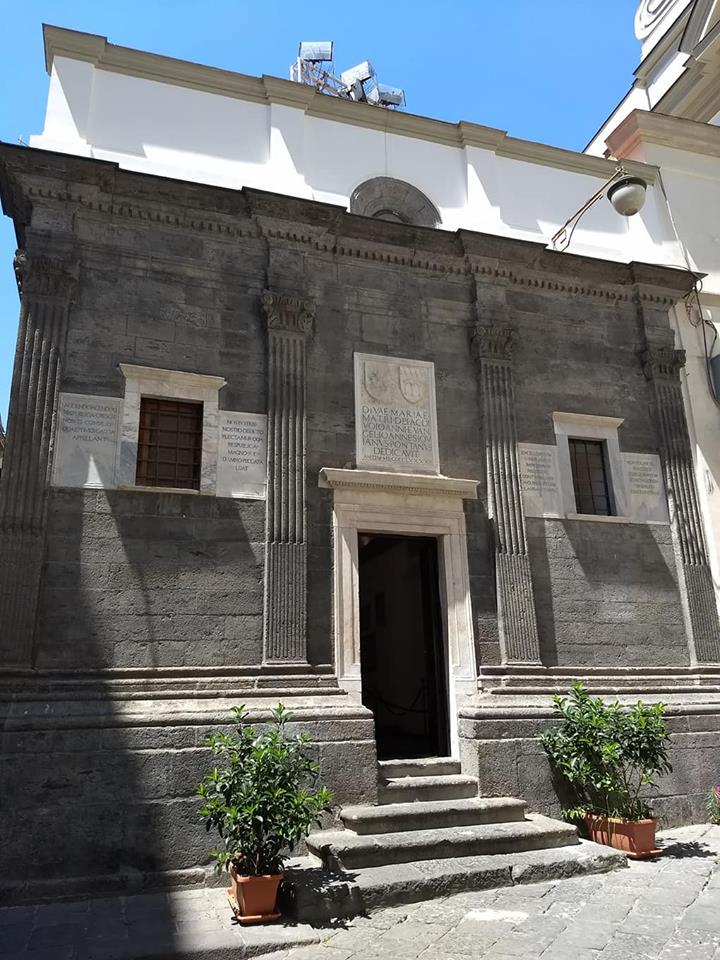
Cappella Pontano
Decumani
A small Renaissance temple on the decumanus, which the humanist Pontano had raised for his lost wife, still lined inside with Latin inscriptions dictated by his grief.
 ◆ History & archaeology
Sedile di Nilo
Decumani
On the corner of a small Spaccanapoli square survives the seat of the old Nilo quarter, where the nobles once gathered before the sedili of Naples vanished.
 ◆ History & archaeology
Port'Alba
Napoli
A seventeenth-century arch cut into the walls leads to the booksellers' street, where stalls of second-hand volumes pile up among yellowed pages and the shade of the old city.
 ◆ History & archaeology
Porta Capuana
zona Garibaldi
Between two cylindrical towers an arch of white marble opens like a Renaissance triumph, the old city gate facing the road to Capua.
 ◆ History & archaeology
Real Albergo dei Poveri
P.za Carlo III
An eighteenth-century colossus willed by Charles of Bourbon to shelter the poor of the Kingdom: a façade running more than three hundred metres, among the largest historic buildings in Europe.