Scoglio del Monacone
Capri
FamousNature
The story
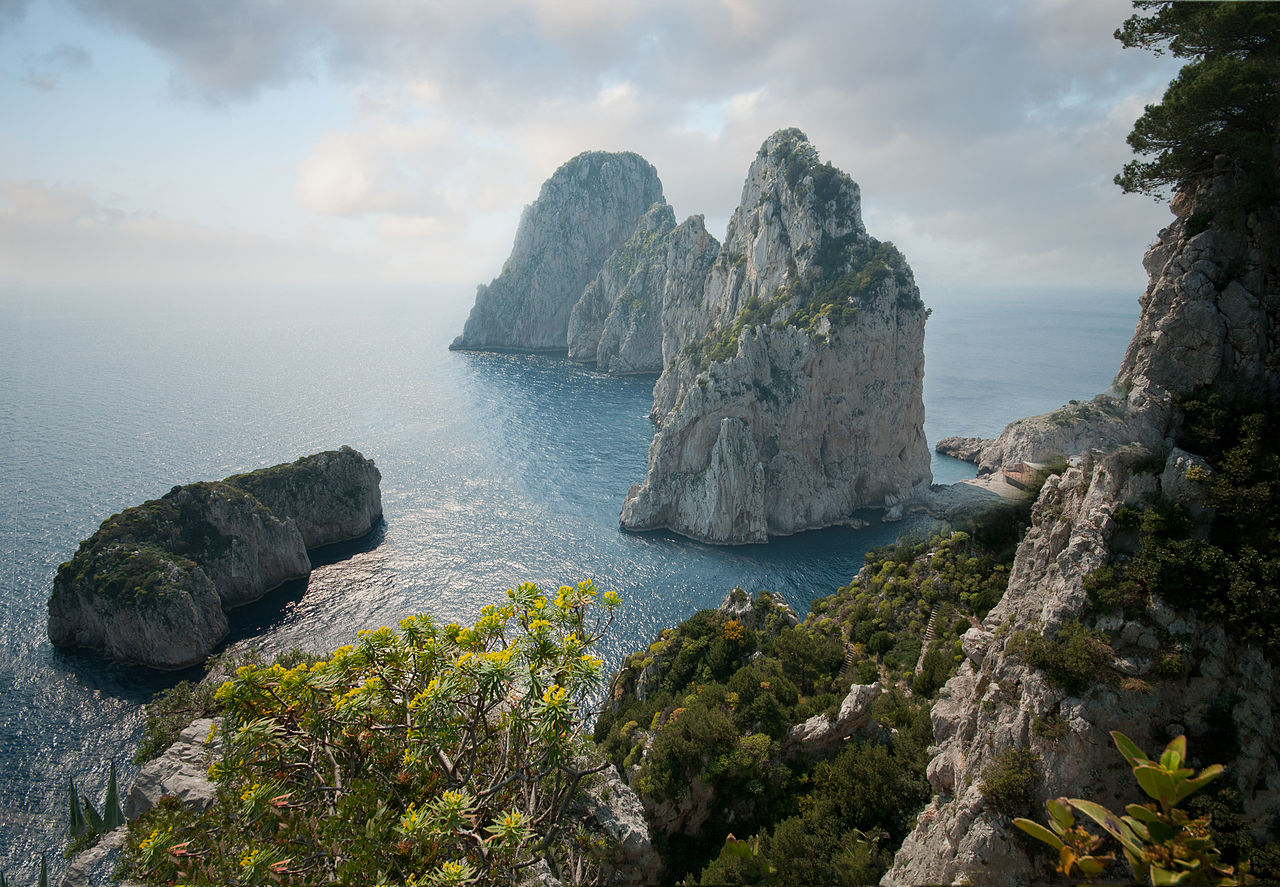
A solitary rock just beyond the Faraglioni, isolated in the deep blue, sought out by those after a swim far from the crowds and the beaten routes.
Access
by sea
The story
The Scoglio del Monacone is the isolated rock that rises from the sea just beyond the Faraglioni, in front of Punta Tragara. Its name recalls the monk seal (in Italian «foca monaca», the source of «Monacone»), which once frequented these waters and survived here until the early twentieth century. On the rock remain traces of Roman structures, perhaps fish tanks or works connected to the age of Augustus.
What to see
A solitary mass of rock, often less photographed than the three Faraglioni but part of the same scene, with the ancient remains emerging on its top and the sea breaking around it. It is seen from above at the Belvedere di Tragara, in line with the Faraglioni, or up close during the boat tour of the island.
How to get there
- Hydrofoil
- Ferry
Hours and prices
Free entry.
Tips
The rock cannot be visited: it is a feature of the landscape, to be looked at from above or from the sea. From the Belvedere di Tragara, reachable on foot from Capri, it lines up with the Faraglioni; to see it up close you need a boat excursion, which usually also includes the passage under the arch of the middle Faraglione.
Frequently asked questions
What is the Scoglio del Monacone?
An isolated rock in the sea off Capri, just beyond the Faraglioni, in front of Punta Tragara, with the remains of Roman structures on its top.
Why is it called Monacone?
The name recalls the monk seal, once present in these waters, where it survived until the early twentieth century.
How can you see the Scoglio del Monacone?
From above at the Belvedere di Tragara, aligned with the Faraglioni, or up close during the boat tour of the island.
More gems in Capri
 History & archaeology
Villa Jovis
Capri
On the highest, loneliest point of the island, the ruins of the villa from which Tiberius ruled the empire for ten years, among cisterns, terraces and the emptiness of the sea all around.
 Museums
Villa Lysis — Jago Museum Capri
Capri
A 1905 Art Nouveau villa by the poet Fersen, dedicated to love and sorrow; since June 2026 it houses the Jago Museum Capri, with Jago's sculptures in the historic rooms high above the sea.
 Nature
Arco Naturale
Capri
An arch of rock suspended among the holm oaks, sheer above the sea, all that remains of an ancient collapsed cave, at the end of a path above Matermania.
 ◆ Nature
Grotta di Matermania
Capri
A great cave that the Romans turned into a nymphaeum, with niches and traces of stucco facing the dawn, perhaps consecrated to the Magna Mater from which it takes its name.
- Views & panoramas
Salto di Tiberio
Capri
The sheer cliff beside Villa Jovis, from which legend says Tiberius had those who betrayed him thrown into the sea: three hundred metres of void beneath your feet.
- Nature
Pizzolungo
Capri
The path that runs along the hillside among the myrtle bushes, passing beneath Malaparte's house until it opens onto the Faraglioni seen from above.
More gems: Nature
 ◆ Nature
Orto Botanico
via Foria
Founded in the Napoleonic age, the botanical garden on via Foria lines up glasshouses, palms and rare species across twelve hectares: a green breath a step away from the traffic.
 ◆ Nature
Pedamentina di San Martino
Vomero→centro
A fourteenth-century stairway dropping from the hill of San Martino down to the city: hundreds of steps through vegetable plots, gardens and glimpses of the bay — one of the finest urban paths in Naples.
 Nature
Villa Comunale
Riviera di Chiaia
The garden stretched out along the sea at Chiaia: avenues of holm oaks, benches and old statues, with the gulf breathing beyond the iron railing.
 Nature
Acquario Anton Dohrn
Riviera di Chiaia
The oldest aquarium in Europe, opened in 1874 inside the Villa Comunale: historic tanks inhabited only by the fauna of the Gulf of Naples, behind the glass.
 Nature
Solfatara
Pozzuoli
The ground breathes: hissing fumaroles, mud that boils up and a smell of sulphur reminding you how alive the earth is beneath the Campi Flegrei.
- ◆ Nature
Vigna di San Martino
collina S. Martino
One of the largest urban vineyards in Europe, worked by the Carthusians since the fourteenth century: seven hectares of vines, citrus and olive trees hanging over the bay, a step from the city's chaos.