Palazzo Sanfelice
Sanità
KnownHistory & archaeology

The story
In the heart of the Sanità, Ferdinando Sanfelice signed his hawk-wing staircase: a baroque set piece of open flights, chosen again and again by the cinema for its theatrical sweep.
Access
courtyards FREE
The story
The Palazzo Sanfelice, in the Rione Sanità, was designed between 1724 and 1728 by the architect Ferdinando Sanfelice as a residence for himself and his family, in an area then healthier than the crowded centre. It is famous above all for its staircase.
What to see
The masterpiece is the open double-flight staircase, called 'hawk-wing': a scenic invention by Sanfelice that turns the courtyard into a theatre, with the flights that cross in perspective. It is one of the most photographed Baroque staircases in Naples.
Tips
The palace is inhabited: the staircase is admired from the courtyard, with discretion and respect for the residents. You are in the Rione Sanità, a stone's throw from the Palazzo dello Spagnolo, which has a similar staircase: it is worth comparing them.
Frequently asked questions
What is the 'hawk-wing' staircase of the Palazzo Sanfelice?
An open double-flight staircase, a scenic invention by Ferdinando Sanfelice, which makes the courtyard a stage; it is among the most famous in Naples.
Who designed the Palazzo Sanfelice?
The architect Ferdinando Sanfelice, between 1724 and 1728, as his own residence.
Where is the Palazzo Sanfelice?
In the Rione Sanità, in Naples.
More gems in Sanità
 History & archaeology
Ipogei dei Cristallini
Sanità
Twelve metres below the Rione Sanità, Greek tombs of the 4th century BC with frescoes intact — Egyptian blues and trompe-l'oeil: Hellenistic Neapolis found again in a baron's garden.
 ◆ Sacred art
Chiesa di Santa Maria della Sanità
Sanità
Fra Nuvolo's basilica keeps watch over the quarter it gives its name to: dedicated to San Vincenzo, 'o Munacone to Neapolitans, it holds the Catacombe di San Gaudioso beneath it.
 ◆ Sacred art
Basilica di San Gennaro extra Moenia
Sanità
Outside the ancient walls, beside the catacombs that once held the body of San Gennaro: one of the oldest churches in Naples, in the shade of the Capodimonte hill.
- ◆ Sacred art
Presepe Favoloso
Sanità
In the sacristy of the basilica of the Sanità the Scuotto brothers have lit up more than a hundred figures: a presepe (nativity scene) where eighteenth-century tradition and fairy tale interlace, suspended between the sacred and sheer wonder.
More gems: History & archaeology
 History & archaeology
Statua del Nilo ("Corpo di Napoli")
Largo Corpo di Napoli
A river god reclining for centuries in a quiet square, whom Neapolitans call the Corpo di Napoli: he leans his bearded head among putti and a sphinx.
 ◆ History & archaeology
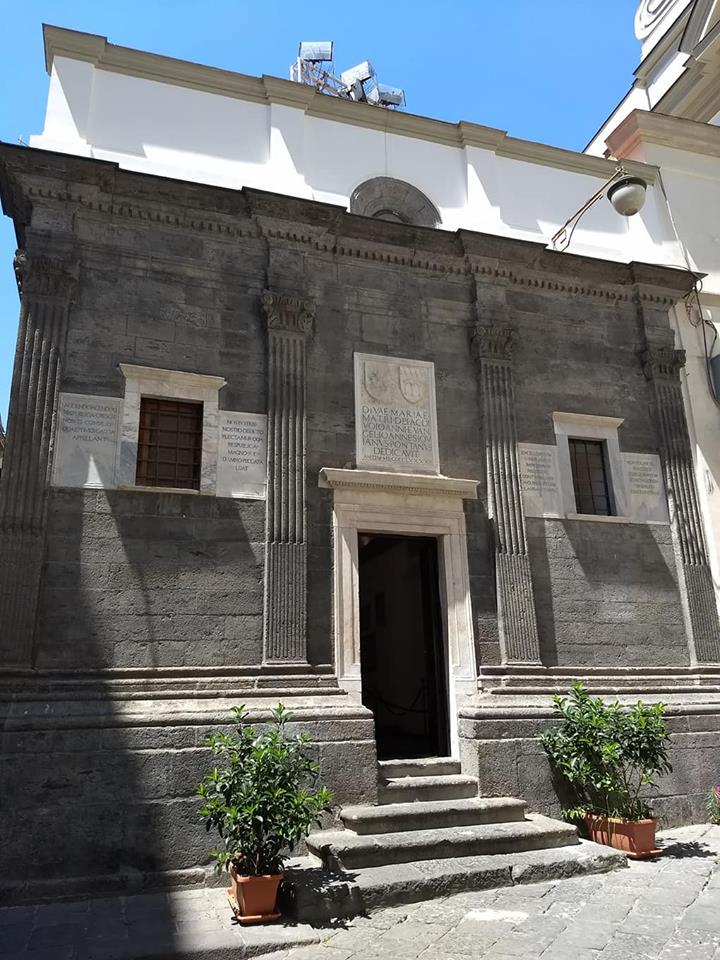
Cappella Pontano
Decumani
A small Renaissance temple on the decumanus, which the humanist Pontano had raised for his lost wife, still lined inside with Latin inscriptions dictated by his grief.
 ◆ History & archaeology
Sedile di Nilo
Decumani
On the corner of a small Spaccanapoli square survives the seat of the old Nilo quarter, where the nobles once gathered before the sedili of Naples vanished.
 ◆ History & archaeology
Port'Alba
Napoli
A seventeenth-century arch cut into the walls leads to the booksellers' street, where stalls of second-hand volumes pile up among yellowed pages and the shade of the old city.
 ◆ History & archaeology
Porta Capuana
zona Garibaldi
Between two cylindrical towers an arch of white marble opens like a Renaissance triumph, the old city gate facing the road to Capua.
 ◆ History & archaeology
Real Albergo dei Poveri
P.za Carlo III
An eighteenth-century colossus willed by Charles of Bourbon to shelter the poor of the Kingdom: a façade running more than three hundred metres, among the largest historic buildings in Europe.