Grotta di Seiano
Posillipo
Hidden gemHistory & archaeology
The story
A Roman tunnel nearly eight hundred metres long bores through the hill in the dark, then opens onto the light of the Gaiola valley and the villa of Pausilypon.
Access
free with guided tour, closed Tuesdays
The story
The Grotta di Seiano is a Roman gallery of the Augustan age, about seven hundred and seventy metres long, dug into the tuff of the Posillipo hill to connect the plain of Bagnoli to the valley of the Gaiola and the villa of the Pausilypon. Forgotten for centuries, it was rediscovered in 1841 and restored by order of Ferdinand II of Bourbon; during the war it served as an air-raid shelter.
What to see
The long tunnel dug into the rock, with the light wells that open towards the sea, is already an experience in itself: one of the most imposing Roman passages of the city, which emerges into the archaeological park of the Pausilypon and onto the Baia di Trentaremi.
Tips
The grotto is the access to the park of the Pausilypon and is walked as part of the guided tour: check days, hours and booking on the official site. It is a long and partly dark tunnel; comfortable shoes are useful. The entrance is at the Discesa Coroglio, at Posillipo.
Frequently asked questions
What is the Grotta di Seiano?
A Roman gallery of the Augustan age about 770 metres long, dug into the tuff of Posillipo to reach the villa of the Pausilypon; rediscovered in the nineteenth century under Ferdinand II of Bourbon.
Where does the Grotta di Seiano lead?
It crosses the hill to the archaeological park of the Pausilypon and the Baia di Trentaremi, on the sea side of Posillipo.
How do you visit it?
As part of the guided tour of the Pausilypon, with days and hours to be checked on the official site; the entrance is at the Discesa Coroglio.
More gems in Posillipo
 Views & panoramas
Parco Virgiliano
Posillipo
At the far end of Posillipo the terraces look out over the islet of Nisida and the open sea: from here the eye takes in the whole gulf and the Campi Flegrei.
 ◆ History & archaeology
Parco Archeologico del Pausilypon
Posillipo
The imperial villa of Vedius Pollio looking over the Gaiola: theatre and odeion among the pines, there where the Romans called this place the pause from pain.
 Views & panoramas
Marechiaro e la Fenestella
Posillipo
The fishing borgo (old village) where Salvatore Di Giacomo imagined the fenestella with its carnation: below, the shallow water and Vesuvius closing the horizon.
 ◆ Castles
Palazzo Donn'Anna
Posillipo
The unfinished seventeenth-century palace juts sheer over the water, dark and labyrinthine: through its empty rooms legend has the shadow of Donn'Anna still wandering.
- Views & panoramas
Terrazza di Sant'Antonio (tredici scese)
Posillipo
Thirteen flights of steps climb to the terrace of Sant'Antonio, where the gulf lines up like a postcard: Vesuvius, sea and city in a single glance.
- Views & panoramas
Via Petrarca / Via Orazio
Posillipo
The two roads run halfway up the hill of Posillipo, natural terraces suspended over the gulf: little villas, bougainvillea and the sea appearing between one bend and the next.
More gems: History & archaeology
 History & archaeology
Statua del Nilo ("Corpo di Napoli")
Largo Corpo di Napoli
A river god reclining for centuries in a quiet square, whom Neapolitans call the Corpo di Napoli: he leans his bearded head among putti and a sphinx.
 ◆ History & archaeology
Cappella Pontano
Decumani
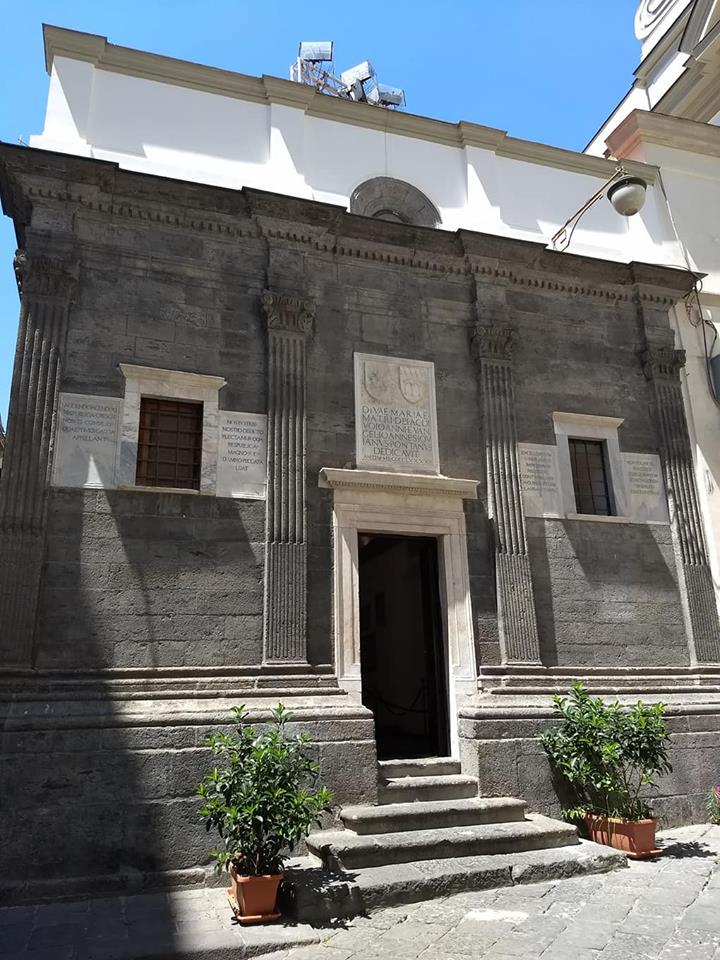
A small Renaissance temple on the decumanus, which the humanist Pontano had raised for his lost wife, still lined inside with Latin inscriptions dictated by his grief.
 ◆ History & archaeology
Sedile di Nilo
Decumani
On the corner of a small Spaccanapoli square survives the seat of the old Nilo quarter, where the nobles once gathered before the sedili of Naples vanished.
 ◆ History & archaeology
Port'Alba
Napoli
A seventeenth-century arch cut into the walls leads to the booksellers' street, where stalls of second-hand volumes pile up among yellowed pages and the shade of the old city.
 ◆ History & archaeology
Porta Capuana
zona Garibaldi
Between two cylindrical towers an arch of white marble opens like a Renaissance triumph, the old city gate facing the road to Capua.
 ◆ History & archaeology
Real Albergo dei Poveri
P.za Carlo III
An eighteenth-century colossus willed by Charles of Bourbon to shelter the poor of the Kingdom: a façade running more than three hundred metres, among the largest historic buildings in Europe.