Anfiteatro Flavio
Pozzuoli
KnownHistory & archaeology

The story
The third largest Roman amphitheatre, at Pozzuoli: above ground the tiers, but it is underground that it strikes you, in the intact passages from which the beasts rose.
Access
€
The story
The Flavian Amphitheatre of Pozzuoli, built in the second half of the first century AD, is by capacity the third Roman amphitheatre in Italy, after the Colosseum and the Campano Amphitheatre of Capua. Pozzuoli — the ancient Puteoli, a great commercial harbour — was the only Roman city besides Rome to have as many as two of them.
What to see
The highlight is the underground level: the whole system of corridors, carceres and spaces beneath the arena, among the best preserved in the Roman world, where the stage machinery was prepared and the beasts were kept. Above, the ellipse of the tiers tells of the greatness of imperial Puteoli.
How to get there
- Cumana
- Metro
Tips
The Campi Flegrei are an active volcanic area (bradyseism): before going, check the opening status on the official channels of the Archaeological Park, because there may be temporary closures. The ticket is often integrated with the other Flegrean sites, with online purchase recommended. It is easily reached by metro or Cumana.
Frequently asked questions
How large is the Flavian Amphitheatre of Pozzuoli?
It is the third Roman amphitheatre in Italy by capacity, after the Colosseum and the Campano Amphitheatre of Capua.
What is there to see at the Flavian Amphitheatre?
Above all the underground level beneath the arena, among the best preserved in the Roman world.
Is the Flavian Amphitheatre always open?
The Flegrean area is subject to bradyseism and possible temporary closures: always check the opening status on the official channels of the Archaeological Park of the Campi Flegrei.
More gems in Pozzuoli
 History & archaeology
Tempio di Serapide (Macellum)
Pozzuoli
Not a temple but the ancient Roman market: on the marble columns the holes bored by marine molluscs tell how much the Flegrean ground has risen and sunk over the centuries.
 Nature
Solfatara
Pozzuoli
The ground breathes: hissing fumaroles, mud that boils up and a smell of sulphur reminding you how alive the earth is beneath the Campi Flegrei.
 Villages
Rione Terra
Pozzuoli (NA)
On the acropolis of Pozzuoli, evacuated in 1970 because of bradyseism, the Rione Terra guards beneath its houses an intact Roman town of streets, workshops and paved hinges.
 Nature
Lago d'Averno
Pozzuoli (NA)
In the extinct crater of a volcano, the still waters of Averno: for the ancients the threshold of the underworld, the one Aeneas crossed to descend into the kingdom of shadows.
 ◆ Volcanoes
Monte Nuovo
Pozzuoli (NA)
Born in a single night from a sixteenth-century eruption, the youngest mountain of the Campi Flegrei holds within its crater a green silence looking out over the gulf of Pozzuoli.
More gems: History & archaeology
 History & archaeology
Statua del Nilo ("Corpo di Napoli")
Largo Corpo di Napoli
A river god reclining for centuries in a quiet square, whom Neapolitans call the Corpo di Napoli: he leans his bearded head among putti and a sphinx.
 ◆ History & archaeology
Cappella Pontano
Decumani
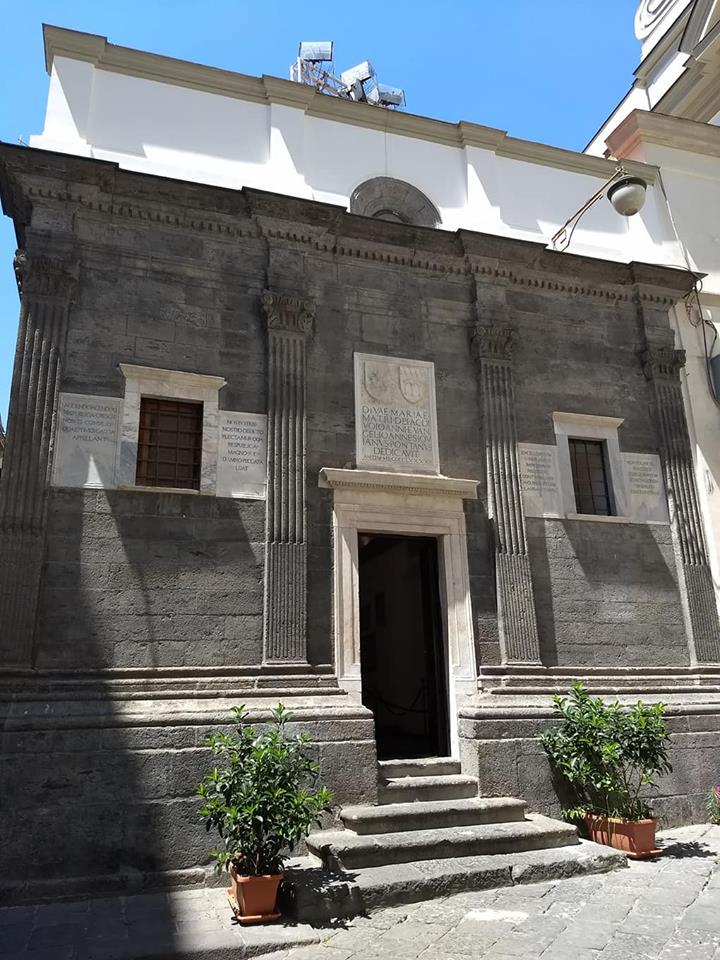
A small Renaissance temple on the decumanus, which the humanist Pontano had raised for his lost wife, still lined inside with Latin inscriptions dictated by his grief.
 ◆ History & archaeology
Sedile di Nilo
Decumani
On the corner of a small Spaccanapoli square survives the seat of the old Nilo quarter, where the nobles once gathered before the sedili of Naples vanished.
 ◆ History & archaeology
Port'Alba
Napoli
A seventeenth-century arch cut into the walls leads to the booksellers' street, where stalls of second-hand volumes pile up among yellowed pages and the shade of the old city.
 ◆ History & archaeology
Porta Capuana
zona Garibaldi
Between two cylindrical towers an arch of white marble opens like a Renaissance triumph, the old city gate facing the road to Capua.
 ◆ History & archaeology
Real Albergo dei Poveri
P.za Carlo III
An eighteenth-century colossus willed by Charles of Bourbon to shelter the poor of the Kingdom: a façade running more than three hundred metres, among the largest historic buildings in Europe.