Statua del Nilo ("Corpo di Napoli")
Largo Corpo di Napoli
KnownHistory & archaeology

The story
A river god reclining for centuries in a quiet square, whom Neapolitans call the Corpo di Napoli: he leans his bearded head among putti and a sphinx.
Access
FREE
The story
The Statue of the Nile, which the Neapolitans call 'the Body of Naples', is a Roman sculpture of the mid-second century that depicts the god Nile as an old man reclining, with the cornucopia. It was erected by the Alexandrian merchants who in Greek-Roman times inhabited this area — the Regio Nilensis — in honour of the river of their land. Long left without a head, in the Middle Ages it was interpreted as a mother nursing, and from this the name given to the square.
What to see
The reclining marble figure, with the putti and the symbols of the river, in a small square of the old centre. The bearded head was added in the seventeenth century; the small original sphinx, stolen after the war, was recovered in Austria and put back in 2014.
Tips
The statue is in the open, in Largo Corpo di Napoli, along the lower decumanus: you see it freely while strolling in the old centre. It is a good point to understand how stratified Naples is. To be combined with nearby San Domenico Maggiore and the churches of the Tribunali.
Frequently asked questions
Why is the Statue of the Nile called the 'Body of Naples'?
Because in the Middle Ages, headless and with the putti, it was interpreted as the mother-city nursing her children, and it gave the name to the square.
What does the statue represent?
The god Nile, reclining like an old man with the cornucopia: a Roman sculpture erected by the Alexandrian merchants who inhabited the area in Greek-Roman times.
Where is the Statue of the Nile?
In Largo Corpo di Napoli, in the old centre, along the lower decumanus.
More gems: History & archaeology
 ◆ History & archaeology
Cappella Pontano
Decumani
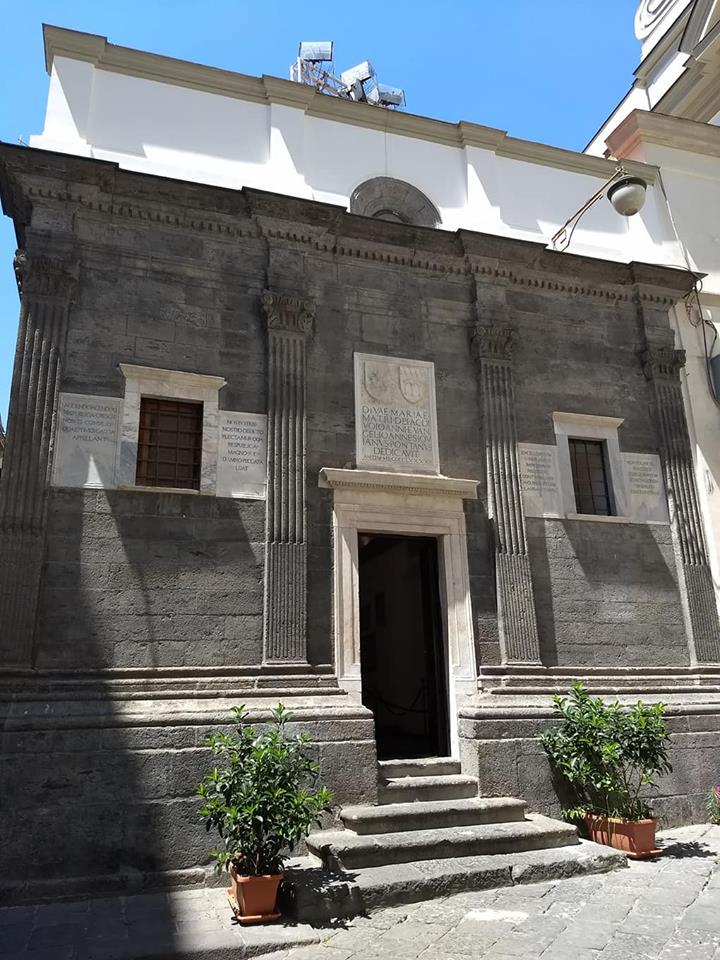
A small Renaissance temple on the decumanus, which the humanist Pontano had raised for his lost wife, still lined inside with Latin inscriptions dictated by his grief.
 ◆ History & archaeology
Sedile di Nilo
Decumani
On the corner of a small Spaccanapoli square survives the seat of the old Nilo quarter, where the nobles once gathered before the sedili of Naples vanished.
 ◆ History & archaeology
Port'Alba
Napoli
A seventeenth-century arch cut into the walls leads to the booksellers' street, where stalls of second-hand volumes pile up among yellowed pages and the shade of the old city.
 ◆ History & archaeology
Porta Capuana
zona Garibaldi
Between two cylindrical towers an arch of white marble opens like a Renaissance triumph, the old city gate facing the road to Capua.
 ◆ History & archaeology
Real Albergo dei Poveri
P.za Carlo III
An eighteenth-century colossus willed by Charles of Bourbon to shelter the poor of the Kingdom: a façade running more than three hundred metres, among the largest historic buildings in Europe.
 History & archaeology
Ipogei dei Cristallini
Sanità
Twelve metres below the Rione Sanità, Greek tombs of the 4th century BC with frescoes intact — Egyptian blues and trompe-l'oeil: Hellenistic Neapolis found again in a baron's garden.