Teatro San Carlo
centro
FamousHistory & archaeology

The story
The red and gold of the oldest working opera house in Europe, where since the eighteenth century the voice has risen towards the frescoed ceiling and the royal box.
Access
guided tours €/FREE
The story
The Real Teatro di San Carlo, founded in 1737, is the opera house of Naples and one of the oldest opera theatres in the world still in activity: it predates La Scala in Milan by forty-one years. It was willed as a symbol of a Naples that laid claim to its rank as a great European capital.
What to see
The auditorium, horseshoe-shaped with five tiers of boxes and the wide royal box, is a masterpiece that served as a model for the theatres of Europe. It was among the first in Italy to have its own ballet school. It can also be visited by day, but the truest way to experience it is a performance.
Tips
For daytime guided tours and for the opera and ballet programme, check the official site. It is next to the Royal Palace and the Galleria Umberto: a triangle of monuments a stone's throw from one another. If you love opera, attending an evening at the San Carlo is an experience in itself.
Frequently asked questions
How old is the Teatro San Carlo?
It was founded in 1737: it is among the oldest opera theatres in the world still in activity, and predates La Scala in Milan by 41 years.
Can you visit the Teatro San Carlo by day?
Yes, with guided tours: check hours and availability on the official site, along with the programme of performances.
Where is the Teatro San Carlo?
In the heart of Naples, next to the Royal Palace and the Galleria Umberto I.
More gems in centro
 History & archaeology
Piazza del Plebiscito
centro
The great square opens between the colonnade of the basilica of San Francesco di Paola and the Palazzo Reale: a hemicycle, equestrian statues and an emptiness that in Naples is close to a miracle.
 History & archaeology
Galleria Umberto I
centro
Beneath the dome of glass and iron the light falls on the marble floor; footsteps and echoes get lost in the octagon, among the shopfronts of the late nineteenth century.
More gems: History & archaeology
 History & archaeology
Statua del Nilo ("Corpo di Napoli")
Largo Corpo di Napoli
A river god reclining for centuries in a quiet square, whom Neapolitans call the Corpo di Napoli: he leans his bearded head among putti and a sphinx.
 ◆ History & archaeology
Cappella Pontano
Decumani
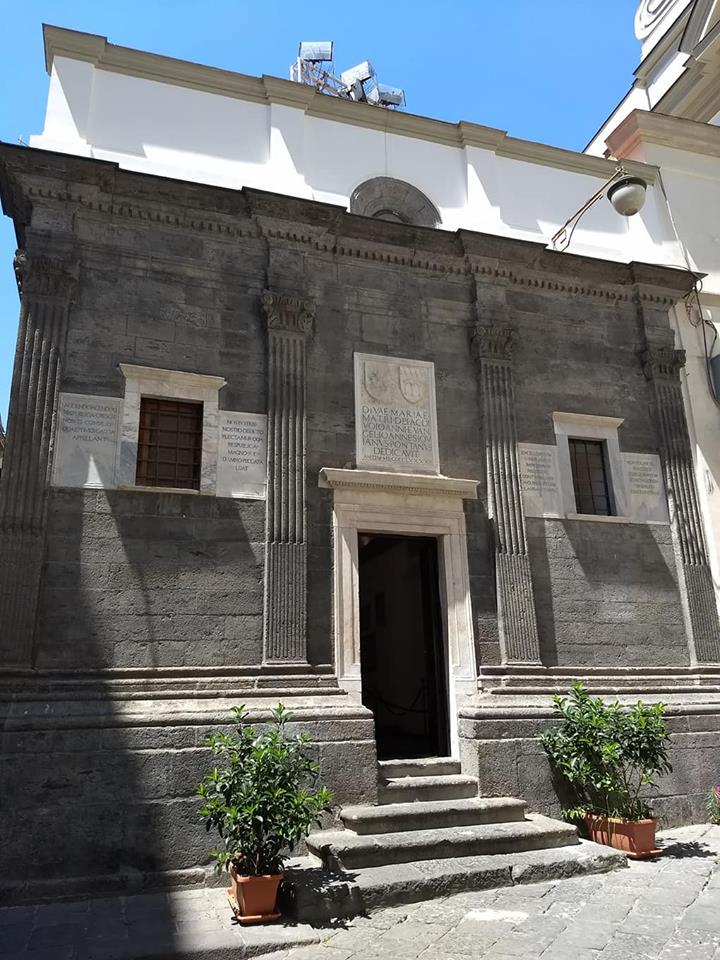
A small Renaissance temple on the decumanus, which the humanist Pontano had raised for his lost wife, still lined inside with Latin inscriptions dictated by his grief.
 ◆ History & archaeology
Sedile di Nilo
Decumani
On the corner of a small Spaccanapoli square survives the seat of the old Nilo quarter, where the nobles once gathered before the sedili of Naples vanished.
 ◆ History & archaeology
Port'Alba
Napoli
A seventeenth-century arch cut into the walls leads to the booksellers' street, where stalls of second-hand volumes pile up among yellowed pages and the shade of the old city.
 ◆ History & archaeology
Porta Capuana
zona Garibaldi
Between two cylindrical towers an arch of white marble opens like a Renaissance triumph, the old city gate facing the road to Capua.
 ◆ History & archaeology
Real Albergo dei Poveri
P.za Carlo III
An eighteenth-century colossus willed by Charles of Bourbon to shelter the poor of the Kingdom: a façade running more than three hundred metres, among the largest historic buildings in Europe.