Marina Grande di Sorrento
Sorrento
KnownVillages
The story
Below the town's cliffs, the old fishermen's borgo (old village) with houses faded by the salt, boats hauled ashore and trattorias fragrant with frying.
Access
FREE
The story
Marina Grande is the ancient fishing village of Sorrento, a 'city within the city' facing the sea, still tied to its traditions and to the cult of its patron Saint Anne. Here the Sorrento gozzi (traditional boats) have always been built, and here, in 1558, the Turks entered Sorrento through the Marina gate. In 1955 the village was the set of the film 'Pane, amore e...' with Sophia Loren.
What to see
A cluster of coloured houses, boats pulled up on shore and fish restaurants on the water, at the foot of the cliffs of Sorrento: one of the most authentic fishing villages of the peninsula, still living and genuine far from the great flows of the centre.
Hours and prices
Free entry.
Tips
Marina Grande is an inhabited village, not a postcard: move with respect among the fishermen's houses. You go down on foot from the centre of Sorrento along the ancient via Marina Grande (with steps); there is also an internal bus. It is the right place for a fish dinner at sunset.
Frequently asked questions
What is Marina Grande of Sorrento?
The ancient fishing village of Sorrento, facing the sea, with coloured houses, boats and fish restaurants; it has remained authentic and inhabited, tied to its patron Saint Anne.
How do you get to Marina Grande of Sorrento?
On foot from the centre along the ancient via Marina Grande (with steps), or by the internal bus; it is a village to be experienced with respect because it is inhabited.
What makes Marina Grande special?
The atmosphere of a real fishing village, the tradition of the Sorrento gozzi and the history that made it the set of the film 'Pane, amore e...' in 1955.
More gems in Sorrento
 Nature
Vallone dei Mulini
Sorrento
A canyon in the heart of the town where an old grain mill crumbles under the vegetation, wrapped in ferns and damp air, in a microclimate that time has forgotten.
 ◆ Museums
Museo Correale
Sorrento
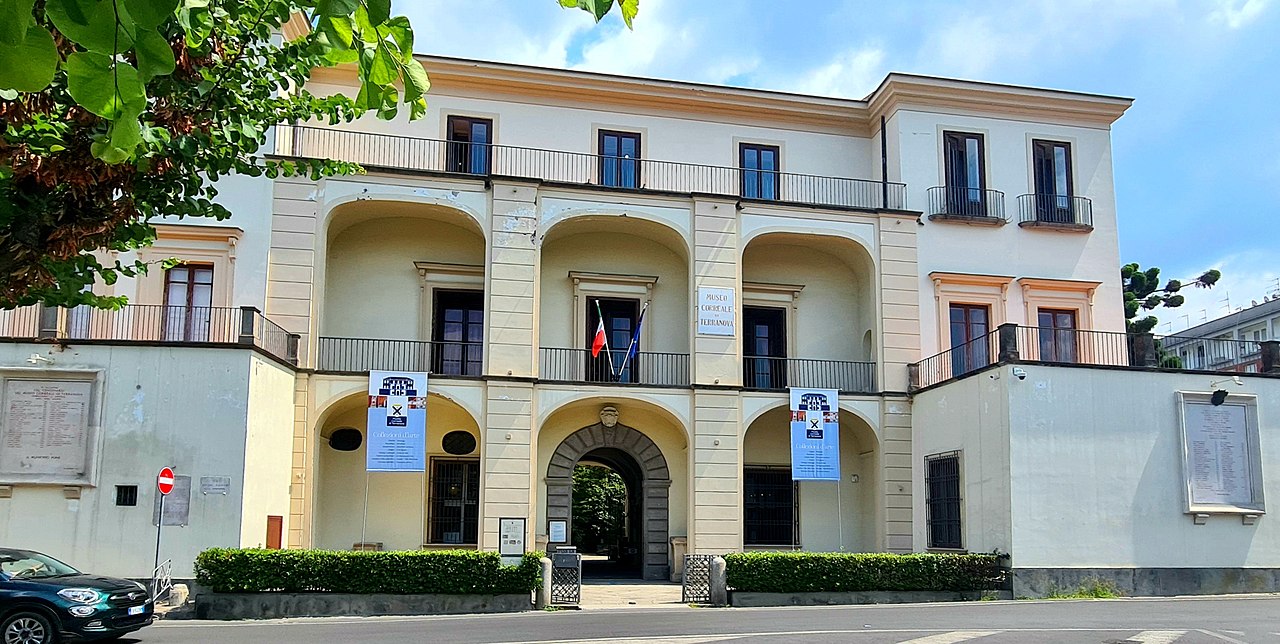
In the family villa of the Correale counts: porcelain, inlaid wood and eighteenth-century views of Naples, and a garden that runs down to a belvedere over the sea.
 ◆ History & archaeology
Sedile Dominova
Sorrento
The only surviving noble sedile in Campania, an open sixteenth-century loggia with a frescoed dome and majolica tiles, today a club for the town's elders on the corner of two alleys.
- Sacred art
Villa Comunale di Sorrento e Chiesa/Chiostro di San Francesco
Sorrento
A terrace suspended over the gulf beside the fourteenth-century cloister of San Francesco, where interlacing arches and bougainvillea frame Vesuvius and the notes of the summer concerts.
- ◆ Nature
Giardini di Cataldo
Sorrento (NA)
You stroll beneath pergolas of lemon and orange trees in the heart of Sorrento, amid the scent of citrus and a taste of limoncello made at home by the family that tends the garden.
More gems: Villages
 Villages
La Pignasecca
Montesanto
The oldest market in Naples unspools through the alleys of Montesanto: fish stalls, fry shops and old-time botteghe (traditional shops) in a hubbub that never stops.
 Villages
Borgo Marinari
S. Lucia
At the foot of Castel dell'Ovo, the little fishermen's borgo (old village) is now a marina of boats and restaurants: stone, salt air and the legend of Virgil's egg hidden in the foundations.
 Villages
Marina Corricella
Procida
The oldest fishermen's borgo (old village) on Procida, an amphitheatre of pastel houses tumbling down to the harbour, where the boats sleep beneath the hanging laundry.
- ◆ Villages
Mercato di Porta Nolana
zona Garibaldi
Beneath the Aragonese arch of Porta Nolana the fish market erupts with voices, crates of seawater and shellfish still alive: Naples at its most unvarnished.
- ◆ Villages
Borgo di Casamale
Somma Vesuviana
The medieval heart enclosed by Aragonese walls and towers, a tangle of alleys where every four years the Festa delle Lucerne lights thousands of little lamps.
- ◆ Villages
Casale Vascello
Procida
An old fortified casale at the foot of Terra Murata: coloured houses press around a courtyard, with the arched vefi (external staircases) once shielding the inhabitants from Saracen raids.