Museo Civico di Procida "Sebastiano Tusa"
Procida (NA)
Hidden gemMuseums
The story
Named after the underwater archaeologist who died in the 2019 Ethiopian air disaster, it gathers what the sea around Procida has given back. It stands in the same complex from which, for two centuries, people looked out at the prison.
Access
€ ~5, seasonal opening hours
The story
The Civic Museum of Procida, named after the archaeologist Sebastiano Tusa, opened in 2022, the year of Procida as Italian Capital of Culture. It is housed at Terra Murata, in the former Conservatorio delle Orfane, and tells the identity of the island in three voices: its volcanic nature, its ancient history and its bond with the sea.
What to see
Three sections: the Environment, with the volcanic geology of Procida and Vivara; Ancient History, with the finds of the excavations of Vivara — including the materials of the Mycenaean settlements, displayed for the first time; and the Sea, which tells of the island's seafaring life also through the collections of the Procidan families.
How to get there
- Hydrofoil
- Ferry
Tips
The museum, at Terra Murata, has its own entrance and hours: check on the official channels of the Municipality of Procida. It is in the same complex (the former Conservatorio delle Orfane) that houses the House of Graziella. To be combined with a walk in the upper village and the Abbey of San Michele.
Frequently asked questions
What is the Civic Museum of Procida?
The civic museum of the island, named after Sebastiano Tusa, opened in 2022 at Terra Murata: it tells of the volcanic nature, the ancient history (excavations of Vivara) and the bond of Procida with the sea.
What can you see at the museum?
Three sections — Environment (geology), Ancient History (finds from Vivara, Mycenaean materials) and Sea (the Procidan seamanship) — in the former Conservatorio delle Orfane.
Where is it?
At Terra Murata, in the former Conservatorio delle Orfane, the same complex as the House of Graziella.
More gems in Procida
 Villages
Marina Corricella
Procida
The oldest fishermen's borgo (old village) on Procida, an amphitheatre of pastel houses tumbling down to the harbour, where the boats sleep beneath the hanging laundry.
 Sacred art
Terra Murata
Procida
The ancient core of Procida climbs the yellow tufo (volcanic tuff) headland, between defensive walls and narrow alleys, suspended between the little harbour of Corricella and the horizon of the bay.
 Sacred art
Abbazia di San Michele
Procida
Behind the walls of Terra Murata, the abbey dedicated to its patron Michael guards paintings, an antique presepe (nativity scene) and catacombe carved into the tufo, its vault turned towards the sea.
- ◆ Views & panoramas
Belvedere Elsa Morante e dei Cannoni
Procida
From the terrace named after Elsa Morante, among old cannons trained on the bay, the view opens onto the Corricella and its pastel houses heaped upon the water.
- Free beaches
Spiaggia del Pozzo Vecchio ("del Postino")
Procida
The dark-sand beach where Massimo Troisi filmed Il Postino, tucked below the cemetery and the tufo walls, with shallow water and the stillness of a film set never struck.
- Free beaches
Spiagge di Chiaia
Procida
A long stairway leads down to it: a broad stretch of sand and shingle sheltered by high tufo walls, with the fishing boats of the Corricella colouring the background.
More gems: Museums
 Museums
MANN — Museo Archeologico Nazionale
P.za Museo
One of the world's great archaeological museums: here the Toro Farnese, the mosaics of Pompeii and the Gabinetto Segreto tell the whole ancient Mediterranean in a single visit.
 ◆ Museums
Antiquarium
Boscoreale
The museum that tells of daily life at the foot of Vesuvius before the eruption, among carbonised loaves, farm tools and finds handed back by the ash.
 ◆ Museums
Museo dell'Osservatorio Vesuviano
Ercolano
The oldest volcanological observatory in the world, willed by the Bourbons in 1841, with historic instruments and mineral collections, looking out over the slopes of Vesuvius.
 ◆ Museums
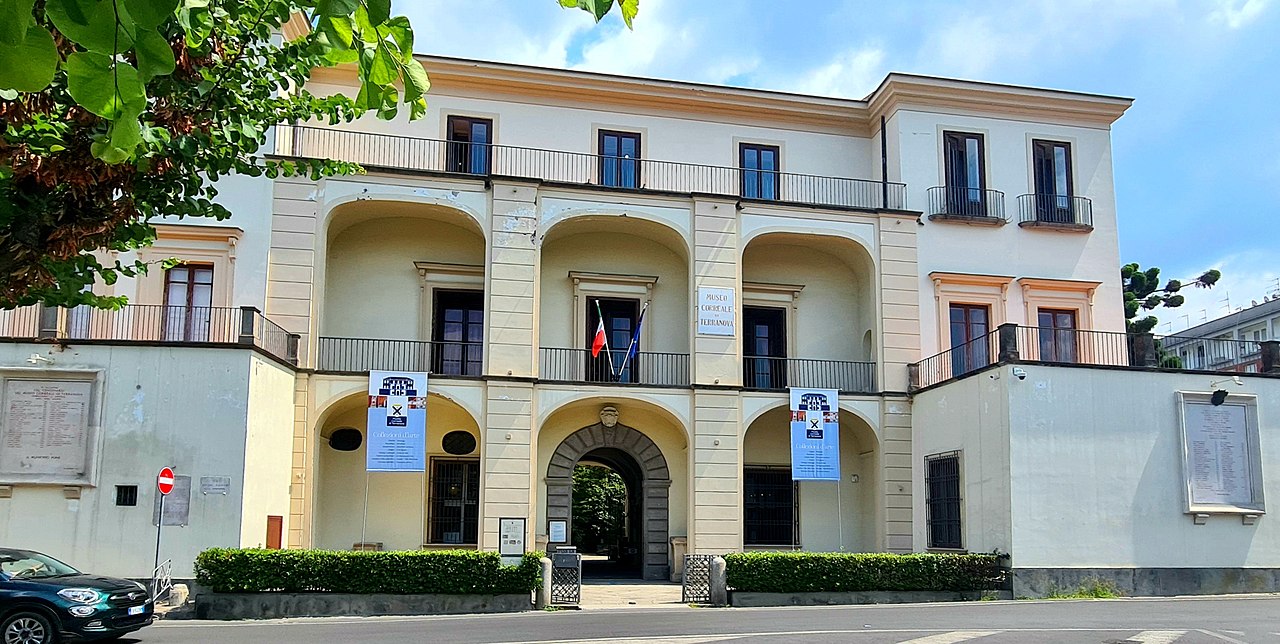
Museo Correale
Sorrento
In the family villa of the Correale counts: porcelain, inlaid wood and eighteenth-century views of Naples, and a garden that runs down to a belvedere over the sea.
 Museums
Villa Lysis — Jago Museum Capri
Capri
A 1905 Art Nouveau villa by the poet Fersen, dedicated to love and sorrow; since June 2026 it houses the Jago Museum Capri, with Jago's sculptures in the historic rooms high above the sea.
- ◆ Museums
Ospedale delle Bambole
Napoli
Behind a shop window in Palazzo Marigliano a craftsman mends glass eyes, porcelain arms and dolls' curls, in a workshop born more than a century ago.