Quartieri Spagnoli
QS
FamousHistory & archaeology

The story
A grid of alleys born in the sixteenth century for the Spanish troops: laundry strung overhead, votive shrines and, at the end of a small square, the great Maradona mural everyone comes looking for.
Access
FREE
The story
The Quartieri Spagnoli (Spanish Quarters) arose in the sixteenth century, under the viceroy Pedro de Toledo, to house the Spanish garrisons and the migrants flowing into the city. Their layout is a dense grid of alleys climbing from the lower levels towards Castel Sant'Elmo. From a soldiers' district they became, over the centuries, a working-class neighbourhood of artisans — tailors and shoemakers above all.
What to see
A maze of narrow alleys, with the 'bassi' (ground-floor one-room dwellings), the washing hung between the buildings, the workshops and the votive shrines: one of the most authentic and vital faces of Naples. Among the draws, the famous mural dedicated to Diego Armando Maradona, the goal of a continuous secular pilgrimage.
How to get there
- Metro
Hours and prices
Free entry.
Tips
The Quartieri Spagnoli are a densely inhabited neighbourhood, not a stage set: move with respect for those who live there, in the alleys and in front of the bassi. They are explored on foot, going up and down the steps; the Toledo metro station is the handiest access. Come for the atmosphere and for the Maradona mural.
Frequently asked questions
What are the Quartieri Spagnoli?
A working-class neighbourhood in the centre of Naples, born in the sixteenth century to house the Spanish troops of the viceroy Pedro de Toledo: a dense grid of alleys climbing towards Castel Sant'Elmo.
Where is the Maradona mural?
In the heart of the Quartieri Spagnoli, where the famous mural dedicated to Diego Armando Maradona has become a constant destination for visitors and fans.
How do you visit the Quartieri Spagnoli?
On foot, among alleys and steps, with respect because it is a densely inhabited neighbourhood; the Toledo metro station is the handiest access.
More gems: History & archaeology
 History & archaeology
Statua del Nilo ("Corpo di Napoli")
Largo Corpo di Napoli
A river god reclining for centuries in a quiet square, whom Neapolitans call the Corpo di Napoli: he leans his bearded head among putti and a sphinx.
 ◆ History & archaeology
Cappella Pontano
Decumani
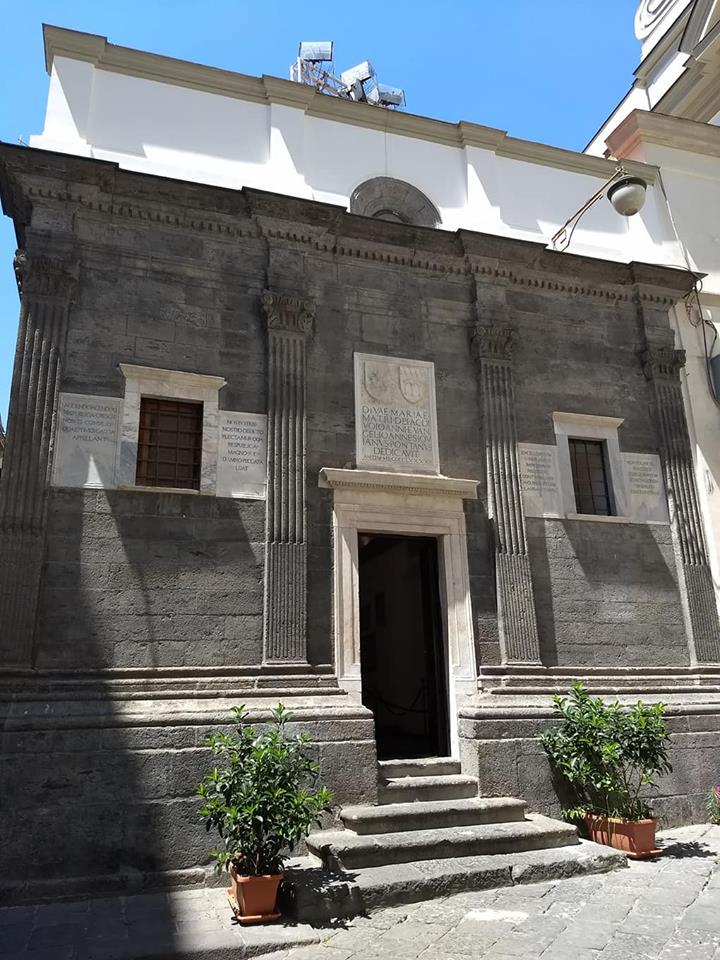
A small Renaissance temple on the decumanus, which the humanist Pontano had raised for his lost wife, still lined inside with Latin inscriptions dictated by his grief.
 ◆ History & archaeology
Sedile di Nilo
Decumani
On the corner of a small Spaccanapoli square survives the seat of the old Nilo quarter, where the nobles once gathered before the sedili of Naples vanished.
 ◆ History & archaeology
Port'Alba
Napoli
A seventeenth-century arch cut into the walls leads to the booksellers' street, where stalls of second-hand volumes pile up among yellowed pages and the shade of the old city.
 ◆ History & archaeology
Porta Capuana
zona Garibaldi
Between two cylindrical towers an arch of white marble opens like a Renaissance triumph, the old city gate facing the road to Capua.
 ◆ History & archaeology
Real Albergo dei Poveri
P.za Carlo III
An eighteenth-century colossus willed by Charles of Bourbon to shelter the poor of the Kingdom: a façade running more than three hundred metres, among the largest historic buildings in Europe.