Monte Nuovo
Pozzuoli (NA)
Hidden gemVolcanoes

The story
Born in a single night from a sixteenth-century eruption, the youngest mountain of the Campi Flegrei holds within its crater a green silence looking out over the gulf of Pozzuoli.
Access
FREE
The story
Monte Nuovo, near Pozzuoli, is the youngest volcano in Europe: it formed in a few days, between 29 September and 6 October 1538, in a violent eruption that erased the medieval village of Tripergole. Today its crater is a nature oasis, covered by the pine wood planted in the 1930s.
What to see
A path climbs among the pines up to the rim of the crater, at one hundred and thirty-three metres, with a view over the gulf and the whole Flegrean area; you can also go down inside the crater. On the southern slopes, small fumaroles recall that the volcano is not extinct.
Tips
You climb up on foot by a path (from Arco Felice): comfortable shoes, water and a hat in summer. You are in the Campi Flegrei in active bradyseism, on a volcano with fumaroles: check the access status of the oasis on the official channels before going and do not leave the paths.
Frequently asked questions
Why is Monte Nuovo famous?
It is the youngest volcano in Europe, born in a few days in the eruption of 1538 that destroyed the village of Tripergole; today the crater is a nature oasis.
Can you climb up Monte Nuovo?
Yes, by a path that climbs to the rim of the crater and allows you to go down inside; being in an active volcanic area, it is best to check the access status and stay on the paths.
Are there fumaroles on Monte Nuovo?
Yes, small fumaroles on the southern slopes recall that the volcano is only quiescent.
More gems in Pozzuoli
 History & archaeology
Anfiteatro Flavio
Pozzuoli
The third largest Roman amphitheatre, at Pozzuoli: above ground the tiers, but it is underground that it strikes you, in the intact passages from which the beasts rose.
 History & archaeology
Tempio di Serapide (Macellum)
Pozzuoli
Not a temple but the ancient Roman market: on the marble columns the holes bored by marine molluscs tell how much the Flegrean ground has risen and sunk over the centuries.
 Nature
Solfatara
Pozzuoli
The ground breathes: hissing fumaroles, mud that boils up and a smell of sulphur reminding you how alive the earth is beneath the Campi Flegrei.
 Villages
Rione Terra
Pozzuoli (NA)
On the acropolis of Pozzuoli, evacuated in 1970 because of bradyseism, the Rione Terra guards beneath its houses an intact Roman town of streets, workshops and paved hinges.
 Nature
Lago d'Averno
Pozzuoli (NA)
In the extinct crater of a volcano, the still waters of Averno: for the ancients the threshold of the underworld, the one Aeneas crossed to descend into the kingdom of shadows.
More gems: Volcanoes
 Volcanoes
Vesuvio — Gran Cono
Ercolano
The last stretch climbs on foot over the scree to the rim of the crater, where the warm breath of the earth mixes with the view of the whole Gulf of Naples.
 Volcanoes
Monte Epomeo
Ischia
The roof of the island at almost eight hundred metres: from the green tufo summit, with its hermitage carved into the rock, the eye takes in all of Ischia and the bay as far as Capri.
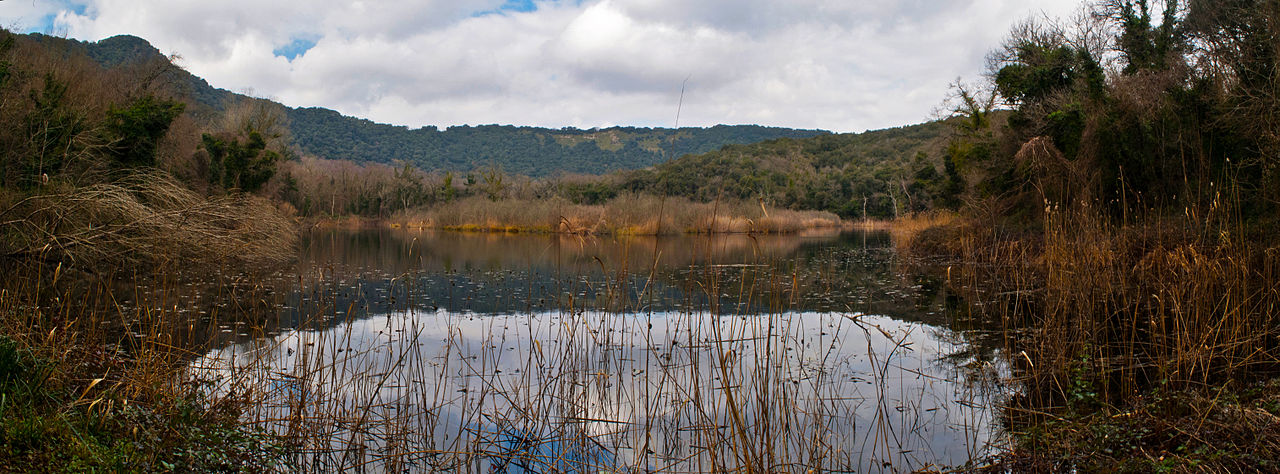 Volcanoes
Cratere degli Astroni
Napoli (NA)
An extinct crater enclosed by wooded walls, with small lakes and silent trails: once a Bourbon hunting reserve, today an oasis where the woodpecker marks the time.
- ◆ Volcanoes
Vulcano di Roccamonfina
Roccamonfina (CE)
An extinct volcano clothed in chestnut groves, where the crater has become a plateau and every trail smells of dark earth and ancient woods.
- ◆ Volcanoes
Monte Rotaro (cratere e fumarole)
Ischia (NA)
A crater 350 metres across and 127 deep, today covered in holm oaks and myrtle. Puffs of vapour still rise from the ground, and among the fumarole grows a plant that hardly grows anywhere else in Europe.
- ◆ Volcanoes
Cratere del Fondo d'Oglio
Ischia (NA)
A perfectly circular hollow hidden in the wood: inside they still grow vines, at the bottom of a volcano. Whoever descends cannot tell where they are until they look up.