Ponte delle Serretelle
Benevento (BN)
Hidden gemHistory & archaeology

The story
A humpback bridge that no longer leads anywhere: the torrent changed course and left it there, one arch collapsed and the roots eating it away. In 1113 men fought here against the Normans.
Access
FREE, in open countryside
The story
The Bridge of the Serretelle is an ancient arched bridge south-west of Benevento, between the hill of the Gran Potenza and the Serretelle stream. Around it a scholarly debate has long turned: namely whether the Roman Via Appia really passed by it. The scholars have been divided — Stefano Borgia thought so, Almerico Meomartini did not — and the more recent archaeological findings have proved the latter right, showing that the road ran a short distance away.
What to see
The bridge, today disused and partly collapsed, is a fragment of antiquity in the landscape south-west of Benevento. Its interest is above all historical and archaeological, tied to the Roman roads that converged on the Samnite city.
Tips
It is a minor and out-of-the-way site, for enthusiasts of Roman history and of the archaeology of the territory. Check the accessibility on site, as it is a disused structure. To be framed in a tour of the Roman bridges and roads of Benevento.
Frequently asked questions
What is the Bridge of the Serretelle?
An ancient arched bridge south-west of Benevento, today disused and partly collapsed.
Did the Via Appia pass by the Bridge of the Serretelle?
It has long been debated: the more recent archaeological findings indicate that the road ran a short distance away, not over the bridge.
Where is the Bridge of the Serretelle?
South-west of Benevento, between the hill of the Gran Potenza and the Serretelle stream.
More gems in Benevento
 History & archaeology
Teatro Romano e il Triggio
Benevento
The great Hadrianic theatre opens up all at once among the alleys of the Triggio, the oldest quarter, where Roman stone and medieval houses blur into one another.
 ◆ Sacred art
Hortus Conclusus
Benevento
In the garden of the San Domenico convent, the bronzes of Mimmo Paladino: a horse in a golden mask among ancient capitals and fountains, in a garden suspended between myth and meditation.
 History & archaeology
Ponte Leproso
Benevento
On the ancient Via Appia the stone arches stride across the river Sabato: the same threshold that travellers bound for Rome once crossed to enter Benevento.
 History & archaeology
Arco di Traiano
Benevento (BN)
Golden marble carved dense with reliefs, the arch that celebrated Trajan still marks the entrance to the road that led toward Brindisi and the East.
 Sacred art
Chiesa di Santa Sofia
Benevento (BN)
A Lombard church with a star-shaped plan, a World Heritage site, where columns and arches trace an unusual geometry left almost intact for over a thousand years.
 Museums
Museo del Sannio
Benevento (BN)
The medieval cloister of Santa Sofia, a UNESCO site, with its forty-seven columns that weave together real and fantastic figures, holds the layered memory of the Sannio.
More gems: History & archaeology
 History & archaeology
Statua del Nilo ("Corpo di Napoli")
Largo Corpo di Napoli
A river god reclining for centuries in a quiet square, whom Neapolitans call the Corpo di Napoli: he leans his bearded head among putti and a sphinx.
 ◆ History & archaeology
Cappella Pontano
Decumani
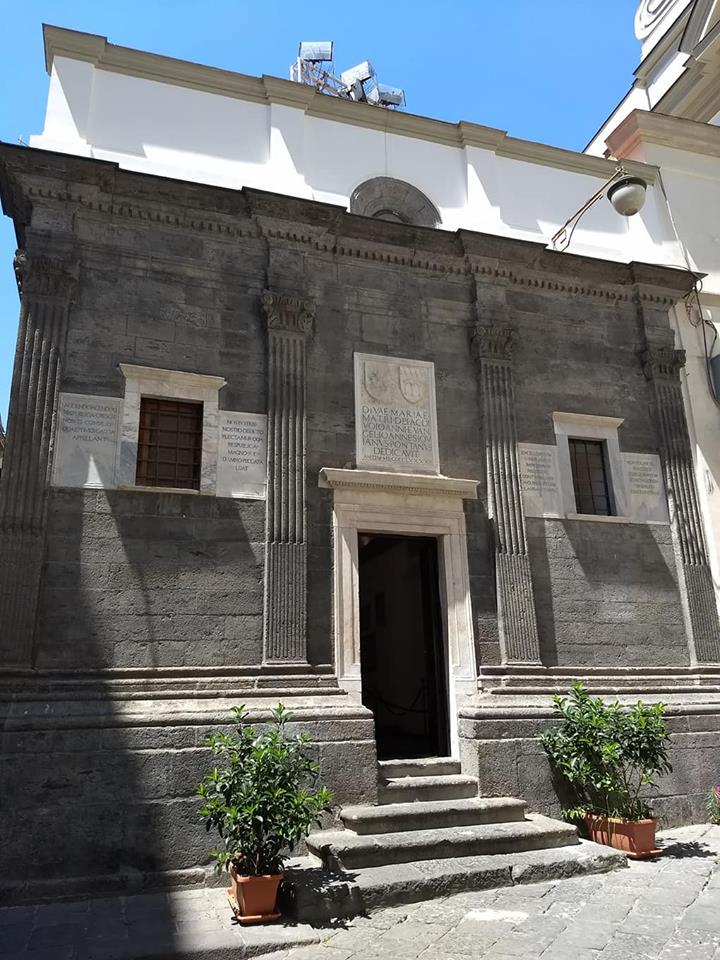
A small Renaissance temple on the decumanus, which the humanist Pontano had raised for his lost wife, still lined inside with Latin inscriptions dictated by his grief.
 ◆ History & archaeology
Sedile di Nilo
Decumani
On the corner of a small Spaccanapoli square survives the seat of the old Nilo quarter, where the nobles once gathered before the sedili of Naples vanished.
 ◆ History & archaeology
Port'Alba
Napoli
A seventeenth-century arch cut into the walls leads to the booksellers' street, where stalls of second-hand volumes pile up among yellowed pages and the shade of the old city.
 ◆ History & archaeology
Porta Capuana
zona Garibaldi
Between two cylindrical towers an arch of white marble opens like a Renaissance triumph, the old city gate facing the road to Capua.
 ◆ History & archaeology
Real Albergo dei Poveri
P.za Carlo III
An eighteenth-century colossus willed by Charles of Bourbon to shelter the poor of the Kingdom: a façade running more than three hundred metres, among the largest historic buildings in Europe.