Sorgenti del Fizzo (Acquedotto Carolino)
Bucciano (BN)
KnownHistory & archaeology
The story
From here the water sets off on thirty-eight kilometres to make the fountains of the Reggia di Caserta play: point zero of Vanvitelli's hydraulic masterpiece, a UNESCO site that almost nobody comes to see.
Access
FREE, area under restoration
More gems in Bucciano
 Sacred art
Santuario della Madonna del Taburno
Bucciano (BN)
In 1401 a deaf-mute shepherdess, Agnese Pepe, is said to have heard the Madonna's voice coming from a cave on the Taburno. On the spot of the miracle a convent grew at 544 metres, today a silent balcony over the Valle Caudina.
- ◆ Sacred art
Grotta di San Simeone
Bucciano (BN)
A thirteen-metre cleft in the rock of the Taburno, lined with rock frescoes and a Byzantine-flavoured Christ enthroned. San Simeone, here, was invoked as the protector of fair weather.
More gems: History & archaeology
 History & archaeology
Statua del Nilo ("Corpo di Napoli")
Largo Corpo di Napoli
A river god reclining for centuries in a quiet square, whom Neapolitans call the Corpo di Napoli: he leans his bearded head among putti and a sphinx.
 ◆ History & archaeology
Cappella Pontano
Decumani
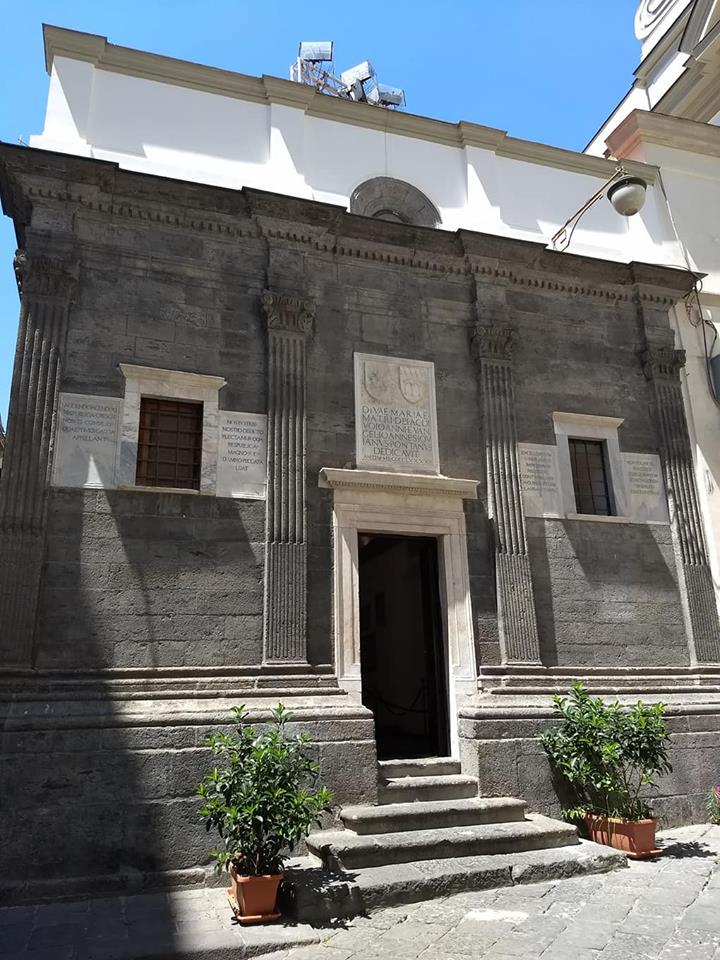
A small Renaissance temple on the decumanus, which the humanist Pontano had raised for his lost wife, still lined inside with Latin inscriptions dictated by his grief.
 ◆ History & archaeology
Sedile di Nilo
Decumani
On the corner of a small Spaccanapoli square survives the seat of the old Nilo quarter, where the nobles once gathered before the sedili of Naples vanished.
 ◆ History & archaeology
Port'Alba
Napoli
A seventeenth-century arch cut into the walls leads to the booksellers' street, where stalls of second-hand volumes pile up among yellowed pages and the shade of the old city.
 ◆ History & archaeology
Porta Capuana
zona Garibaldi
Between two cylindrical towers an arch of white marble opens like a Renaissance triumph, the old city gate facing the road to Capua.
 ◆ History & archaeology
Real Albergo dei Poveri
P.za Carlo III
An eighteenth-century colossus willed by Charles of Bourbon to shelter the poor of the Kingdom: a façade running more than three hundred metres, among the largest historic buildings in Europe.