Reggia di Caserta
Caserta
FamousHistory & archaeology

The story
Vanvitelli's grand staircase, then three kilometres of garden climbing all the way to the waterfall, among fountains and mythological statues designed to astonish the Bourbons.
Access
€ 12 apartments / 9 park, closed Tuesdays; train from Garibaldi ~40-60 min ~€4
The story
The Royal Palace of Caserta (Reggia di Caserta) is the royal residence willed by Charles of Bourbon to make the new capital of the Kingdom the rival of Versailles. The first stone was laid on 20 January 1752 to a design by Luigi Vanvitelli; the works continued for almost a century, until 1845. With the Carolino Aqueduct and the Belvedere of San Leucio it has been a UNESCO World Heritage Site since 1997, and is today among the most visited museums in Italy (over a million visitors a year).
What to see
The Royal Apartments with Vanvitelli's monumental staircase, the state rooms and the court theatre; and above all the Park, which stretches for three kilometres in a succession of basins, cascades and fountains up to the Great Waterfall, with the English Garden beside it. It is the largest royal palace in the world by volume.
How to get there
- Metro
Tips
The park is enormous: reckon on a whole day, and consider the shuttle or the internal bike to reach the Great Waterfall without wearing yourself out. Book the ticket online in peak periods. Hours and fares change with the season: check them on the official site. It is easily reached by train (Caserta station is in front of the Palace).
Frequently asked questions
Who designed the Royal Palace of Caserta?
Luigi Vanvitelli, at the will of Charles of Bourbon; the first stone was laid in 1752 and the works ended in 1845.
Is the Royal Palace of Caserta a UNESCO site?
Yes, since 1997, together with the Carolino Aqueduct and the complex of San Leucio.
How much time is needed to visit the Royal Palace of Caserta?
A whole day: to the Royal Apartments is added the park, about three kilometres long up to the Great Waterfall.
This page may contain affiliate links: if you book through them, the site earns a small commission at no extra cost to you. Trasparenza
More gems in Caserta
 History & archaeology
Belvedere di San Leucio
Caserta
Ferdinando IV's silken utopia: a factory-village where silk was woven for the courts of Europe, with the looms and the workers' houses gathered around the belvedere.
- History & archaeology
Reggia di Caserta — Collezione Terrae Motus
Caserta (CE)
In the halls of the Reggia di Caserta the Terrae Motus collection brings together the art born from the shock of the 1980 earthquake, from Warhol to Beuys, willed by the gallerist Lucio Amelio.
 Villages
Casertavecchia
Caserta (CE)
On the ridge of the Tifatini mountains, this intact medieval borgo (old village) hugs the Norman cathedral with its Arab-Sicilian geometries, stone alleys and the cool air rising from the plain of Caserta.
 Castles
Castello di Casertavecchia
Caserta (CE)
In the medieval borgo (old village) of Casertavecchia stand the ruins of the castle and its cylindrical tower, overlooking the plain of Terra di Lavoro.
 ◆ Nature
Oasi WWF Bosco di San Silvestro
Caserta (CE)
A former Bourbon hunting reserve behind the Reggia, today a protected wood where holm oaks and oaks climb two hills and silence has replaced the royal hunts.
More gems: History & archaeology
 History & archaeology
Statua del Nilo ("Corpo di Napoli")
Largo Corpo di Napoli
A river god reclining for centuries in a quiet square, whom Neapolitans call the Corpo di Napoli: he leans his bearded head among putti and a sphinx.
 ◆ History & archaeology
Cappella Pontano
Decumani
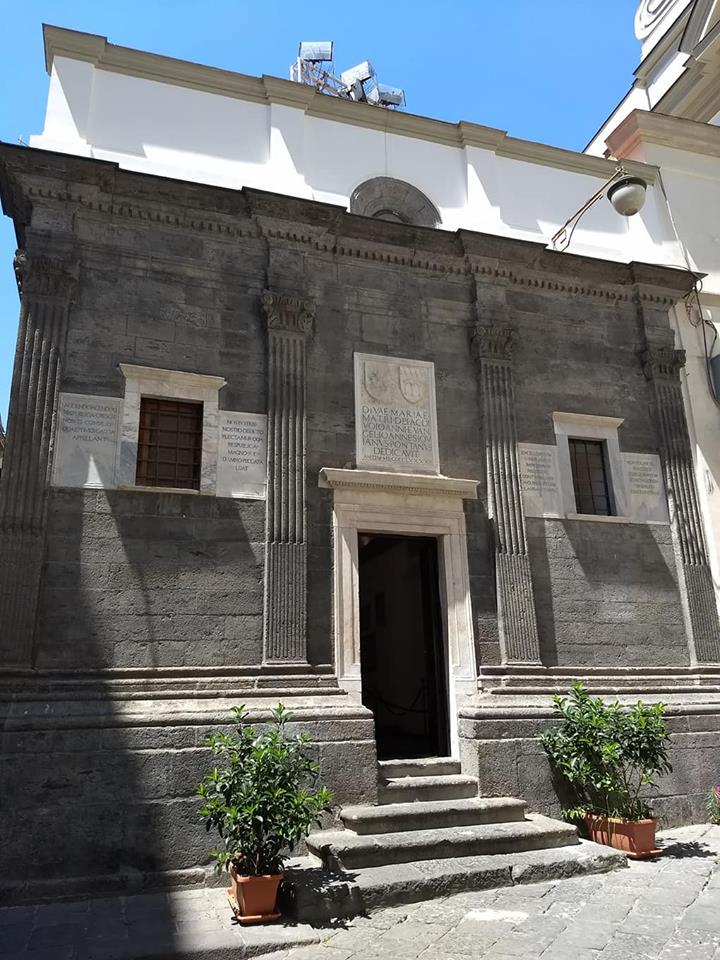
A small Renaissance temple on the decumanus, which the humanist Pontano had raised for his lost wife, still lined inside with Latin inscriptions dictated by his grief.
 ◆ History & archaeology
Sedile di Nilo
Decumani
On the corner of a small Spaccanapoli square survives the seat of the old Nilo quarter, where the nobles once gathered before the sedili of Naples vanished.
 ◆ History & archaeology
Port'Alba
Napoli
A seventeenth-century arch cut into the walls leads to the booksellers' street, where stalls of second-hand volumes pile up among yellowed pages and the shade of the old city.
 ◆ History & archaeology
Porta Capuana
zona Garibaldi
Between two cylindrical towers an arch of white marble opens like a Renaissance triumph, the old city gate facing the road to Capua.
 ◆ History & archaeology
Real Albergo dei Poveri
P.za Carlo III
An eighteenth-century colossus willed by Charles of Bourbon to shelter the poor of the Kingdom: a façade running more than three hundred metres, among the largest historic buildings in Europe.