Prata Sannita
Prata Sannita (CE)
Hidden gemHistory & archaeology

The story
Clinging to the rock above the river Lete, the medieval borgo (old village) of Prata Sannita gathers its houses around the castle of the Pandone: stone alleys and bridges in the silence of the Matese.
Access
Free/private castle
The story
Prata Sannita is a small hill village of the Middle Volturno Valley, on the southern side of the Matese. The name perhaps refers to the prata legionum, the fields of the Roman legions at the time of the Samnite wars, and appears already in 958 in the Chronicon of the monastery of San Vincenzo al Volturno. The town is divided in two: the medieval Prata Inferiore, with the fortified village, and the more recent Prata Superiore, on a dominating plateau.
What to see
The heart of Prata is the medieval fortified village of Prata Inferiore, dominated by the imposing castle. Around it, the landscape of the Matese and the Volturno valley, among hills and woods of the Upper Caserta area.
Tips
The old village is explored on foot, among the alleys of Prata Inferiore and the castle. You arrive by car, in the Upper Caserta area; to be combined with the other villages of the Caserta Matese and the Volturno valley.
Frequently asked questions
What is there to see at Prata Sannita?
The medieval fortified village of Prata Inferiore with its imposing castle.
Where does the name Prata Sannita come from?
It perhaps refers to the prata legionum, the fields of the Roman legions; the addition 'Sannita' is of 1862, to distinguish it from Prata di Principato Ultra.
Where is Prata Sannita?
In the Middle Volturno Valley, on the southern side of the Matese, in the province of Caserta.
More gems in Prata Sannita
- ◆ Castles
Castello di Prata Sannita
Prata Sannita (CE)
At Prata Sannita, along the waters of the Lete, the medieval castle lines up towers and battlements in the silent heart of the Matese.
- Nature
Cascate e gole del Lete
Prata Sannita (CE)
The river of oblivion carves a gorge of green pools and small waterfalls, among old mills, washhouses and the gutted walls of a paper mill. You follow it alongside the water, with the stone borgo (old village) hanging above your head.
More gems: History & archaeology
 History & archaeology
Statua del Nilo ("Corpo di Napoli")
Largo Corpo di Napoli
A river god reclining for centuries in a quiet square, whom Neapolitans call the Corpo di Napoli: he leans his bearded head among putti and a sphinx.
 ◆ History & archaeology
Cappella Pontano
Decumani
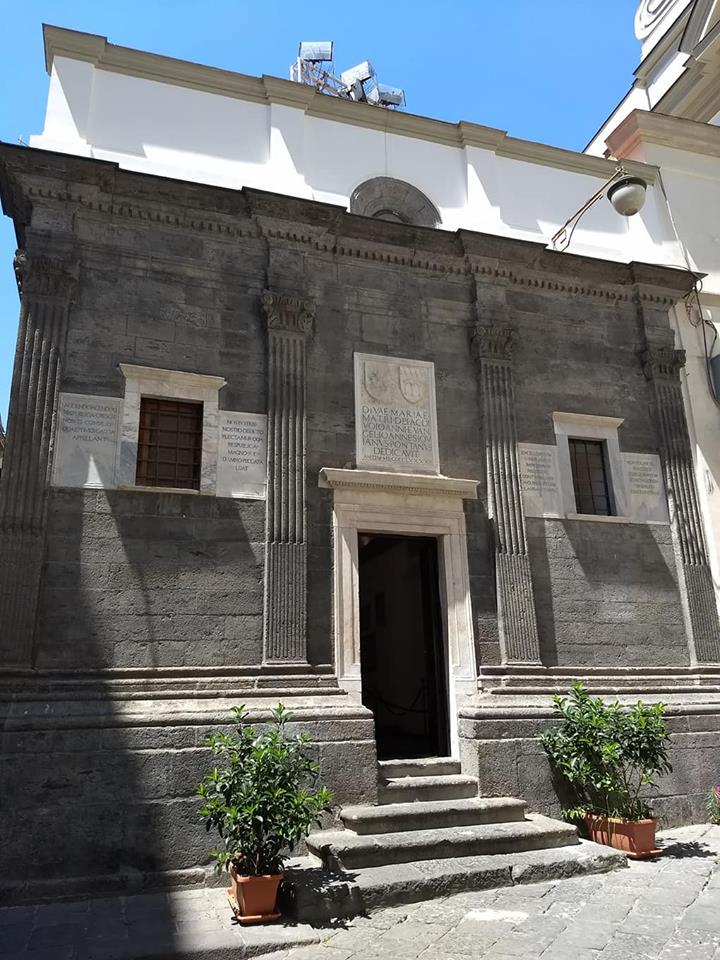
A small Renaissance temple on the decumanus, which the humanist Pontano had raised for his lost wife, still lined inside with Latin inscriptions dictated by his grief.
 ◆ History & archaeology
Sedile di Nilo
Decumani
On the corner of a small Spaccanapoli square survives the seat of the old Nilo quarter, where the nobles once gathered before the sedili of Naples vanished.
 ◆ History & archaeology
Port'Alba
Napoli
A seventeenth-century arch cut into the walls leads to the booksellers' street, where stalls of second-hand volumes pile up among yellowed pages and the shade of the old city.
 ◆ History & archaeology
Porta Capuana
zona Garibaldi
Between two cylindrical towers an arch of white marble opens like a Renaissance triumph, the old city gate facing the road to Capua.
 ◆ History & archaeology
Real Albergo dei Poveri
P.za Carlo III
An eighteenth-century colossus willed by Charles of Bourbon to shelter the poor of the Kingdom: a façade running more than three hundred metres, among the largest historic buildings in Europe.