Ponte di Annibale e terme di Triflisco
Bellona (CE)
KnownHistory & archaeology
The story
Here the Volturno narrows between the rocks, and memory says that Hannibal threw a bridge across to move his army over, the same army that loosed a herd of oxen with blazing horns against the Romans. Of the bridge only a few teeth of stone remain in the green water.
Access
FREE, riverbank reachable on foot from Triflisco
More gems in Bellona
- Sacred art
Mausoleo Ossario dei 54 Martiri di Bellona
Bellona (CE)
On 7 October 1943 the Germans picked 54 men inside the church and shot them on the edge of a tufo (volcanic tuff) quarry twenty-five metres deep, then brought the earth down over the bodies with hand grenades. At the bottom of the quarry, since 1945, a monument carries their names.
- ◆ History & archaeology
Cammarelle delle Fate (criptoportico romano)
Bellona (CE)
Twenty-two interconnected cisterns dug at the foot of the hill: the people, who could no longer read the stones, swore they were the chambers of the fairies. They were instead the belly of a Roman villa of the 2nd century BC.
More gems: History & archaeology
 History & archaeology
Statua del Nilo ("Corpo di Napoli")
Largo Corpo di Napoli
A river god reclining for centuries in a quiet square, whom Neapolitans call the Corpo di Napoli: he leans his bearded head among putti and a sphinx.
 ◆ History & archaeology
Cappella Pontano
Decumani
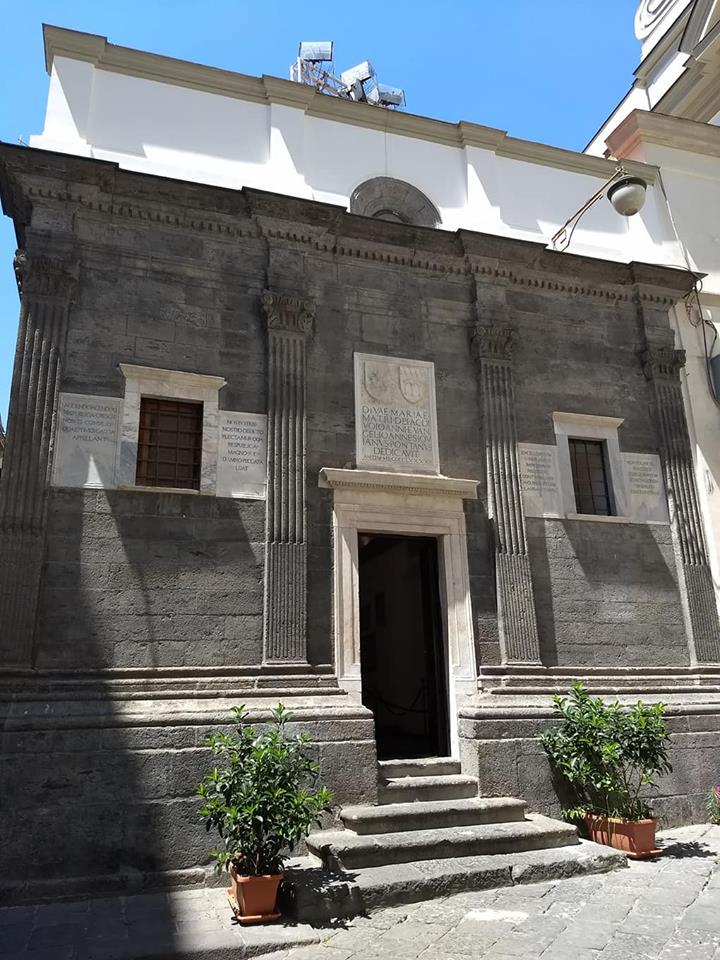
A small Renaissance temple on the decumanus, which the humanist Pontano had raised for his lost wife, still lined inside with Latin inscriptions dictated by his grief.
 ◆ History & archaeology
Sedile di Nilo
Decumani
On the corner of a small Spaccanapoli square survives the seat of the old Nilo quarter, where the nobles once gathered before the sedili of Naples vanished.
 ◆ History & archaeology
Port'Alba
Napoli
A seventeenth-century arch cut into the walls leads to the booksellers' street, where stalls of second-hand volumes pile up among yellowed pages and the shade of the old city.
 ◆ History & archaeology
Porta Capuana
zona Garibaldi
Between two cylindrical towers an arch of white marble opens like a Renaissance triumph, the old city gate facing the road to Capua.
 ◆ History & archaeology
Real Albergo dei Poveri
P.za Carlo III
An eighteenth-century colossus willed by Charles of Bourbon to shelter the poor of the Kingdom: a façade running more than three hundred metres, among the largest historic buildings in Europe.