Area archeologica di Abellinum
Atripalda (AV)
Hidden gemHistory & archaeology

The story
A few steps from Avellino, the Civita district of Atripalda holds the ruins of Abellinum, with domus, walls and paved streets resurfacing beneath the modern town.
More gems in Atripalda
- ◆ Sacred art
Abellinum romana + specus martirum
Atripalda (AV)
At Atripalda the Roman Abellinum surfaces and, beneath the church, the Specus Martyrum: the crypt where the first Christian martyrs of Irpinia were laid.
- ◆ Sacred art
Specus Martyrum (Chiesa di Sant'Ippolisto)
Atripalda (AV)
Below the church opens the cave of the martyrs: here, after the persecutions of Diocletian, the bodies of the Christians of Abellinum were laid to rest. Squat pillars, low vaults, and the distinct sensation of being a guest in someone else's home.
More gems: History & archaeology
 History & archaeology
Statua del Nilo ("Corpo di Napoli")
Largo Corpo di Napoli
A river god reclining for centuries in a quiet square, whom Neapolitans call the Corpo di Napoli: he leans his bearded head among putti and a sphinx.
 ◆ History & archaeology
Cappella Pontano
Decumani
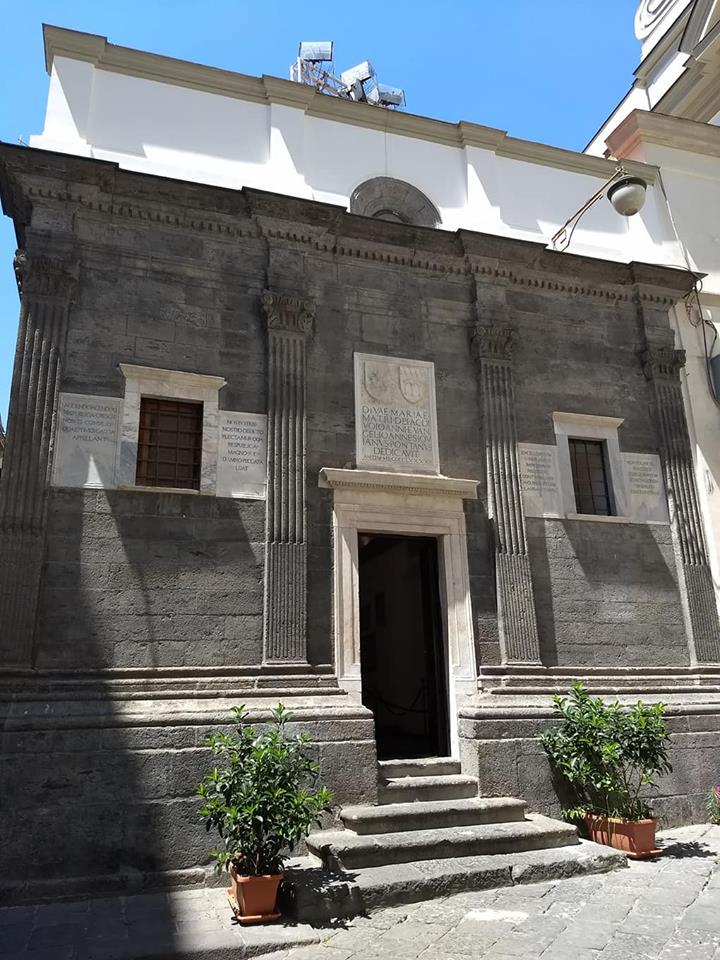
A small Renaissance temple on the decumanus, which the humanist Pontano had raised for his lost wife, still lined inside with Latin inscriptions dictated by his grief.
 ◆ History & archaeology
Sedile di Nilo
Decumani
On the corner of a small Spaccanapoli square survives the seat of the old Nilo quarter, where the nobles once gathered before the sedili of Naples vanished.
 ◆ History & archaeology
Port'Alba
Napoli
A seventeenth-century arch cut into the walls leads to the booksellers' street, where stalls of second-hand volumes pile up among yellowed pages and the shade of the old city.
 ◆ History & archaeology
Porta Capuana
zona Garibaldi
Between two cylindrical towers an arch of white marble opens like a Renaissance triumph, the old city gate facing the road to Capua.
 ◆ History & archaeology
Real Albergo dei Poveri
P.za Carlo III
An eighteenth-century colossus willed by Charles of Bourbon to shelter the poor of the Kingdom: a façade running more than three hundred metres, among the largest historic buildings in Europe.