Anfiteatro Campano
Santa Maria Capua Vetere (CE)
FamousHistory & archaeology

The story
Second in size only to the Colosseum, the arena where Spartacus trained still holds the underground corridors from which gladiators and beasts rose toward the light.
Access
€
The story
The Campano Amphitheatre, at Santa Maria Capua Vetere — the ancient Capua —, is by size second only to the Colosseum, which it probably preceded and served as a model for. Capua was the city of the gladiators: here stood the school from which, in 73 BC, the revolt of Spartacus set out. Over the centuries many of its stones were reused, for example in the Castello delle Pietre of Capua.
What to see
There remain the imposing arcaded structure, the arena and above all the underground passages — the corridors and cells beneath the fighting floor, among the most legible in the Roman world. The ticket usually also includes the Mithraeum, with its frescoes, and the Gladiators' Museum.
Tips
Visit the amphitheatre, the Mithraeum and the Gladiators' Museum together: they are part of the same circuit. The Mithraeum opens on request, check on site. Fares and hours on the official site. You are at Santa Maria Capua Vetere, a stone's throw from Capua and its old centre.
Frequently asked questions
Why is the Campano Amphitheatre important?
It is the second Roman amphitheatre by size after the Colosseum, in ancient Capua, city of the gladiators from which the revolt of Spartacus set out in 73 BC.
What can you visit at the Campano Amphitheatre?
The arcaded structure, the arena and the underground passages; the ticket usually also includes the Mithraeum and the Gladiators' Museum.
Where is the Campano Amphitheatre?
At Santa Maria Capua Vetere, in the province of Caserta, on the site of ancient Capua.
More gems in Santa Maria Capua Vetere
 Museums
Museo Archeologico dell'Antica Capua
Santa Maria Capua Vetere (CE)
A stone's throw from Spartacus's gladiator amphitheatre, the museum gathers the centuries of Etruscan and Roman Capua, from the statues of mothers to the Campanian horsemen.
 ◆ History & archaeology
Arco di Adriano (Arco Campano)
Santa Maria Capua Vetere (CE)
Of three arches only two survive, mutilated, in the middle of a modern crossroads: this was the triumphal gate through which the Appia entered the second city of the empire. Today the brick piers stare at the traffic lights.
More gems: History & archaeology
 History & archaeology
Statua del Nilo ("Corpo di Napoli")
Largo Corpo di Napoli
A river god reclining for centuries in a quiet square, whom Neapolitans call the Corpo di Napoli: he leans his bearded head among putti and a sphinx.
 ◆ History & archaeology
Cappella Pontano
Decumani
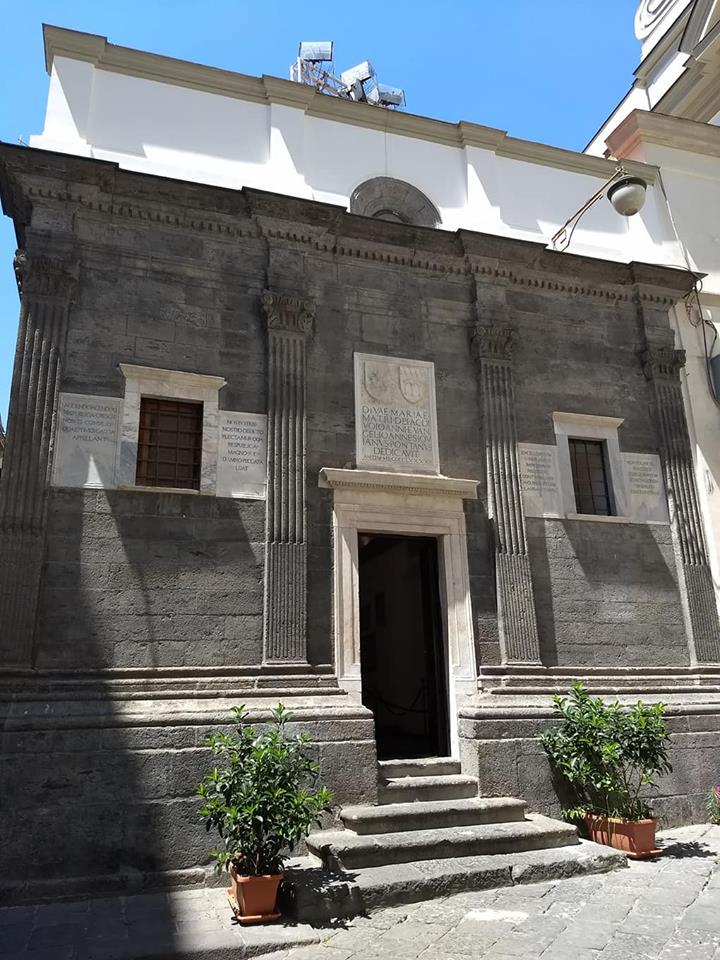
A small Renaissance temple on the decumanus, which the humanist Pontano had raised for his lost wife, still lined inside with Latin inscriptions dictated by his grief.
 ◆ History & archaeology
Sedile di Nilo
Decumani
On the corner of a small Spaccanapoli square survives the seat of the old Nilo quarter, where the nobles once gathered before the sedili of Naples vanished.
 ◆ History & archaeology
Port'Alba
Napoli
A seventeenth-century arch cut into the walls leads to the booksellers' street, where stalls of second-hand volumes pile up among yellowed pages and the shade of the old city.
 ◆ History & archaeology
Porta Capuana
zona Garibaldi
Between two cylindrical towers an arch of white marble opens like a Renaissance triumph, the old city gate facing the road to Capua.
 ◆ History & archaeology
Real Albergo dei Poveri
P.za Carlo III
An eighteenth-century colossus willed by Charles of Bourbon to shelter the poor of the Kingdom: a façade running more than three hundred metres, among the largest historic buildings in Europe.