Villa Rufolo
Ravello
FamousHistory & archaeology

The story
The gardens that inspired Wagner's magic garden of Klingsor; in summer the stage hanging over the gulf turns music into a window on the sea.
Access
€
The story
Villa Rufolo faces the cathedral square of Ravello, sheer above the Coast. Built in the thirteenth century by the wealthy Rufolo family — merchants so famous that a Landolfo Rufolo appears in Boccaccio's Decameron — it is a jewel of Arab-Norman taste, later reworked in the nineteenth century. Its gardens, in 1880, inspired in Richard Wagner 'Klingsor's magic garden' of Parsifal.
What to see
The complex joins the entrance Tower, the cloister with its double order of columns of Arab-Sicilian taste, and the Great Tower. But the heart is the panoramic gardens sheer above the gulf, among the most photographed in Italy, which in summer host the concerts of the Ravello Festival, with the stage suspended over the sea.
Tips
Come for the gardens and the view: the flowered terrace over the gulf is the image of Ravello. In summer check the programme of the Ravello Festival, whose concerts are held here. Openings and fares on the official site. Ravello is high up on the Coast: fit it into an itinerary with Amalfi.
Frequently asked questions
What makes Villa Rufolo famous?
Its panoramic gardens sheer above the Coast, which inspired Wagner and which in summer host the concerts of the Ravello Festival.
From what period is Villa Rufolo?
From the thirteenth century, built by the Rufolo family in Arab-Norman style, with nineteenth-century reworkings.
Where is Villa Rufolo?
In Ravello, on the cathedral square, in the province of Salerno, on the Amalfi Coast.
More gems in Ravello
 Sacred art
Villa Cimbrone — Terrazza dell'Infinito
Ravello
A balcony of marble busts suspended over the gulf, where the gaze meets nothing at all: Gore Vidal called it the most beautiful view in the world.
 Sacred art
Duomo di Ravello
Ravello (SA)
A pulpit borne by lions and clad in golden mosaics, the bronze door and the silence of a piazza suspended above the Costiera.
- ◆ History & archaeology
Auditorium Niemeyer
Ravello
A white wave of concrete with a single eye flung wide open on the coast: Oscar Niemeyer's Mediterranean vision, curved and foreign among the stones of Ravello.
More gems: History & archaeology
 History & archaeology
Statua del Nilo ("Corpo di Napoli")
Largo Corpo di Napoli
A river god reclining for centuries in a quiet square, whom Neapolitans call the Corpo di Napoli: he leans his bearded head among putti and a sphinx.
 ◆ History & archaeology
Cappella Pontano
Decumani
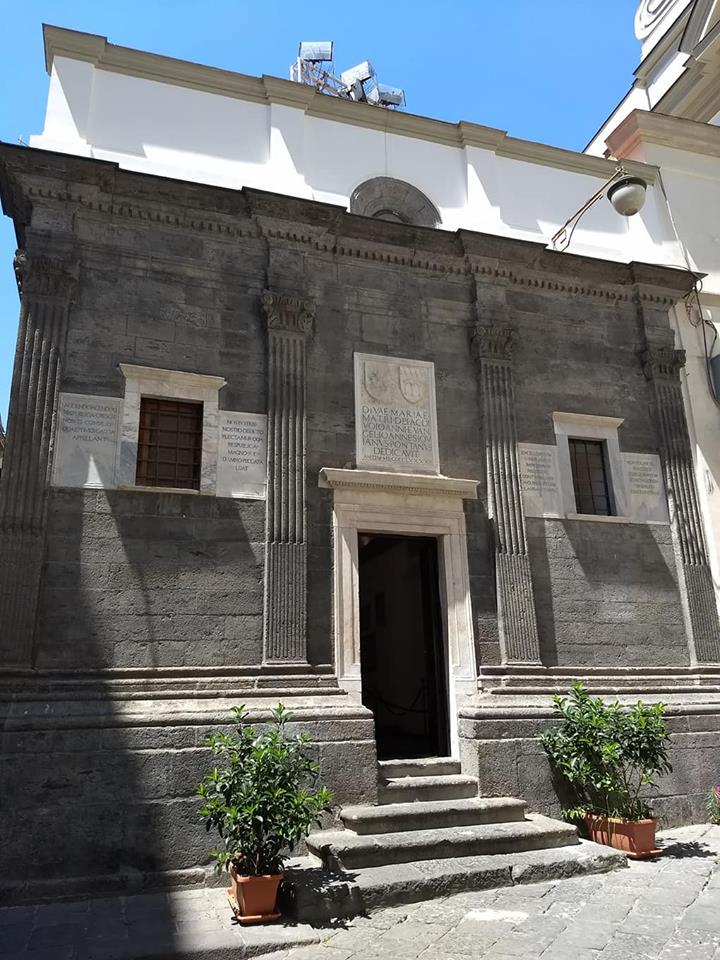
A small Renaissance temple on the decumanus, which the humanist Pontano had raised for his lost wife, still lined inside with Latin inscriptions dictated by his grief.
 ◆ History & archaeology
Sedile di Nilo
Decumani
On the corner of a small Spaccanapoli square survives the seat of the old Nilo quarter, where the nobles once gathered before the sedili of Naples vanished.
 ◆ History & archaeology
Port'Alba
Napoli
A seventeenth-century arch cut into the walls leads to the booksellers' street, where stalls of second-hand volumes pile up among yellowed pages and the shade of the old city.
 ◆ History & archaeology
Porta Capuana
zona Garibaldi
Between two cylindrical towers an arch of white marble opens like a Renaissance triumph, the old city gate facing the road to Capua.
 ◆ History & archaeology
Real Albergo dei Poveri
P.za Carlo III
An eighteenth-century colossus willed by Charles of Bourbon to shelter the poor of the Kingdom: a façade running more than three hundred metres, among the largest historic buildings in Europe.