Sturno
Sturno (AV)
Hidden gemVillages
The story
The village once called Frigento-Sturno that wanted a name of its own, clinging to a ridge swept by the wind of the Ufita.
Access
FREE
The story
Sturno is a young village, and this is its truest story. Born as a cluster of hamlets dependent on nearby Frigento, it obtained independence at the will of Joachim Murat: 9 April 1809 is considered the date of its foundation, after a long claim to autonomy that the people of Frigento opposed and that took years to define the boundaries. Then on 23 November 1980 the Irpinia earthquake struck it hard, with five victims and the collapse of the ancient church of San Michele Arcangelo of 1688 — from which, however, the statue of the Archangel was saved.
What to see
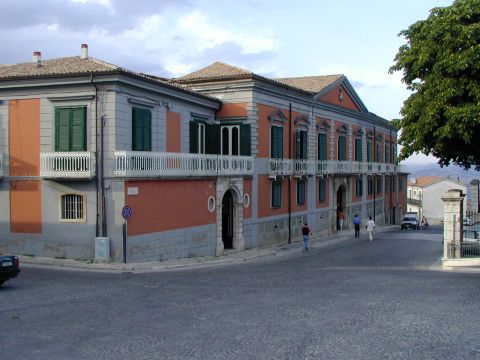
Sturno is not a picture-postcard village of medieval stone: its identity is another, and it is the one worth seeking. It is the town that wanted to exist, breaking away from Frigento in 1809, and that rebuilt itself after 1980. In the valley of the Ufita, between the slopes of Monte Frigento and the river, the centre still keeps the statue of San Michele Arcangelo, survived the collapse of its church and become a symbol of the town's continuity.
Hours and prices
Free entry.
Tips
Come to Sturno for the history and the identity more than for a single monument: it is a case where knowing the story of the village — the foundation of 1809, the rebirth after the earthquake — changes the way you look at it. Handy to arrive by car, in the valley of the Ufita. A good stop along an itinerary in inland Upper Irpinia.
Frequently asked questions
When was the municipality of Sturno founded?
On 9 April 1809, when it obtained independence from Frigento at the will of Joachim Murat, after a long claim to autonomy.
What happened at Sturno with the 1980 earthquake?
The quake of 23 November 1980 caused five victims and grave damage, including the collapse of the ancient church of San Michele Arcangelo of 1688; the statue of the Archangel was saved.
Where is Sturno?
In the valley of the Ufita, in the province of Avellino, between the slopes of Monte Frigento and the river Ufita.
More gems: Villages
 Villages
La Pignasecca
Montesanto
The oldest market in Naples unspools through the alleys of Montesanto: fish stalls, fry shops and old-time botteghe (traditional shops) in a hubbub that never stops.
 Villages
Borgo Marinari
S. Lucia
At the foot of Castel dell'Ovo, the little fishermen's borgo (old village) is now a marina of boats and restaurants: stone, salt air and the legend of Virgil's egg hidden in the foundations.
 Villages
Marina Corricella
Procida
The oldest fishermen's borgo (old village) on Procida, an amphitheatre of pastel houses tumbling down to the harbour, where the boats sleep beneath the hanging laundry.
- ◆ Villages
Mercato di Porta Nolana
zona Garibaldi
Beneath the Aragonese arch of Porta Nolana the fish market erupts with voices, crates of seawater and shellfish still alive: Naples at its most unvarnished.
- ◆ Villages
Borgo di Casamale
Somma Vesuviana
The medieval heart enclosed by Aragonese walls and towers, a tangle of alleys where every four years the Festa delle Lucerne lights thousands of little lamps.
- Villages
Marina Grande di Sorrento
Sorrento
Below the town's cliffs, the old fishermen's borgo (old village) with houses faded by the salt, boats hauled ashore and trattorias fragrant with frying.